


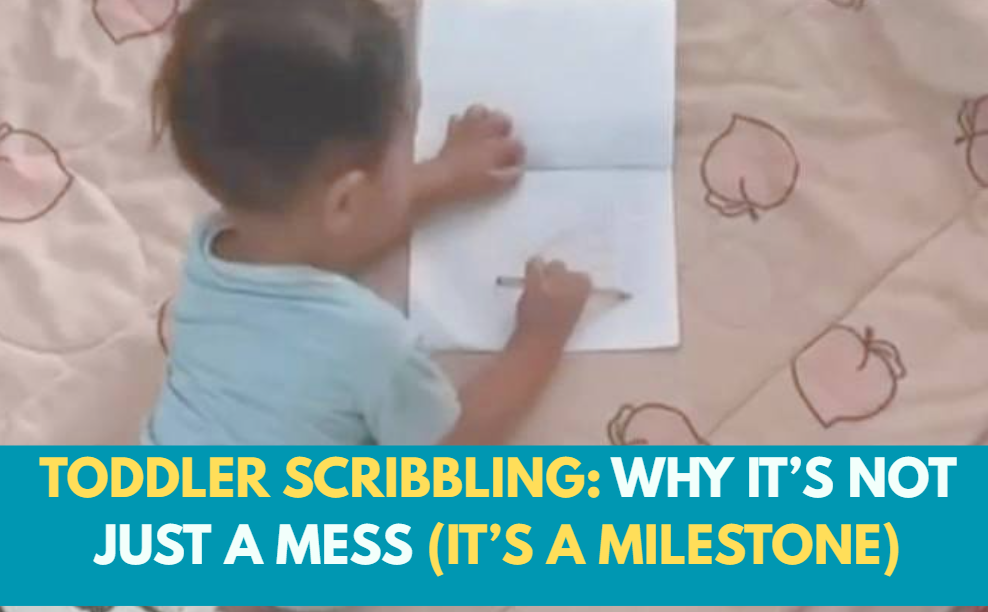
This morning, my two-year-old grabbed a pencil and his notebook.
He sprawled out on his stomach on his favorite peach blanket and got to work.
To anyone watching, it appeared to be random scribbles.
But that proud little face?
Pure magic.
If you are a parent watching your toddler make those first marks on paper, you have probably wondered: “Is this actually doing anything?”
The answer is yes.
Those messy lines and loops are the real foundation of toddler drawing and writing development.
In this article, I will share what I have learned watching my son “write” his very important letters (almost certainly about cookies) and what the science says about why it all matters.
Quick Takeaway
Before we dive in, here is what you need to know right now:
- Toddler scribbling is a genuine developmental milestone, not just mess
- Pre-writing skills for toddlers grow through free play, not formal instruction
- The “fist grip” on a pencil is completely normal before age 3
- Encouraging marks on paper builds fine motor skills, confidence, and early literacy
- The best pre-writing activities for 2-year-olds are simple, low-pressure, and already at home
- If your toddler shows no interest yet, that is completely normal too
Understanding Toddler Scribbling as a Developmental Milestone
When your toddler grabs a crayon and starts drawing, something real is happening inside their brain.
Honestly, the first time my son did it, I was not thinking about developmental milestones.
I was thinking: “Great, five quiet minutes.”
But the more I watched, the more I understood.
He moves his hand, and a mark appears.
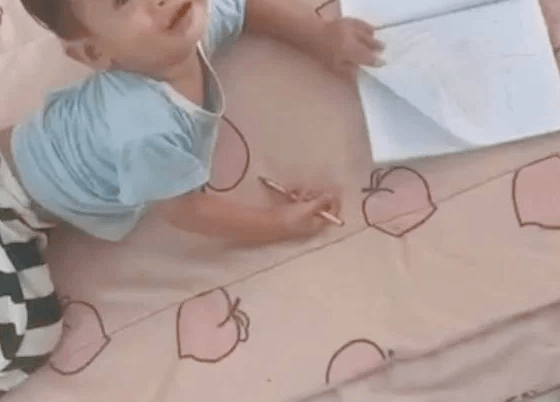
He controls what happens.
That simple loop is early writing development in action, happening right there on a kitchen floor.
Here is what toddlers are actually learning every time they scribble:
- How much pressure to apply to the page
- How to control their hand movements with intention
- That their actions create visible, lasting results
- That making marks feels satisfying and worth repeating
My son has no idea he is practicing anything.
He just knows dragging that pencil across the page feels deeply good.
Why toddler scribbling benefits go deeper than the surface
Before children can write the alphabet, they need to enjoy making marks.
You cannot build a house without a foundation, and scribbling is that foundation.
Experts call it writing readiness for toddlers.
It is not about perfect letters yet.
It is about building curiosity and confidence first.
When we rush past this stage or try to correct it, we often undermine the very motivation that drives a child to pick up a pencil in the first place.
The Pencil Grip Journey: Messy Is Completely Fine
One thing I have stopped worrying about is how my son holds his pencil.
Right now, he uses what I call the “fist of determination” grip.
His whole hand is wrapped around that pencil like it is a tiny sword.
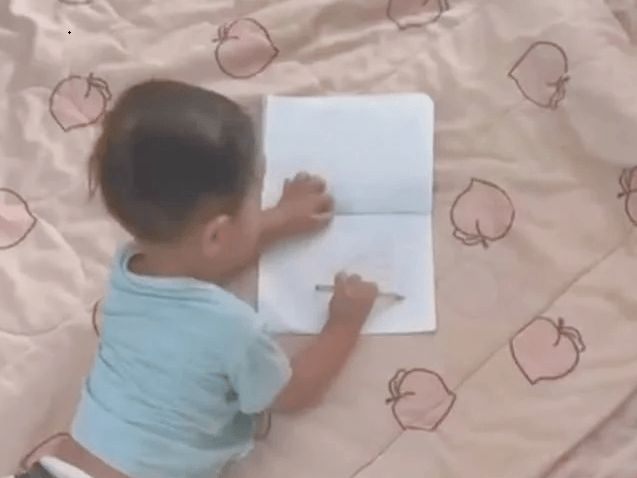
I used to gently nudge his fingers into the right position.
Then I learned that at two years old, the sword grip is completely normal.
Toddler pencil grip stages by age
Understanding how pencil grip in kids develops helped me relax entirely:
| Stage | Age Range | What It Looks Like |
| Fist grip | 1 to 2 years | Whole hand wrapped around the pencil |
| Digital pronate grip | 2 to 3 years | Fingers pointing down, hand moves as one unit |
| Four-finger grip | 3 to 4 years | Starting to use fingers more independently |
| Tripod grip | 4 to 5+ years | The way most adults hold a pencil |
Children reach each stage on their own timeline.
Pushing the “correct” grip too early usually just makes them frustrated and less interested in picking up a pencil at all.
Building fine motor skills for writing
Every time your child picks up a pencil, they are strengthening the small muscles in their hands and fingers.
These small hand movements take years to master, and these everyday activities support them beautifully:
- Playing with playdough and clay
- Using chunky crayons or sidewalk chalk
- Stacking and sorting blocks
- Turning pages in books
- Picking up small objects during supervised play
All of it builds the same muscles they will need for writing later.
None of it looks like “practice” to your toddler, and that is exactly the point.
The Best Pre-Writing Activities for 2-Year-Olds (That Actually Work)
You do not need workbooks, programs, or structured lessons.
The best pre-writing activities for 2-year-olds are simple, mostly free, and already available in most homes.
What we do every morning
- Morning scribble time is a regular fixture here. I give my son a cheap lined notebook and let him go wild. No rules, no corrections, just creative chaos on a budget.
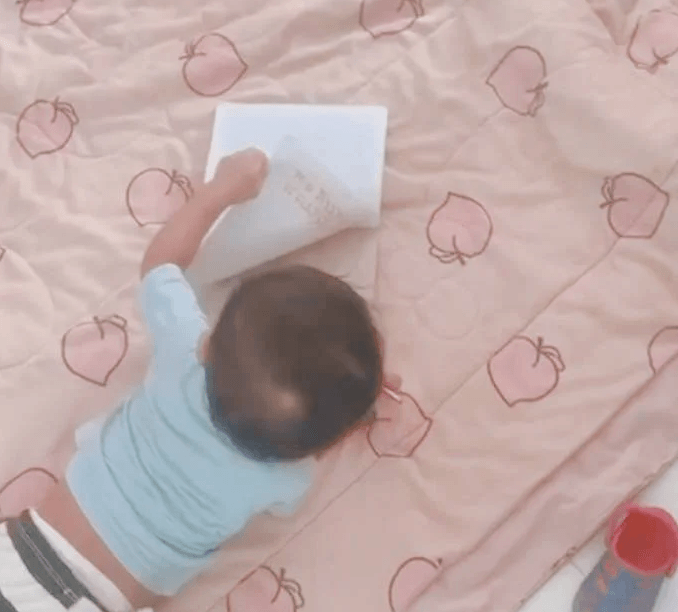
- Page turning sounds small, but it is a real skill. My son loves the drama of flipping to a fresh page after filling one with scribbles. He is learning that books have order and structure, a beginning and an end, and that you move through them from one page to the next. It is a pre-reading skill dressed up as play.
- Floor drawing is another favorite. I let him lie on his stomach, which is surprisingly effective for building core strength, which helps later with sitting at a desk for longer stretches.
Simple activities to try this week
- Paper on the wall: Tape a large piece of paper at toddler height and let them scribble standing up. The vertical position builds different muscles than drawing flat on a table.
- Switch up the tools: Crayons one day, chalk the next, then a paintbrush and water on a dark sidewalk. Even a stick in the dirt counts. Each tool requires a slightly different grip and pressure, building hand control in different ways.
- Sensory drawing trays: Spread flour, sand, or salt in a baking tray and let them draw with their fingers. This gives tactile feedback that pencil-on-paper does not, and cleanup is weirdly satisfying.
- Blank paper over coloring books: Skip the coloring books for now. At this age, blank paper invites more creativity and less pressure to “stay inside the lines.” There are no lines. That freedom is the whole point.
The goal is not perfection.
It is exploration, repetition, and the quiet confidence that builds when a child knows their marks have value.
How to Encourage a Toddler to Write Without Pushing Too Hard
Here is what I have learned: if I push, my son shuts down. If I celebrate, he lights up.
What to say when they show you their work
When my son shows me his “writing,” I do not ask what it is.
Children this age are not drawing specific things yet, and that question feels like a test. Instead, I try these:
- “Wow, you really worked hard on that.”
- “Tell me about what you made.”
- “I love all those lines and shapes.”
- “Thank you for writing that down for me.”
Each of these builds his belief that his marks have meaning and value.
Because to me, they genuinely do.
Small habits that make a big difference
- Keep supplies reachable. If your toddler has to ask for crayons, the spontaneous urge to draw often passes. A low shelf or open bin at their level removes that barrier completely.
- Have a loose writing spot. It does not need to be a desk or a craft room. A corner of the floor with a clipboard works. Toddlers draw better when they feel like they have a “place” for it.
- Draw alongside them. Toddlers learn by copying. When they see you pick up a crayon and make marks on paper, they want to do exactly the same thing. Sit down and scribble next to them sometimes.
- Put their work on the fridge. That small, visible gesture tells them their writing matters and is worth displaying. It is one of the simplest confidence builders you have access to.
Know when to back off
If your toddler is not into writing yet, that is completely fine.
Some children love it at 18 months.
Others, like my nephew, would rather eat the crayons until they are three.
Both are completely normal.
The moment it feels like a chore, the magic disappears.
Do not force it, and do not compare.
What These Scribbles Mean for Later Learning
I used to think scribbling was just cute.
Now I understand it is foundational.
The connection to reading
When toddlers scribble, they are learning that marks on paper carry meaning.
That is the same core idea behind reading.
Letters are just marks that represent sounds and words.
Children who scribble freely and often tend to grow into more confident readers and writers, because they already know the purpose of making marks.
Early problem-solving in action
Watch your toddler while they draw.
They are making real decisions: which color to reach for, how hard to press, when to flip the page, whether to fill the whole space or leave most of it blank.
Those are early problem-solving and planning skills, showing up in real time in the form of a chaotic page of loops.
The joy factor is worth protecting
When toddlers scribble without pressure, they learn that creating feels good.
That internal motivation, the simple pleasure of putting marks on paper, is what carries them through years of learning letters, words, and sentences.
Protect it. It is more valuable than any grip correction.
My Biggest Lesson as a Parent
The photos I took this morning show my son completely absorbed.
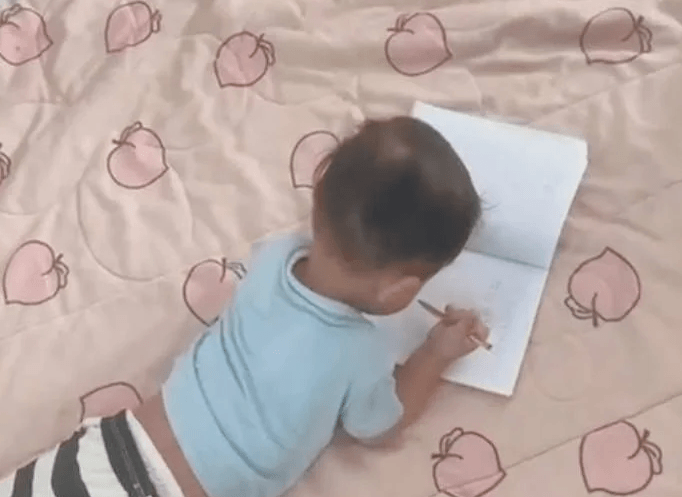
Tongue out slightly, eyes focused, totally in his own world.
That look taught me something: he does not need me to teach him right now.
He needs me to hand him the tools and step back.
So I stopped correcting his grip.
I stopped asking him to draw specific things.
I stopped worrying about whether he is “ready.”
Instead, I buy cheap notebooks he can destroy without guilt, celebrate every scribble like it is a masterpiece, and trust the process.
Your child’s brain already knows what it needs.
Those scribbles that look like chaos are actually carefully ordered practice, designed by your toddler’s own natural development.
Our job is to keep the pencils sharp and the encouragement steady.
Final Thoughts: Respect the Scribble
Encouraging your two-year-old to write doesn’t need to be complicated or expensive.
Before your child can write their name, spell a word, or fill out a worksheet, they need to believe they have something worth saying.
They need the confidence that comes from making marks on paper and having those marks treated as meaningful.
So the next time your toddler hands you a page full of scribbles, do not see a mess.
See the beginning of literacy.
See fine motor skills being built in real time. See a little person figuring out how to communicate with the world.
And maybe, just maybe, see a very important letter about cookies.
Every scribble matters.
Every mark is progress.
And every page of “Chaos” is really just a beautifully organized lesson in becoming a writer.
Frequently Asked Questions
When should a toddler hold a pencil correctly?
Most children naturally develop a proper tripod grip (the three-finger hold most adults use) between ages 4 and 5. Before that, fist grips and digital pronate grips are completely normal and developmentally appropriate. Trying to force the “correct” grip before age 4 often backfires and discourages future writing practice altogether.
Why do toddlers scribble instead of drawing real pictures?
Scribbling is real drawing for toddlers. Children scribble because their brains and hands are still developing the coordination needed for controlled, intentional marks. The scribble stage, roughly ages 1 to 3, comes before the shape stage and is a necessary and healthy part of toddler drawing development. There is no shortcut through it, and there should not be.
At what age do toddlers start drawing recognizable shapes?
Most children begin drawing simple recognizable shapes such as circles, crosses, and straight lines around age 3 to 4, and draw recognizable figures like a basic person around age 4 to 5. Every child develops at their own pace, and being slightly earlier or later is both normal within a reasonable range.
Do coloring books help with pre-writing skills?
Coloring books can be useful at older ages, but for 2-year-olds, blank paper is generally better. Coloring books ask children to stay within lines, which adds pressure and constraint before their fine motor control is ready for it. At this age, free scribbling on blank paper builds more confidence and creativity than structured coloring.
Disclaimer: I am a parent and a university educator, not a licensed child psychologist or pediatrician. This guide is based on my personal parenting experience and educational background. Always consult your child’s teacher or pediatrician for professional advice regarding your child’s educational development.
