


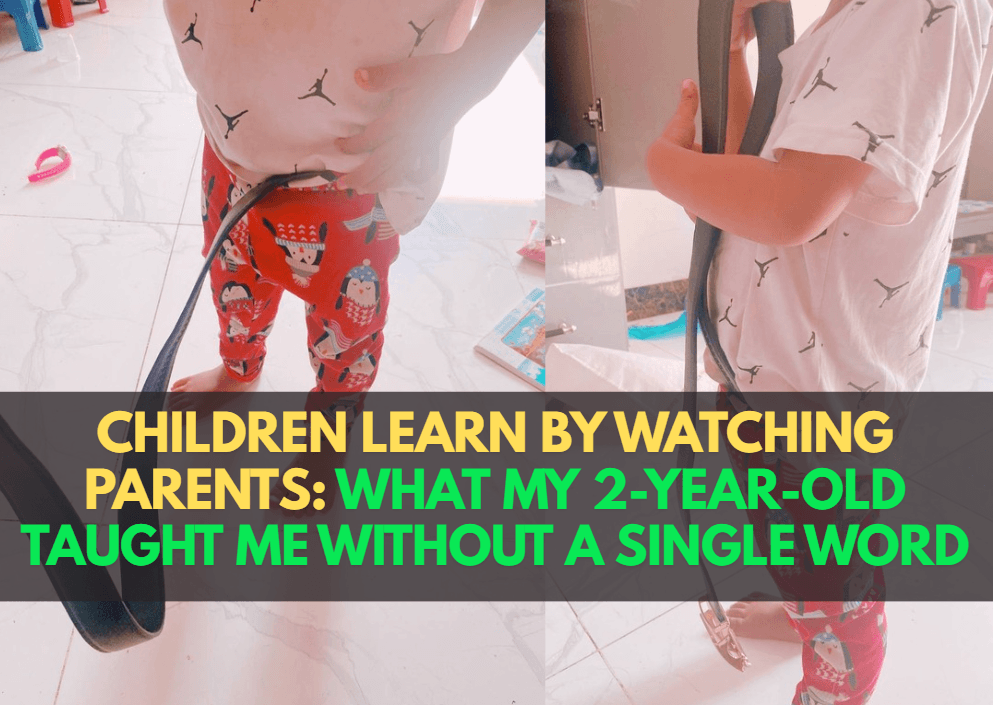
My son is two years old, and last week, he buckled my belt around his pajama pants without anyone showing him how.
If you have ever wondered why toddlers copy everything their parents do, the honest answer started right there in my bedroom doorway.
Key Takeaways
- Toddlers around age two often copy entire routines, not just single actions, because they are watching far more closely than most parents realize.
- This story follows a two-year-old who watched his father get dressed every morning, then later put on a belt by himself with no instruction at all.
- He buckled it the wrong way, buckle end first, but still finished the task on his own and went straight to show his mother.
- Getting the approval mattered to him almost as much as getting it right, which is a normal part of how toddlers practice new skills.
- The bigger lesson: toddlers are not just copying what their parents do. They are quietly trying on the kind of person they want to become.
I have been a Professor of Human Resource Development for over six years. I have taught leadership theory, organizational behavior, and adult learning methodology to hundreds of university students.
I have explained, in considerable academic detail, how people pick up behaviors from the people they admire most.
I understood all of it in theory.
Then my two-year-old stood completely still for the first time in his life, watching me take off my belt, and I understood it in a way no lecture had ever managed to teach me.
This is what that evening taught me about how children learn by watching parents, and why it changed every ordinary morning that came after.
The Morning Ritual I Did Not Know Was a Lesson
Almost every day, when I put on my university uniform to go and teach, my son watches.
Not casually. Not from across the room with one eye on a toy car.
He watches with the focused, unblinking attention of someone studying for a test they have not been told they will take.
Every button. Every adjustment. Every detail of a man getting ready to go out and do his work in the world.
The belt was different.
It held a particular fascination for him. Every morning when I buckled it, the small click of the clasp, the straightening of the leather across my waist, his eyes locked onto my hands with an intensity I had noticed but never really understood.
Watching his dad get dressed had become its own quiet ritual for him.
I thought he was simply curious about the object, the way toddlers are curious about keys, phones, and anything that belongs exclusively to the adult world.
I did not realize he was taking notes.
The Return
I came home from the university at 6:45 PM.
He heard the door and came running, which is normal.
He greets me most evenings with the whole-body enthusiasm of someone for whom your arrival is genuinely the best part of the day.
But this evening was different.
From the front door, all the way through the house, he held my belt.
Not my hand. Not my sleeve. The belt. He gripped it and walked beside me, holding on as though it were a thread connecting him to something important he was not ready to let go of yet.
I did not think much of it in the moment. I was tired from teaching, and I moved through the evening routine without paying close attention to the small person walking beside me, holding my belt, watching everything.
I should have been paying closer attention.
The Silence
When I began to change, something unusual happened.
He stopped moving.
If you have spent any time with the Head of Negotiations, as we call him in our house, you know that stillness is not his natural state. He operates at a steady baseline of motion: investigating, rearranging, testing, auditing.
Even when sitting, something is always moving. A hand. A foot. Some object is being rotated for inspection.
But as I changed out of my uniform, he stood completely still.
My wife called from the other room. “Hey, Mr. Boy! Come help Mommy with the dishes.”
He did not move.
He stood and watched me in total silence. His eyes followed every movement.
The shirt is coming off. The trousers folded. Each item was placed carefully into the wardrobe.
He watched it all with the concentration of a researcher observing a subject in the field.
When I placed the belt into the wardrobe and closed the door, I thought the observation session was over.
It was not over. It was entering its second phase.
The Deployment
The moment I closed the wardrobe door, he opened it.
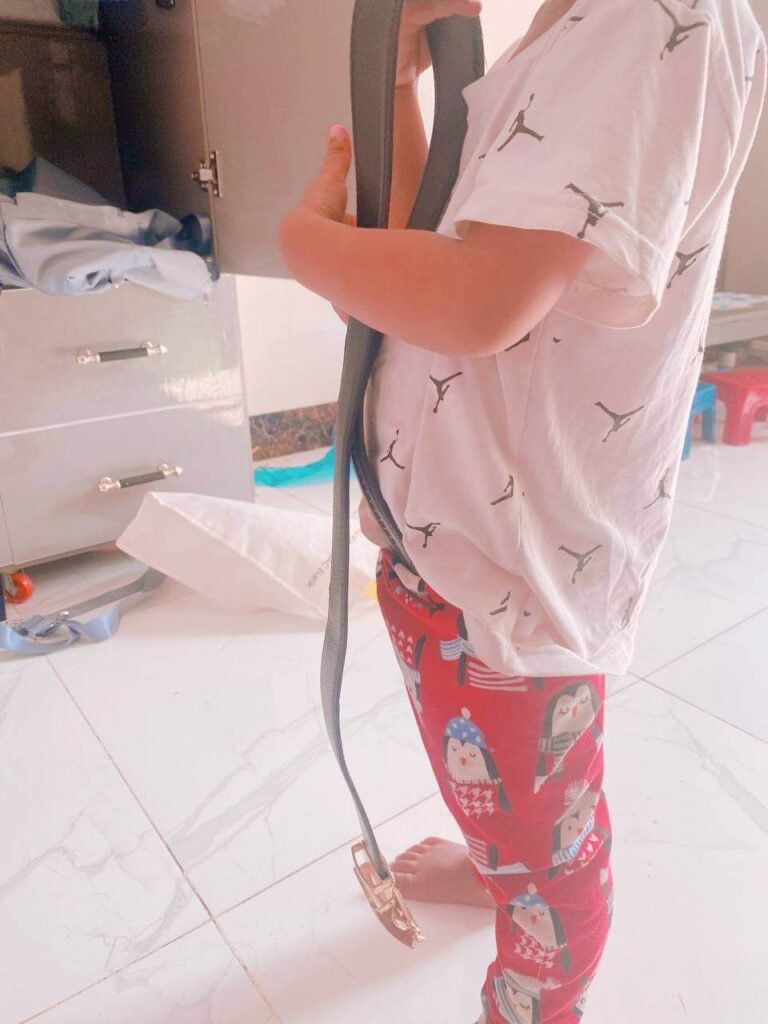
He reached in, pulled out the belt, and walked to the center of the room.
What followed was one of the most carefully observed and independently executed skill replications I have witnessed, inside a classroom or outside of one.
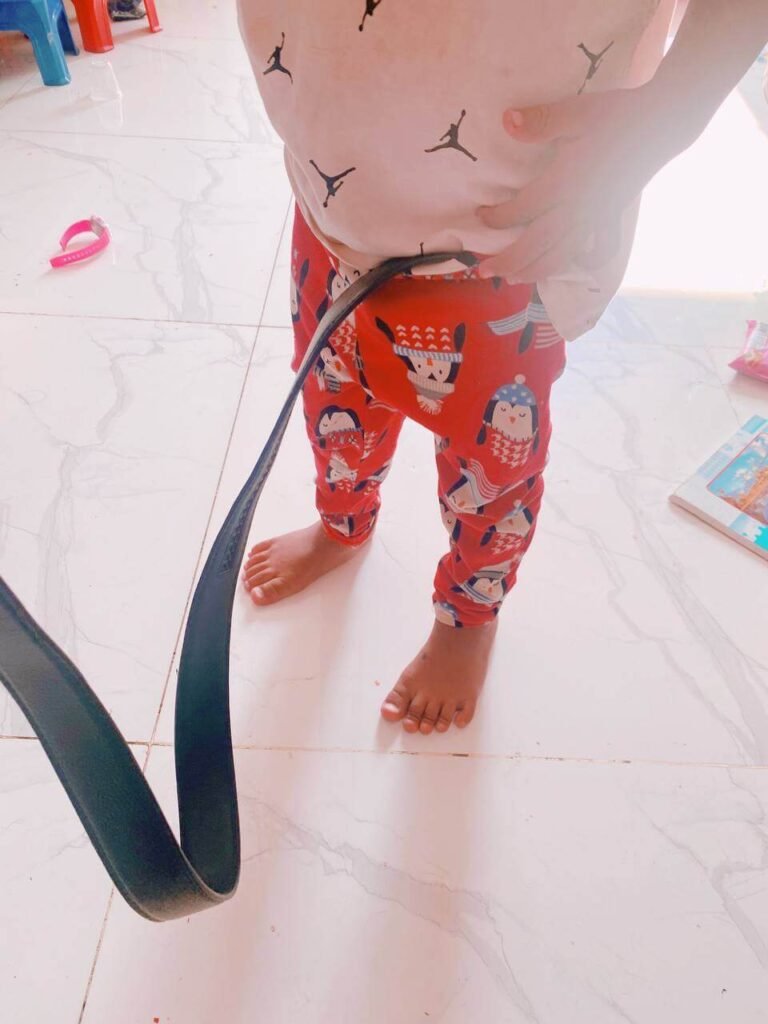
He looped the belt. He threaded it through. He worked at the buckle with the unhurried determination of someone who had been mentally rehearsing this for a while and was finally ready to try it for real.
His method had one technical deviation from standard procedure: he threaded the buckle end through first.
He did not seem troubled by this. Or maybe he noticed and decided it was not relevant to the main objective, which was getting the belt onto his pants.
A reasonable call, given the circumstances.
Without a single explicit lesson, demonstration, or instruction, he got the belt on. His own way. His own timeline.
His own understanding of how a belt works and why a man wears one.
The two photos that go with this story are from that exact moment, the belt looped around his waist over his red penguin pajama pants, before he had it fully buckled.
The Performance Review
He did not stay in the room to admire his own work.
The moment the belt was on, he turned and walked, with considerable purpose, to find his mother.
“Mommy, Mommy! Hey! Hey!”
He pointed at his waist. He wanted her to see. He needed her to see.
Not because he was unsure whether he had succeeded, but because success, at any age, means more when someone you love is there to witness it.
His mother looked at him. She looked at the belt. She looked at the buckle-end-first setup and made the right call: focus on the achievement, not the methodology.
“Oh! Good job!”
He stood there for a moment, taking that in.
Then he walked away, belt trailing slightly, with the quiet satisfaction of someone who had set out to do something and done it.
It was a small thing on the surface: a toddler who had picked up a habit from his dad without one word of instruction.
Why Do Toddlers Copy Everything Their Parents Do?
In Human Resource Development, we talk about role modeling often.
It refers to the process where people learn behaviors by watching others perform them, then trying those behaviors themselves.
It is one of the oldest ideas in leadership training, long before anyone formalized it in a textbook: people do not learn most from what you tell them.
They learn from what they watch you do, morning after morning, when you think no one is paying attention.
But there is a deeper layer to this that the leadership seminars do not always capture clearly.
It is the difference between a child who copies a behavior and a child who copies an identity.
My son does not want a belt.
He wants to be the man who wears the belt.
He wants to wake up in the morning, put on his clothes, buckle his belt, and go out into the world to do something that matters, the way he has watched his father do every single morning for as long as he can remember.
He wants to come home in the evening tired and satisfied. He wants someone at the door to greet him when he returns.
He is two years old. He cannot put any of this into words.
But he says it clearly enough every morning when he stands and watches me get dressed, and every evening when he holds my belt all the way from the front door into the house.
He is not copying my behavior. He is rehearsing my life.

That is really the answer to why toddlers want to be just like their parents. It is not about the object, the belt, the shoes, the phone, the car keys. It is about wanting to become the person who uses it.
How Children Learn by Watching Parents (and Why It Sticks)
After he showed his mother, I sat down and thought about what I had just watched.
I thought about all the mornings I had buckled that belt while reviewing lecture notes, thinking about my schedule, getting ready for the day, without once thinking about who was watching.
He was always watching.
Not occasionally. Not sometimes.
Almost every single morning, which means there were mornings I had no idea he was even in the room, mornings when I was too focused on my own routine to notice the small person taking it all in.
In organizational leadership, there is a phrase I have used in lectures many times: culture is what you do when you think nobody is looking.
I had been building a culture, one ordinary morning at a time, without realizing it.
The culture of a man who gets ready carefully, who dresses with intention, who goes out to do his work and comes home to his family.
A culture my son had been watching, absorbing, and quietly getting ready to repeat.
He repeated it that evening. Buckle end first. Penguin pajamas. Full confidence.
And his supervisor gave him a perfect review.
This is what real-life observational learning looks like with toddlers.
Not a classroom exercise, not a parenting strategy on a checklist, just a small boy watching quietly, filing everything away, waiting until he was ready to try it himself.
What This Means for Parents Who Want to Lead by Example
You are always being watched.
Not in a pressuring way. Not in a way that should make you anxious about every imperfect moment, every rushed morning, every version of yourself that is less than your best.
But in the quiet, accumulating way that matters most.
The daily rituals, the small habits, the way you carry yourself through ordinary moments: your children are taking notes on all of it.
They are not writing down what you tell them. They are writing down what you do. How you treat the people around you.
Whether you keep your word. Whether you come home when you say you will. Whether you are the same person at 6:45 PM, tired after a long day, or as you are at 8:00 AM, fresh and ready for the world.
Lead by example parenting is not a slogan to put on a wall. It is every morning you get dressed while your toddler watches.
It is every evening you come through the door and show them what coming home looks like.
Toddler mimicking parent behavior is not a quirky phase to wait out; it is your child actively studying the version of life you are living in front of them, one small, repeated act at a time.
They are studying the belt. They have always been studying the belt.
The only question is what they will find when they finally put it on themselves.
A Final Note: The Morning After
The next morning, I buckled my belt as usual before leaving for the university.
He was watching.
I know that now in a way I did not before. So I did it a little more carefully. A little more deliberately.
With more awareness of the small person in the room who is filing every detail away for a lesson I will not be there to give.
He will teach it to himself, in his own time, his own way. Buckle end first, if that is what it takes.
This is what children learn by watching parents really looks like in practice: the quiet moments, the routine ones, the ones we move through without thinking.
That is where the real teaching happens.
And when he puts that lesson into practice again someday, I hope someone is there to tell him, good job.
Conclusion
So, if you are asking why toddlers copy everything their parents do, the honest answer is that they are not copying you just for the sake of copying.
They are quietly rehearsing the life they want to live, one ordinary morning at a time, buckle end first if that is what it takes.
Frequently Asked Questions
Why do toddlers copy everything their parents do?
Toddlers copy everything their parents do because daily routines are the clearest, most repeated source of information they have about how to be a person. They are not just copying single actions; they are copying patterns: how you move through a morning, how you treat people, how you handle small tasks. By around age two, this copying shifts from accidental to deliberate.
At what age do toddlers start copying their parents?
Most toddlers show intentional copying somewhere between 18 and 24 months, though the close watching often starts even earlier than that. By age two, many children can copy a full multi-step routine they have only ever watched, with no direct instruction at all, the way the toddler in this story did with a belt.
Why is my toddler so focused on watching me get dressed?
Getting dressed is a routine you repeat nearly every day in the same order, which makes it easy for a toddler to study closely. It is also tied to something they care about deeply: you leaving and you coming back. That mix of repetition and meaning is exactly what holds a toddler’s attention.
What does it mean when a toddler picks up a habit from one parent specifically?
It usually means that the parents’ routine is the one your child has had the most consistent access to watching. Toddlers tend to lock onto whichever adult behavior is most visible and most predictable in their day, which is often tied to who they see getting ready and leaving the house most often.
How can I lead by example for my toddler without overthinking it?
You do not need to perform for your child or change who you are. The honest version is usually enough: keep your small routines consistent, let them watch the ordinary parts of your day, and respond to their attempts with the same kind of encouragement you would want someone to give you.
Disclaimer: I am a parent and a university educator, not a licensed child psychologist or pediatrician. This guide is based on my personal parenting experience and educational background. Always consult your child’s teacher or pediatrician for professional advice regarding your child’s educational development.
