


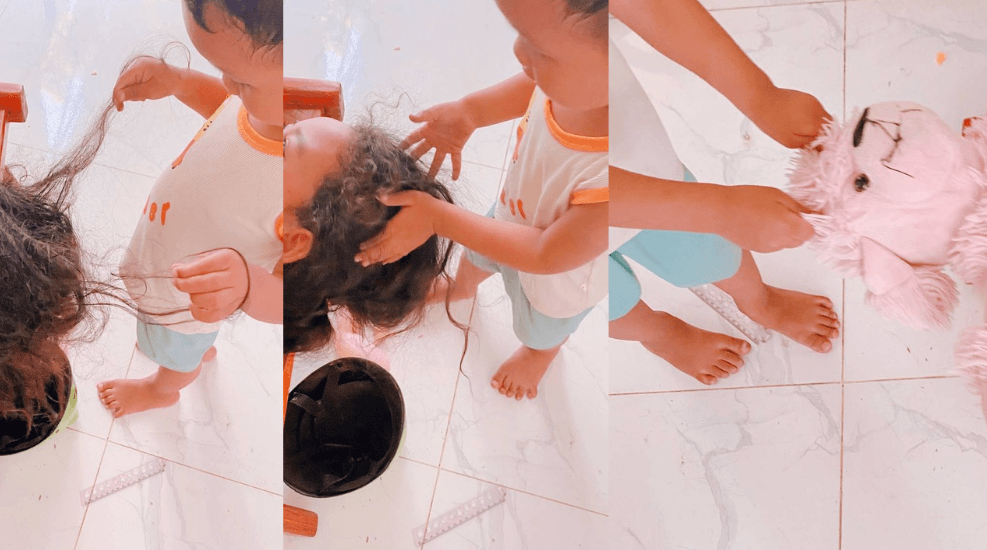
In every professional field, there is a moment that separates theoretical knowledge from practical competence.
In medicine, it is the first time a student operates without full supervision.
In law, it is the first time a graduate argues a case alone.
In hair care, apparently, it is a rainy Sunday evening in Battambang, when your 8-year-old sister mentions she forgot to wash her hair and your 2-year-old brother decides that this is, in fact, his department.
This is a story about how toddlers learn through play.
Not in a structured classroom, not with a lesson plan, and not because any adult arranged it.
It happened in the gap between what needed to be done and who volunteered to do it.
Key Takeaways
- Toddlers learn through play by watching, imitating, and self-correcting in real situations. No lesson plan required.
- The apprentice model is the oldest form of human skill development, and it happens naturally between siblings at home.
- When an older child lets a younger one try something real, that act of patience is one of the most powerful learning gifts a sibling can give.
- A toddler who voluntarily repeats a skill right after finishing it the first time is one of the strongest signs that genuine learning has taken place.
- Rainy, unplanned afternoons are not obstacles to childhood development. They are often where the best moments begin.
- Treating a child’s effort as legitimate work — asking “how much do I owe you?” — tells them their contribution has real value.
The Conditions That Created the Opportunity
It was raining heavily last Sunday evening.
The kind of rain that arrives during the Cambodian rainy season with complete commitment, shutting down outdoor plans and redirecting the entire family’s energy back indoors.
My daughter, the Assistant Manager, was lounging on the wooden bench.
My son, the Head of Negotiations, was nearby, as he always is, monitoring the situation for developments.
My wife and I were preparing dinner.
Then the Assistant Manager said the words that opened the door to everything that followed.
“Oh, Mom! I forgot to wash my hair yesterday evening.”
I was busy at the stove. I replied without looking up. “Are you sure you forgot?”
What I did not realize was that this exchange, this small, unremarkable domestic moment, had been heard by someone else in the room.
Someone who processes information quickly, acts on opportunity without hesitation, and has been observing the hair-washing routines of this household for his entire professional career.
The Head of Negotiations heard the problem statement.
And he moved immediately to offer a solution.
The Consultation
He walked over to his sister and began his inspection.
He examined her hair from the front. From the side. From above.
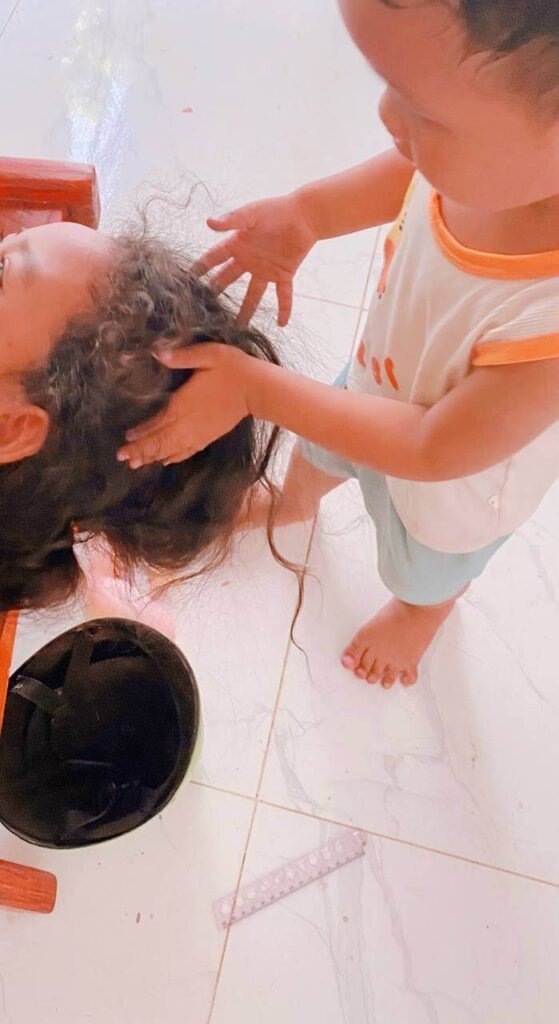
He approached the assessment with the systematic thoroughness that I have come to recognize as his professional signature, the same focused energy he brings to chair reorganization, wardrobe audits, and bicycle fleet assessments.
My daughter, recognizing an opportunity when she saw one, leaned into the situation.
“Can you check my hair and see if it’s clean?”
He looked closely. He assessed. He reached out and grabbed a handful of her hair.
His professional verdict, communicated entirely through action rather than words, was clear: this situation required immediate intervention.
“Can you wash my hair for me?” she asked.
He accepted the commission without hesitation.
In organizational terms, this is called Unsolicited Service Provision Converted to Formal Engagement.
A consultant who identifies a client need, performs the initial assessment, and transitions smoothly into active service delivery without any formal procurement process.
The salon was open.
The Treatment
What followed was ten minutes that I will not forget for a long time.
He worked with both hands. He pulled. He separated.
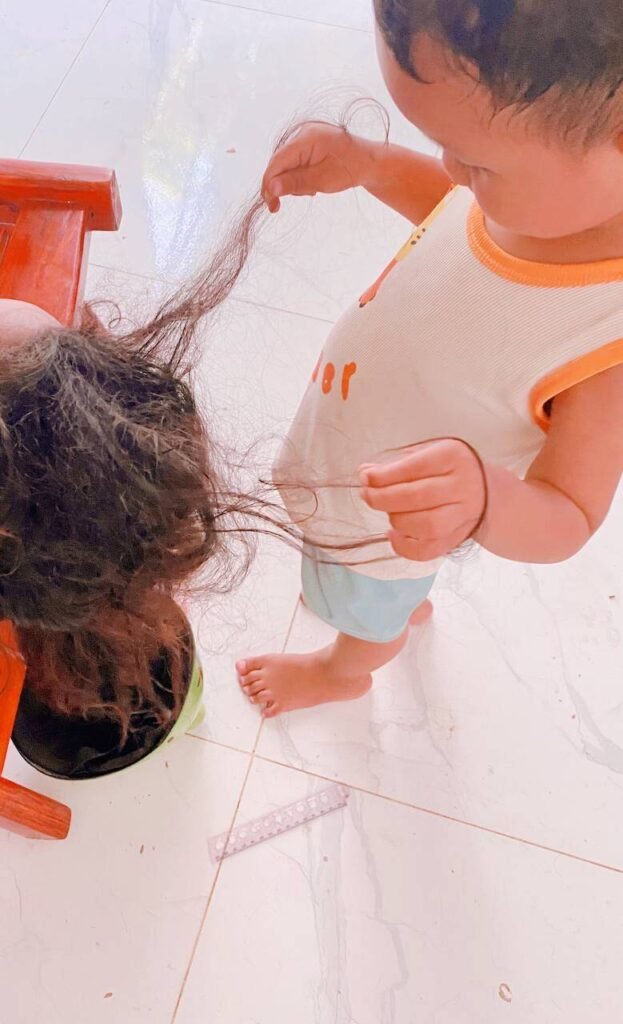
He examined individual strands with the careful attention of someone who has high standards for their work and intends to meet them.
He approached each section of hair with fresh energy, as though the previous section had simply been the warm-up for this one.
My daughter’s commentary throughout the session was consistent and specific.
“Gently, Mr. Boy.”
“Ouch. That hurts.”
“Please. Be gentle.”
She did not move.
She did not call for help.
She did not reach up and remove his hands from her hair.
She sat there on the wooden bench, in the patient posture of a first client who has commissioned a service and intends to see it through to completion, regardless of the methodology being applied.
I sat nearby.
I was not laughing loudly.
I was laughing in the way that you laugh when something is simultaneously funny and genuinely touching: quietly, to yourself, with your hand over your mouth.
The Invoice
When the ten minutes were complete, the Head of Negotiations stepped back from his work.
My daughter straightened up.
She ran a hand through her hair, which was, in fairness, no cleaner than before but had been very thoroughly assessed.
She looked at her brother with the expression of someone who has just survived something and is choosing to frame it as a spa experience.
“How much do I owe you?” she asked.
I want to pause here and acknowledge this question.
My 8-year-old daughter, without any prompting from either parent, asked her 2-year-old brother how much she owed him for the service he had just performed.
She treated him as a professional.
She treated the transaction as legitimate. She asked for the invoice.
He replied.
In his toddler-mumbled speech, the particular dialect of Khmer that only people who spend significant time with him can fully interpret, he named his price.
Two thousand Riel.
The Credit Negotiation
My daughter considered this figure.
She did not dispute it. She did not argue that the service had been imperfect, that the methodology had caused her mild physical discomfort, or that no actual shampoo had been involved.
She simply said, “I don’t have any money right now. Can I owe it to you?
Once the rain stops, I’ll go get the money for you.”
In Human Resource Development, we study negotiation extensively.
We examine interest-based bargaining, positional negotiation, and the management of competing priorities at the table.
I have taught entire modules on the subject.
I have never seen a more efficient piece of credit negotiation than what my daughter executed in that moment.
She acknowledged the debt.
She confirmed her intention to pay.
She provided a specific condition, the cessation of rain, as the trigger for payment.
She left the service provider with no grounds for dispute.
He accepted the terms.
The transaction was complete.
The debt was recorded.
The rain, presumably, would eventually stop.
The Safety Compliance Step
At this point, I had assumed the session was over.
It was not over.
The Head of Negotiations picked up the green frog helmet, his sister’s helmet with the pompom ears, which regular readers of this blog will recognize from a previous operational deployment, and placed it carefully on her head.
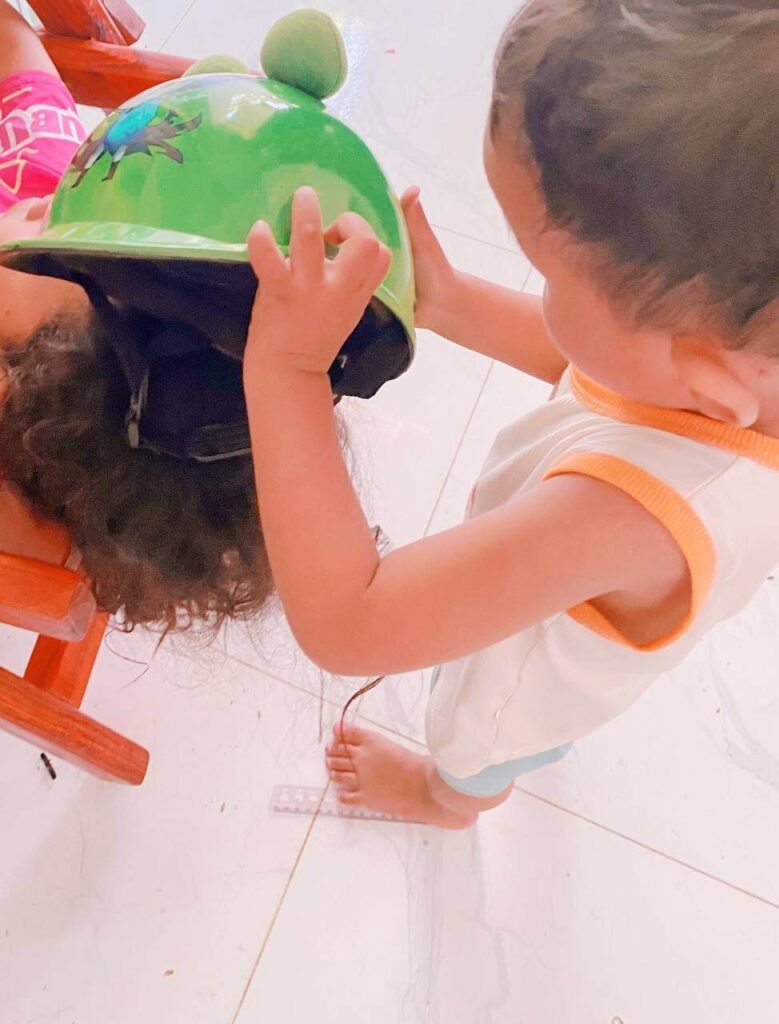
She sat there, beneath the green frog helmet, on the wooden bench, in the rain-quieted house.
She looked at me.
I looked at her.
Neither of us had a professional framework that fully explained what had just happened.
In the absence of a better interpretation, I am choosing to classify this as Post-Service Safety Protocol: a final step in the treatment process, ensuring that the client’s head is protected following the rigorous assessment it has just undergone.
It is, to my knowledge, not standard practice in most salons.
But the Head of Negotiations has always preferred to exceed minimum requirements.
The Practice Session
After my daughter went to wash her hair properly, this time with actual water and shampoo, the Head of Negotiations did something that told me everything I needed to know about where his mind was.
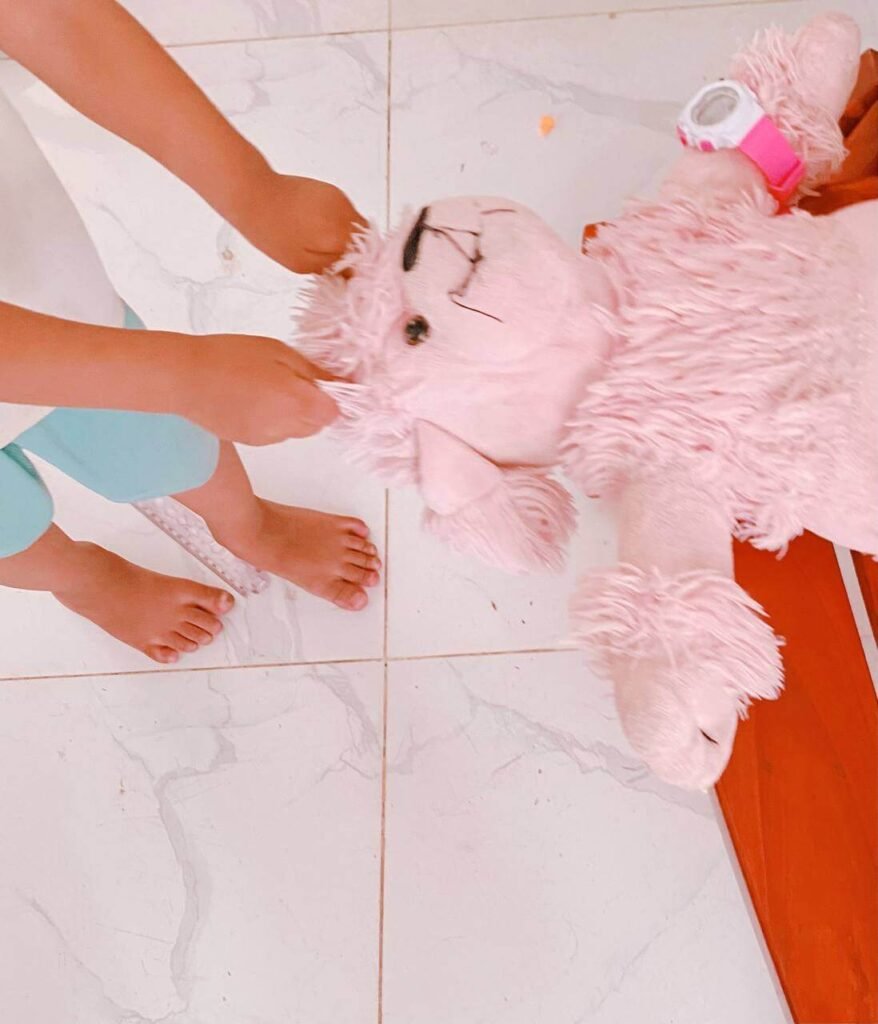
He went to find the Pink Poodle.
Long-term readers of this blog will remember the Pink Poodle from her previous role as the primary facilitator in our household waste-management training program.
She has served this family with quiet dedication for a considerable time.
She has one ear, for reasons that remain under administrative review.
He placed her on the floor.
He examined her hair with the same systematic attention he had applied to his sister’s.
He began working through it, strand by strand, both hands, full professional focus.
He was consolidating his skills.
In training methodology, this is called Post-Session Practice: the period immediately following a live performance where a learner voluntarily repeats the skill in a lower-stakes environment to reinforce what they have learned.
It is one of the most reliable indicators of genuine engagement with a subject.
He had just completed his first real client session.
And before the evening was over, he had already moved on to his second.
How Toddlers Learn Through Play: What the Apprentice Model Actually Teaches Us
The apprentice model is the oldest form of professional training in human history.
Long before universities, long before textbooks, long before certification programs and competency frameworks, human beings learned skills the same way my son learned hair care last Sunday evening.
They watched someone who knew how to do it.
They found a willing subject.
They practiced on the real thing.
They made mistakes that their subject communicated directly and specifically.
And then they went home and practiced on whatever was available until the next real session.
This is how toddlers learn through play, though most parents never name it in the moment.
The learning is not happening because someone designed it. It is happening because a child heard a problem, identified a gap, and decided to fill it.
My daughter was his master class.
The Pink Poodle was his revision session.
Neither of them was asked to play this role.
It emerged naturally from a rainy evening, a forgotten hair wash, and a small boy who heard a problem and decided, without any particular authority or qualification, that solving it was his responsibility.
This is how real learning happens.
Not in a structured curriculum.
Not in a planned lesson.
In the gap between what needs doing and who volunteers to do it.
When you see a toddler imitating an older sibling, what you are watching is not play in the idle sense of the word.
You are watching the apprentice model in action.
The same model that trained doctors, architects, chefs, and craftspeople across centuries.
The context is smaller.
The stakes are lower. But the mechanism is identical.
5 Parenting Lessons From a Toddler’s Pretend Play Session
1. Let siblings be each other’s teachers
My daughter could have said no.
She could have called for her mother or me.
Instead, she asked him to check her hair, commissioned his services, and sat still for ten minutes while he figured it out.
That patience, that willingness to be the subject of someone else’s learning, is one of the greatest gifts an older sibling can give.
The benefits of sibling play go far beyond entertainment.
They include patience, communication, leadership, and the experience of being trusted with a real task.
When an older child lets a younger one try something real, even imperfectly, something important happens for both of them.
2. The invoice moment matters more than you think
When my daughter asked, “How much do I owe you?” she did something profound without knowing it.
She told her brother that his work had value.
That his effort deserved recognition.
That what he did was real, not just play.
Treating a child’s contribution as legitimate work, whether they are 2 or 12, is one of the most powerful things a parent or sibling can do.
Never underestimate what a child carries with them when someone says: Your effort counts.
3. Watch what they do immediately after
The Pink Poodle session told me more about his engagement than the sister session did.
When a child voluntarily repeats a skill without being asked, that is not idle play.
That is a learner who has found something they want to understand better.
One of the clearest signs that toddler learning through imitation has actually worked is this: they go find a way to do it again, on their own, right away.
Follow that energy. It is telling you something important about where their real curiosity lives.
4. The rainy day is not an obstacle
The rain that cancelled our weekend trip created the conditions for one of the most memorable learning moments of the year.
Screen-free, unstructured, unplanned, and completely driven by the children themselves.
Some of the best things that happen in a family happen because the original plan fell through. Analog play, the kind that emerges from boredom and proximity, is exactly what many children are missing right now.
Leave room for the unplanned afternoon.
It will often give you more than the scheduled one ever could.
5. Always have a Pink Poodle available
This is not metaphorical advice.
A patient, available practice subject is an essential piece of any learning environment.
Ours has one ear and has served us faithfully across multiple training programs.
She has earned her place in this family.
Every child needs a Pink Poodle: something they can practice on without judgment, without stakes, and without time pressure.
The practice subject does not need to be perfect. It just needs to be available.
A Final Note
The rain stopped later that evening.
My daughter did not go to get the 2,000 Riel.
The Head of Negotiations did not ask for it.
Some debts, between siblings, are not really about the money.
They are about the afternoon when it was raining, and your little brother took your problem seriously, worked on it for ten full minutes with both hands, charged you a fair market rate, and then went to practice on the Pink Poodle so he would do better next time.
That kind of effort deserves more than 2,000 Riel.
It deserves to be written down.
And it deserves to be remembered for what it actually was: a real, unplanned, completely natural example of how toddlers learn through play.
No app, no curriculum, no flashcard, and no screen required.
Applying the Apprentice Model in Your Home
How to spot the exact moment your toddler transitions from “playing” to “learning.”
Toddlers learn through play by observing, imitating, and self-correcting in real situations. When a child watches an older sibling do something and then tries it themselves, they are using the same apprentice model that trained professionals across centuries.
The key difference from formal learning is that the child chooses the subject, chooses the timing, and receives direct feedback from the environment, or, in this case, from a sister saying, “ouch, that hurts.”
Why does “unstructured role play” build faster cognitive skills than flashcards?
Pretend play teaches toddlers problem-solving, communication, sequencing, and social understanding. When a toddler pretends to run a hair salon, they are practicing observation skills, cause-and-effect reasoning, negotiation (setting a price), and responding to client feedback. These are foundational cognitive and social skills, developed entirely through child-directed, screen-free play.
The hidden signs of intrinsic motivation during toddler role play
For a 2-year-old, role play builds language development, concentration, fine motor skills, and the ability to follow a self-directed sequence of steps. It also builds confidence. A child who completes a job from start to finish, even a pretend one, experiences the satisfaction of competence. That feeling is one of the early foundations of intrinsic motivation.
How to safely let older siblings act as “teachers” for your toddler?
Older siblings give toddlers a model to imitate who is closer to their developmental level than an adult. They demonstrate skills at a pace and scale the toddler can observe clearly. They also create real stakes: when a toddler helps an older sibling, the interaction is genuine, not simulated. That authenticity is what makes sibling play such a powerful learning environment.
Applying the “Apprentice Model” to everyday household chaos
The apprentice model is the learning process where a child watches a more experienced person perform a task, attempts it themselves, receives direct feedback, and practices until they are competent. It is the oldest form of human skill transmission. Children follow this model naturally from infancy, long before any formal education begins, and it works just as well on a rainy Sunday evening in Cambodia as it does in any professional training room.
Why is cancelling your weekend plans the best thing for your toddler’s development?
The most effective approach is to reduce scheduled activities and leave gaps in the day. Turn off screens. Let boredom happen. Children who have nothing planned will almost always find something to do. And what they find often reveals what they are genuinely curious about.
The rainy evening that gave my son his first client came from exactly that: a cancelled trip, a quiet house, and two children left to their own devices.
Managing the mess (and the risks) of sibling-led play sessions?
Children who play with siblings practice social negotiation, empathy, cooperation, and conflict resolution in a low-stakes environment. They also teach and learn from each other in ways that parallel formal mentorship. A patient older sibling who lets a younger child try something real, even imperfectly, is giving a learning gift that no toy or app can replicate.
Why does your toddler ignore you but mimic everything their 8-year-old sibling does?
Toddlers imitate older siblings because siblings represent an achievable model. An adult performs tasks too quickly and at a scale that is hard for a toddler to follow. An older child operates closer to the toddler’s own level: slower, more observable, and more accessible. Imitation is how toddlers have always learned, and siblings are among their most natural teachers.
Disclaimer: I am a parent and a university educator, not a licensed child psychologist or pediatrician. This guide is based on my personal parenting experience and educational background. Always consult your child’s teacher or pediatrician for professional advice regarding your child’s educational development.
