


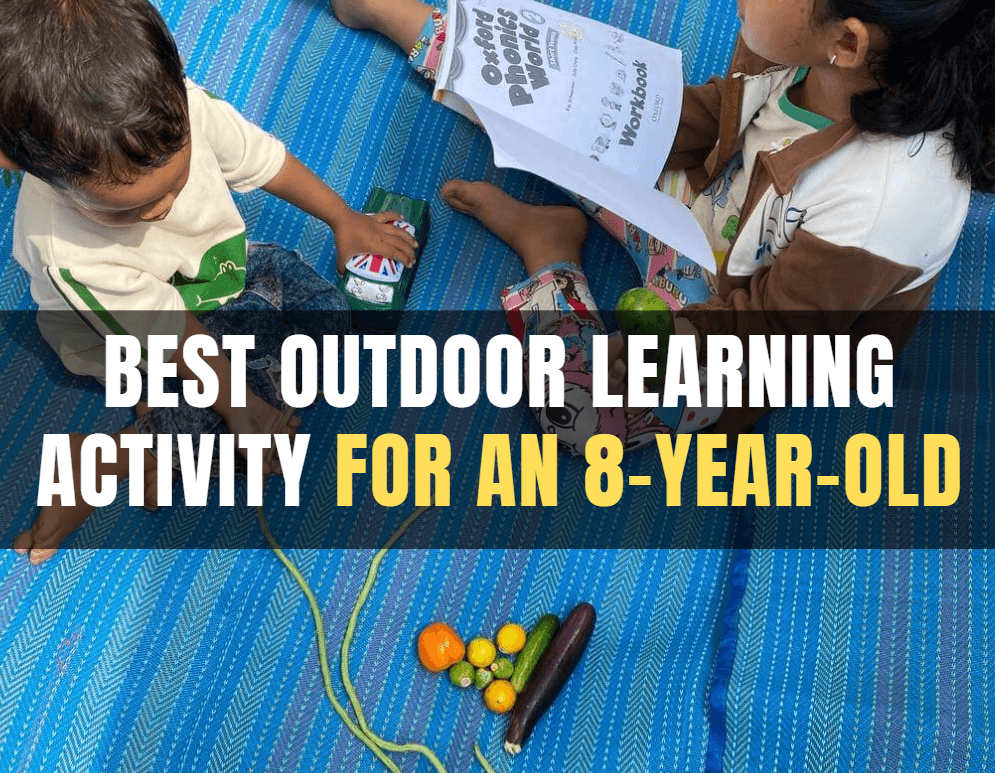
If you want to see what academic burnout looks like in real time, watch an eight-year-old try to pronounce a difficult word in a second language for the fifth time in a row.
That was us last Sunday morning.
My daughter, whom I lovingly call the Assistant Manager in our household, was sitting at her desk working through her Oxford Phonics workbook.
She had been studying hard all week, and the lessons were getting advanced.
Then she hit a wall. The word was “cucumber.”
“Cumcober. Cucummer. Cucum…”
After the fifth failed attempt, I watched the color drain from her face.
Her shoulders dropped.
The frustration was no longer about the word.
It was becoming something deeper.
When a child is overwhelmed with learning, pushing harder does not build skill. It just builds resentment.
I made a decision. I closed her book, picked up a pencil, and told her we were moving outside.
Why kids learn better outdoors
Research consistently shows that children absorb new information more effectively when they are not under pressure.
A change of environment alone can reset the nervous system, lower cortisol, and open up the kind of relaxed focus that actual learning requires.
But the bigger reason is sensory engagement.
Taking the classroom outside works because children do not just read about the world — they touch it, smell it, and move through it.
That physical contact gives abstract concepts a real address in the brain.
Moving the classroom off-site
We headed out to the garden behind our house.
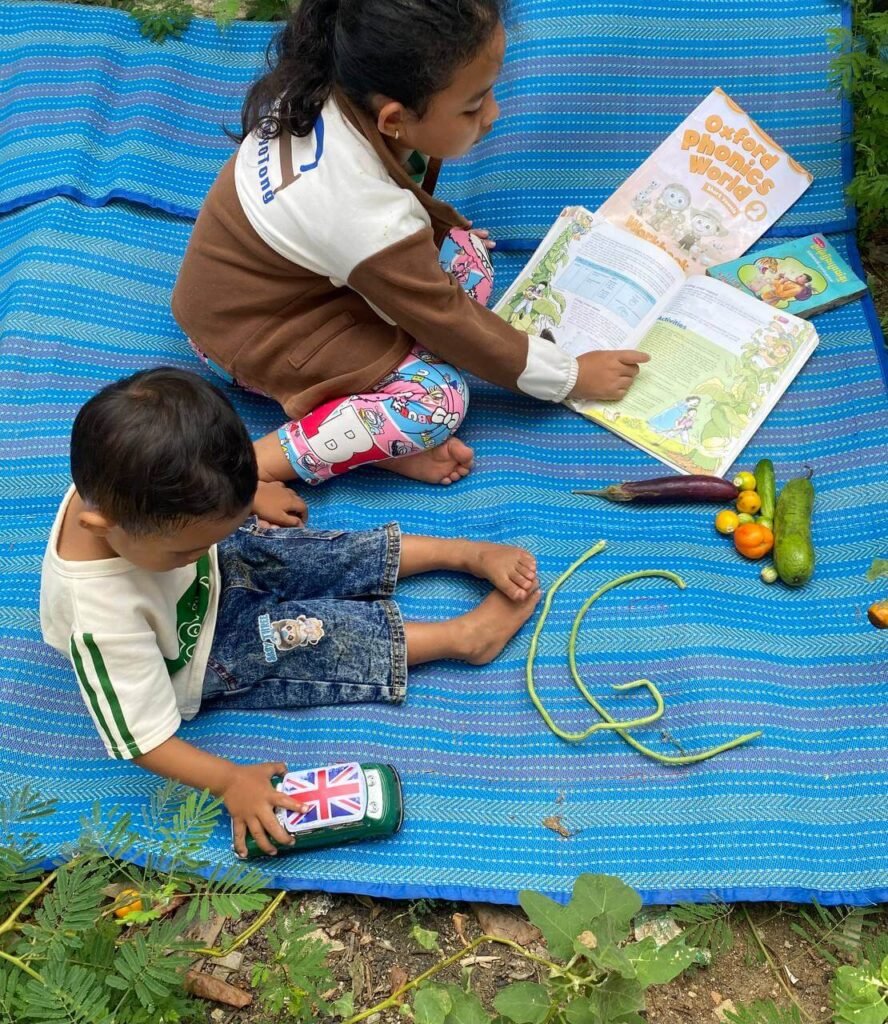
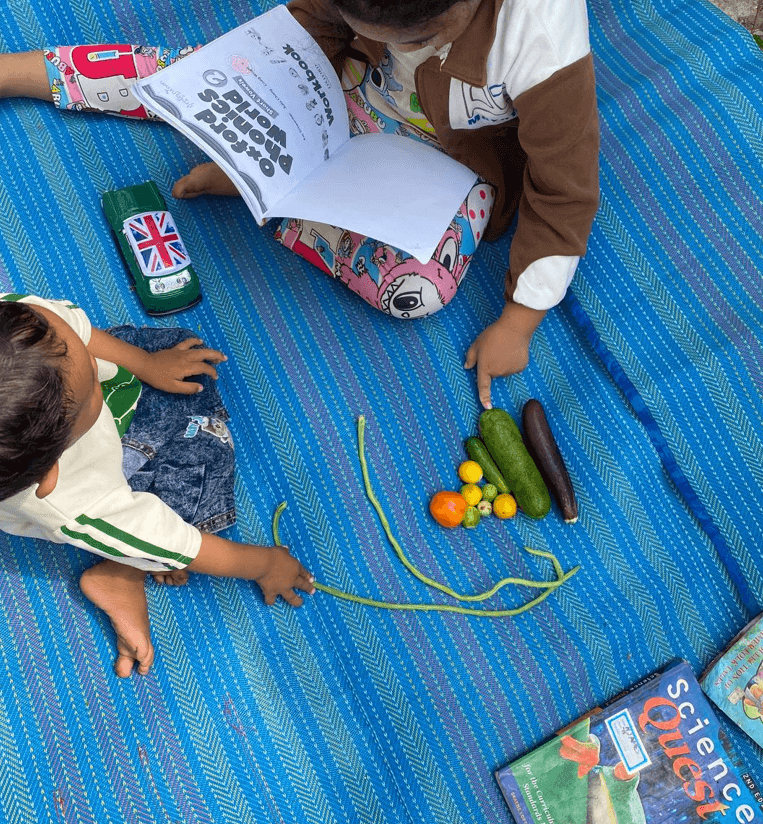
I laid out a blue woven mat in the shade, brought her phonics workbook, and grabbed my Science Quest book.
Then we did something that changed the entire energy of the morning.
We went into the garden and harvested the exact vegetables she had been struggling to read about.
We gathered a fresh cucumber still cool from the morning shade, purple eggplants, including our local trub veng, long beans curling on the mat, and the round pale wax gourd we call tula laach.
Suddenly, the confusing letters on the page had a physical form she could hold, smell, and touch.
This is the core of hands-on learning: children do not just read about the world, they hold a piece of it.
Touching a real vegetable while saying its name out loud makes the English words stick in a way that reading alone cannot match.
The abstract becomes concrete, and the foreign becomes familiar.
The Garden Matching Game
Simply moving outside was not enough on its own.
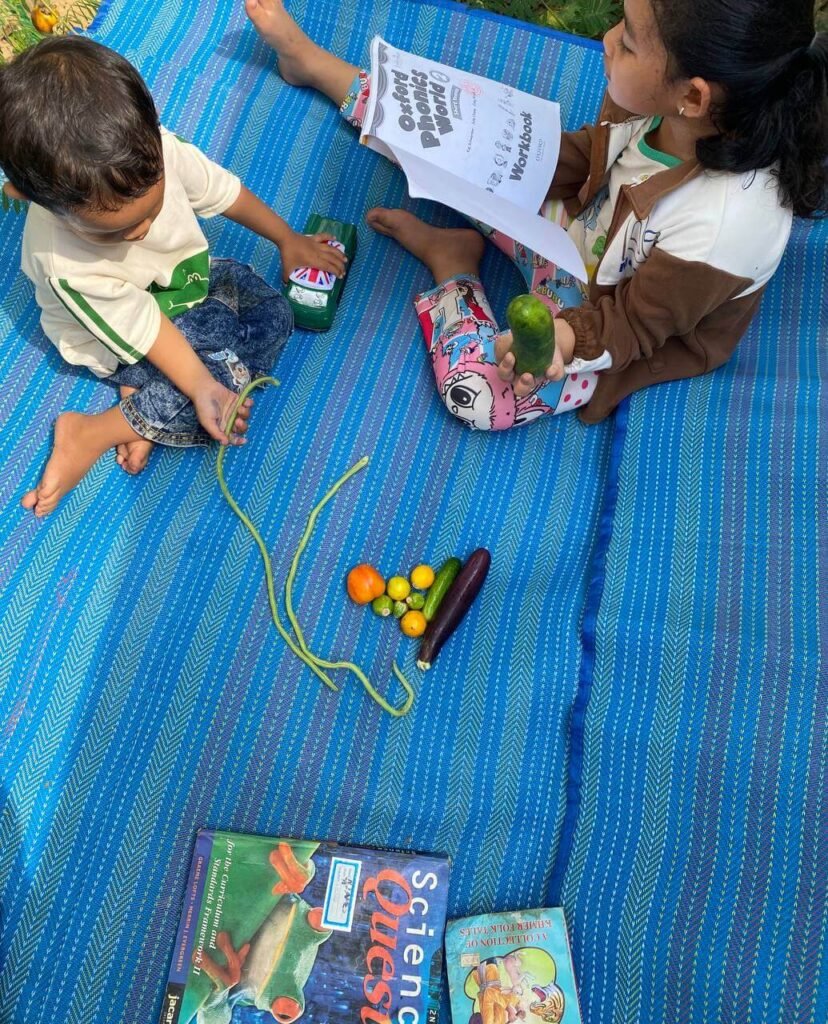
We turned the phonics session into a physical matching game — one of the easiest outdoor matching games you can do without any preparation.
As she read a word from her workbook, she had to use one hand to point to the correct physical vegetable on the mat.
I would call out a vegetable name, and she had to identify it both on the page and in front of her.
To add a layer of focus, I had her hold the heavy cucumber in one hand while managing her workbook with the other.
The physical weight of the vegetable became an anchor for the word she was learning to read.
This kind of kinesthetic learning, where the body and the mind work together, is something no desk can replicate.
Did she point to the right vegetable perfectly every time?
No. Her accuracy was around 60 percent. But as a parent, I know perfection is never the goal of a single afternoon.
She was engaged, she was trying, and she was no longer pale with stress. That was the real win.
The best lessons are unplanned
Here is the thing about outdoor learning that no curriculum planner can ever schedule.
While we were deep in our vegetable matching session, a small insect crawled onto a nearby leaf in the garden.
My daughter’s hand shot out immediately.
“Dad, that’s an insect!” she yelled.
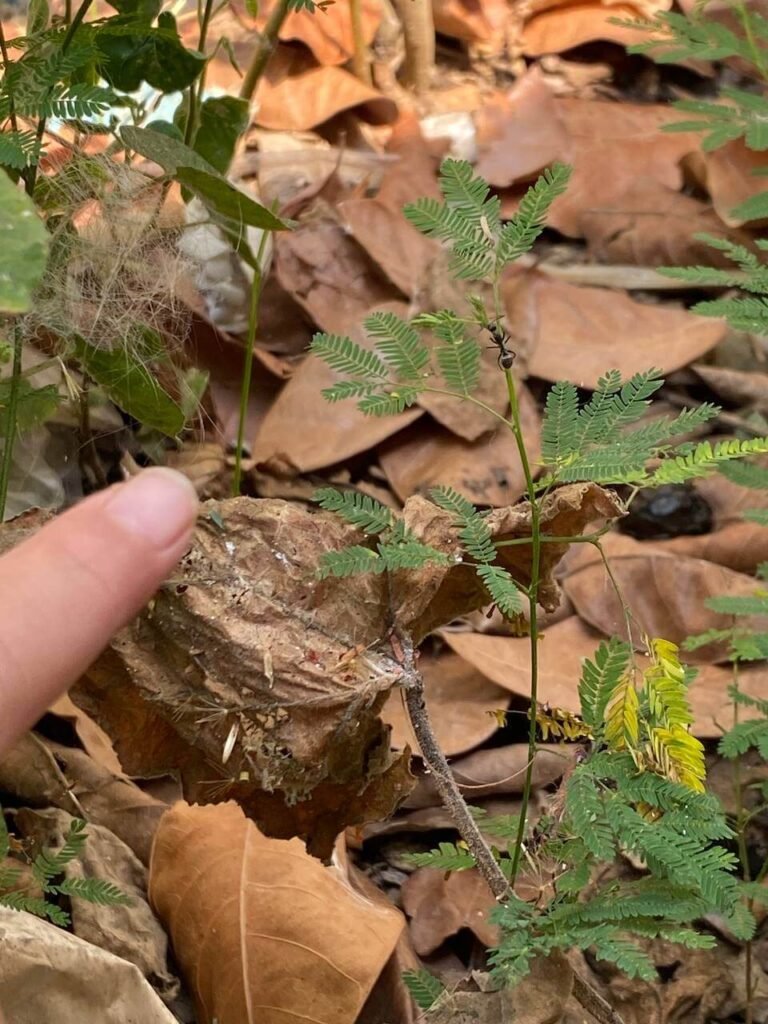
Then, with a huge smile, she added, “A is for Ant!”
She had connected a live discovery in the garden to a phonics lesson from weeks ago with no prompt from me.
This is what experiential learning looks like when it is actually working — not a child reciting something back, but a child making connections on her own.
The Sibling Effect (Again)
Meanwhile, my two-year-old son had been observing the entire session from the edge of the mat.
He did not say much, but he mirrored every single action his big sister took.
When she picked up the cucumber, he grabbed a long bean.
When she pointed at something, he pointed too.
He was absorbing the entire lesson just by watching and copying.
This kind of sibling observation is incredibly underrated.
You do not need a structured curriculum.
You need proximity to older children who are already exploring.
Unstructured play alongside siblings does more in an afternoon than most formal exercises can do in a week.
Close the manual and go outside
By simply swapping a stressful desk for a blue mat in the garden, we turned a frustrated morning into one of the best learning days we have ever had.
We did not add more pressure. We just changed the environment.
The vegetables are still sitting on our kitchen counter.
Every time my daughter walks past them, she says the names out loud with a smile on her face.
That is what real learning looks like.
Not perfect. Not pressured. Just real.
Sometimes the best way to be a good parent is knowing when to close the manual and step outside.
Frequently asked questions
Why do kids learn better outdoors?
Outdoor environments reduce the performance pressure children feel at a desk. When a child is not being watched and evaluated, the nervous system relaxes, and the brain becomes more receptive to forming new connections.
Outdoor settings also introduce sensory variety — texture, smell, movement, light — which gives the brain more ways to encode and recall what it is learning.
What is hands-on learning for kids?
Hands-on learning, sometimes called experiential or kinesthetic learning, means children interact physically with what they are studying.
Instead of reading the word “cucumber” on a page, they hold a real cucumber, smell it, say the word out loud, and connect the letters to something tangible. The more senses involved, the stronger the memory.
What are the benefits of outdoor learning for children?
Outdoor learning reduces academic stress, improves focus, and builds vocabulary through real-world context.
It also develops observation skills, encourages curiosity-driven discovery, and gives younger children natural opportunities to absorb knowledge by watching and copying others around them.
What should I do when my child is frustrated with learning?
Stop. Change the environment before the frustration turns into resentment. A short break outdoors, a walk around the garden, or a hands-on activity connected to the topic can reset your child’s emotional state.
Children cannot absorb new information when they are in a stress response. Removing the pressure is not giving up — it is good teaching.
How can I start teaching my kids outside?
You do not need equipment or a large garden. Take whatever your child is studying and find a physical version of it outside.
A phonics lesson becomes a nature scavenger hunt. A vocabulary list becomes a matching game with real objects. Start with five minutes and follow your child’s curiosity from there.
Disclaimer: I am a parent and an HR/education professional, not a licensed child psychologist or occupational therapist. This guide is based on my personal parenting experience. Always consult your child’s pediatrician for professional advice regarding your child’s behavioral development or potential sensory processing issues.
