



Every evening at 7:00 PM, my family sits down for dinner.
After a quick break, my daughter and I start what we jokingly call “Home Academy” at 7:45 PM.
It is our learning time, and I take it seriously.
But last week, something unexpected happened.
My 2-year-old son was not having it.
He did not want to be left out.
He marched in wearing his favorite orange shark shirt, grabbed his sister’s old notebook, and plopped down next to us.
He was ready to learn.
That moment turned into one of the most interesting lessons I have had as a parent, because what I watched him do next is something child development researchers have a name for.
It is called pretend reading, and it matters far more than I realized.
Quick Takeaway
Pretend reading is when a toddler mimics the act of reading before they can actually decode words. They hold books, turn pages, point at pictures, and make sounds as if they are telling a story. Far from being just cute behavior, pretend reading is a recognized early literacy milestone that signals your child is building print awareness, vocabulary, and a lifelong identity as a reader. You do not need flashcards or apps to encourage it. You just need books within reach and the willingness to let your toddler join in.
What Exactly Is Pretend Reading?
When my daughter started reading out loud, my son joined in. Sort of.
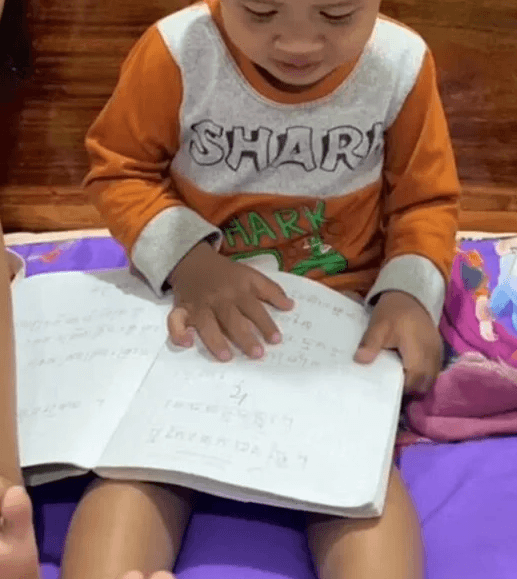
“Ahh… Ahh… EE… Ou…”
Not real words.
But he copied everything else: her volume, her pauses, even the rhythm of how she spoke.
And he looked completely serious about it.
Pretend reading happens when toddlers mimic the act of reading before they actually can.
They hold books, turn pages, point at pictures, and make sounds like they are telling a story.
It looks like playing.
But it is one of the most important early literacy activities a toddler can do, because it means your child has already figured out that books are meaningful objects worth paying attention to.
This behavior is sometimes called emergent literacy, the stage where children begin absorbing the rules and rhythms of written language through observation and play, long before formal reading instruction begins.
Is Pretend Reading a Sign of Intelligence?
Watching my son “read” made me wonder if he was ahead of the curve.
But after looking into it, I realized pretend reading is not really about being gifted or advanced.
It is about something better: interest.
When toddlers pretend to read, they are showing that they want to be part of the reading world.
They already see books as important, fun, or worth paying attention to.
That attitude matters far more than whether they can recognize letters yet.
So, is pretend reading a sign of intelligence?
Maybe. But more importantly, it is a sign that your child is watching, absorbing, and quietly building early literacy skills without even realizing it.
Children who engage in pretend reading at age two are demonstrating book awareness, print motivation, and narrative understanding, all of which are foundational pre-reading skills.
The “Point and Name” Game and Why It Matters
My son interacts differently depending on what kind of book is in front of him.
With his sister’s notebook, he scribbles.
But with his colorful alphabet books, he plays what I call the “Point and Name” game.
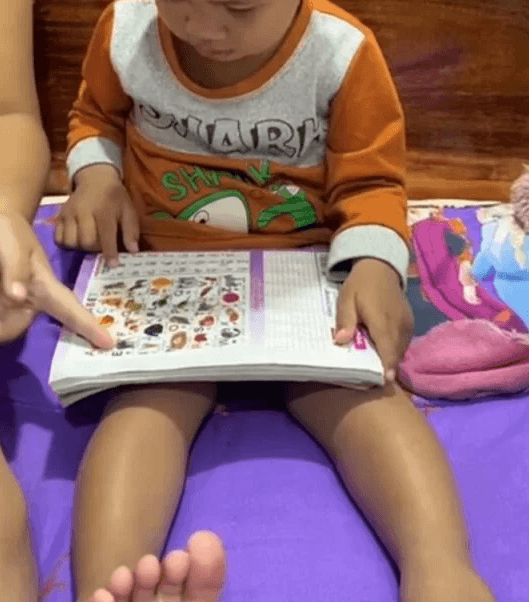
Watch a toddler with a picture book, and you will notice they use their index finger like a tool.
My son does this constantly.
He stops mid-“sentence, jabs his finger at a picture of a lion or a piece of fruit, and looks up at me.
That moment is actually a big deal.
He is isolating a concept.
He understands that this specific drawing connects to a real thing in the world.
For parents trying to encourage this, busy books work best.
Books with grids of pictures, things like animals, foods, or household items, give his little finger a target to land on.
When he points, I give him the word right away.
He points to the cat. I say, “Cat.” He tries, “Ca.”
It feels like a game to him.
But he is building vocabulary.
He is not just looking at the page.
He is starting to decode it.
Toddlers pointing at pictures in books is one of the earliest and most reliable signs of emerging print awareness, and it is something you can actively encourage during every reading session.
What Is Print Awareness, and How Does a Toddler Develop It?
At one point during his performance, my son stopped and pointed at something in the notebook.
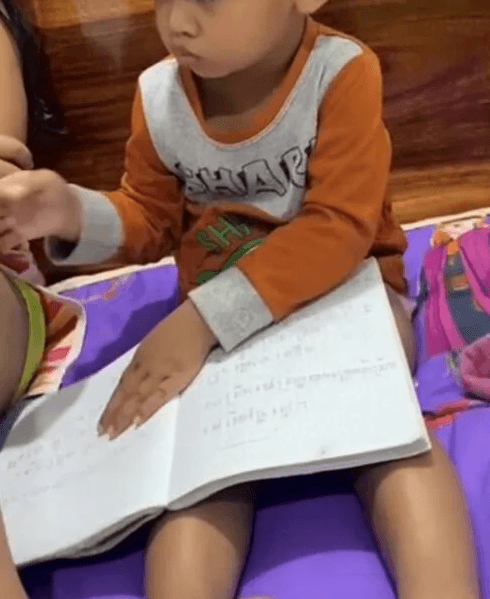
He made a sound, then looked up at me like he was asking, “Is this right?”
That tiny moment is called print awareness.
Print awareness is when a child starts to understand that marks on a page have meaning, that books are read in a certain direction, and that pictures and words are connected.
It is a core emergent literacy skill that researchers consistently link to reading success in kindergarten and beyond.
My son cannot read yet.
But he already knows the squiggles and images on the page mean something.
He is figuring out the rules just by watching us.
And the best part?
I did not have to teach him.
He learned it by crashing our study session.
Building Print Awareness at Home (No Flashcards Required)
You do not need special programs or apps to build print awareness in your toddler.
Here is what actually works, based on what I have seen at home.
- Let them join in. When older siblings are reading or doing homework, let the little one sit nearby. The sibling reading environment is one of the most underrated tools in early literacy. Children absorb more from watching a brother or sister read than most parents realize.
- Point while you read. Run your finger under the words during bedtime stories. It shows them that reading moves from left to right and that words are separate units.
- Let them turn the pages. It teaches them that books have a flow and an order, both key print awareness concepts.
- Do not correct their pretend reading. If they are holding the book upside down and babbling, that is perfectly normal for a 2-year-old pretending to read books. They are practicing, not failing.
- Ask questions about pictures. “What do you see here?” helps them connect images to meaning, which is exactly what print awareness is about.
None of this feels like work. It feels like family time.
And that is exactly the point.
How to Design a Learning Space That Includes Toddlers
A lot of parents ask how I get a 2-year-old to sit still for more than thirty seconds.
The honest answer is that I do not force it.
But I do set up the environment so it is easy for him to join in.
Our “Home Academy” is not a rigid desk setup.
We usually sit on the bed or a soft rug, and that is intentional.
A tall dining table would physically exclude him.
He is too short to see the books, and being strapped into a high chair makes everything feel like a chore instead of a choice.
By bringing things down to his level, the barrier disappears.
A few things that help make early literacy activities feel natural for toddlers:
- Comfort first. Use soft bedding or a mat. If he wants to roll around, he can. If he wants to sit up and read, he can do that too.
- Let him wear what makes him feel ready. If the shark shirt gives him confidence, that is his uniform.
- Give him his own prop. If his sister has a pencil, he gets a crayon. If she has a textbook, he gets a notebook.
- Put books within reach. Books sitting on a shelf that they cannot get to? They will not care. Books right there on the mat, waiting to be opened? They cannot resist.
If you want your toddler to care about reading, reduce the barriers.
The physical environment shapes behavior far more than we give it credit for.
Why I Did Not Send Him Back to Play
Part of me wanted to say, “Buddy, go play. This is your sister’s time.”
But I did not. And I am glad.
Right now, my son is building his identity.
He sees himself as a learner.
He sees himself as someone who can do what his sister does.
That confidence is fragile, and I was not going to chip away at it just to keep the study session tidy.
Research on early literacy consistently shows that a child’s attitude toward reading, their belief that books are for them, develops years before they can decode a single word.
The environment we create at home either reinforces that belief or quietly erodes it.
In a few years, he will be reading for real.
And I think he will remember these nights.
The nights he “read” next to his sister in his shark shirt, making sounds that did not quite mean anything but somehow meant everything.
The Real Meaning Behind Pretend Reading
Pretend reading is not just noise.
It is not just cute. It is your toddler running a practice version of literacy inside their brain.
They are trying on the identity of a reader, experimenting with sounds and symbols, and learning that books are worth their attention.
The emergent literacy skills being built during pretend reading, print awareness, print motivation, vocabulary, and narrative understanding are the exact same skills that predict reading success years later.
You do not have to orchestrate this.
You just have to allow it.
So if your 2-year-old grabs a book, babbles at the pages, and looks up at you like they just recited poetry, play along.
Nod. Smile. Maybe even clap.
They are not faking it.
They are practicing for the real thing.
And that is worth celebrating.
Frequently Asked Questions
At what age do toddlers start pretend reading, and is it normal for a 2-year-old?
Yes, it is completely normal. Most toddlers begin pretend reading between 18 months and 3 years, though some start earlier if they are frequently read to or have older siblings who model reading. There is no fixed milestone age; the behavior emerges naturally as a healthy sign of print awareness. If your 2-year-old is babbling over a book and turning pages, they are right on track.
Is pretend reading a sign of intelligence?
It can be, but more importantly, it is a sign of motivation. Pretend reading tells you your child sees reading as valuable and wants to participate in it. That attitude, more than raw intelligence, is what predicts strong literacy outcomes in school.
How can I encourage pretend reading at home?
Keep books at floor level where your toddler can grab them freely. Read aloud every day and let them turn the pages. If an older sibling reads nearby, let the toddler join the session with their own book. Do not correct babbling or upside-down books. Just engage positively whenever they show interest.
What books are best for toddlers’ early literacy?
For building print awareness and encouraging the “point and name” game, look for busy books with grids of pictures (animals, foods, vehicles), board books with one image per page, and simple books with repetitive text. Bold illustrations with high contrast work best for very young toddlers. Revisiting the same books repeatedly is also more beneficial than constantly introducing new ones.
What are the stages of emergent literacy?
Emergent literacy generally progresses through four broad stages. First, children develop print motivation, the desire to interact with books at all. Second, they build print awareness, understanding that marks on a page carry meaning. Third, they develop phonological awareness, sensitivity to the sounds within words. Fourth, they begin connecting letters to sounds (alphabetic knowledge). Pretend reading fits squarely into the first and second stages.
Does having an older sibling help a toddler learn to read?
Yes. Sibling influence on toddler literacy is real and well-documented. Younger children who observe older siblings reading regularly tend to develop print awareness earlier and show stronger reading motivation. The key is allowing the younger child to participate rather than excluding them from reading time.
Do I need flashcards or apps to build print awareness?
No. Everyday reading routines, pointing at words during bedtime stories, letting toddlers turn pages, asking questions about pictures, and putting books within reach are the most effective, research-backed ways to build print awareness at home. Flashcards and screen-based apps are not necessary and are often less effective than simple shared reading.
Disclaimer: I am a parent and a university educator, not a licensed child psychologist or pediatrician. This guide is based on my personal parenting experience and educational background. Always consult your child’s teacher or pediatrician for professional advice regarding your child’s educational development.
