


I am a university professor who teaches conflict resolution and HR management.
I help adults work through difficult situations every day.
But honestly?
Negotiating with grown-ups is way easier than dealing with a two-year-old who wants a candy bar.
Last week, my son had a full meltdown at our local grocery store.
I want to share exactly what happened and the toddler tantrum tips that actually worked when I was standing in the cereal aisle, feeling like the worst parent alive.
Quick Takeaway
Toddler tantrums in public are normal and manageable. The fastest way to calm a toddler’s tantrum is to offer two choices instead of a flat “no,” move to a quieter space when screaming starts, and stay calm so your child can regulate their emotions.
Reconnect with a hug once it passes. Avoid giving in to demands, as this reinforces future tantrums.
What Happened at the Grocery Store
The trip started fine.
My son was in his striped pajamas (yes, we left the house like that), happily exploring the bottom shelves.
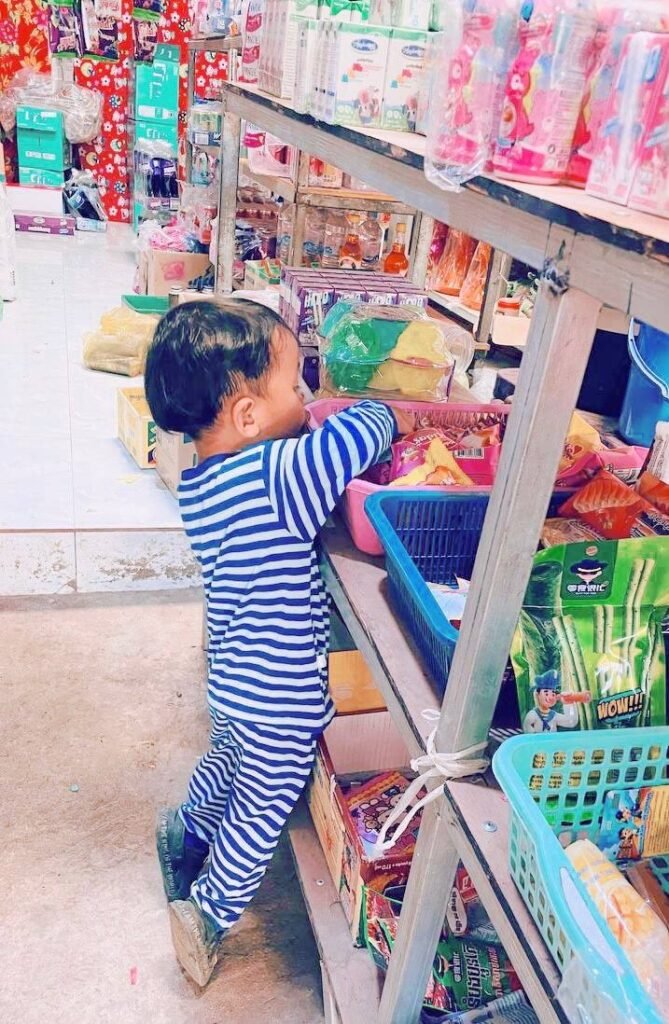
Everything was going well until he spotted a snack he wanted.
The Cereal Aisle Standoff
This is where toddler meltdowns at the store usually begin.
Your kid grabs something.
You say no. They fall apart. Everyone looks over.
In that moment, you have two options.
You can say no and deal with the screaming, or buy the snack to keep things quiet.
I used to go with option two.
It felt easier in the moment.
But I learned that giving in only makes future tantrums worse.
Child development experts agree: caving under pressure teaches your child that a meltdown is the fastest route to getting what they want.
The Choice Technique: Stopping an Outburst Without Giving In
Instead of grabbing the snack out of his hands, which always triggers screaming, I tried something different.
I gave him two choices.

“You can hold that snack while we walk around, but we will put it back before we leave. Or you can put it back now and pick a banana instead.”
He did not love either option.
But here is the thing: giving him a choice made him feel like he had some control.
That is one of the most effective ways to stop toddler outbursts without caving, and it is a core principle in positive parenting techniques.
Why it works: Toddlers are wired to push for independence.
Toddler development and independence are deeply connected at this age.
They want to make decisions.
When you offer choices, even small ones, you are respecting that need while still holding your boundary.
This is sometimes called the “choice technique” in gentle parenting discipline, and it works because it redirects the power struggle rather than escalating it.
The Silent Protest (And Why It Is Actually a Win)
After the snack went back on the shelf, I knew something was coming.
I picked him up and moved us outside to a quieter spot.
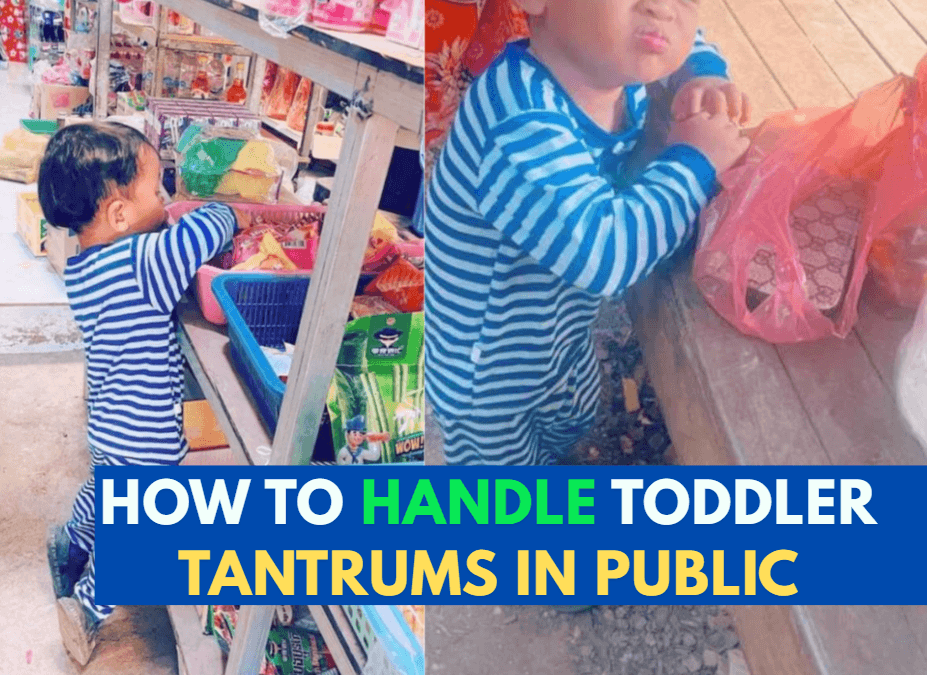
I expected tears and screaming. Instead, I got “the face.”
You know exactly which face.
Nose scrunched. Eyes squinting. That look of pure toddler sass.

He was not crying, but he was absolutely not happy with me.
That moment taught me something important about managing big emotions while you’re out: you do not have to fix their feelings right away.
I used to feel embarrassed when my son looked upset in a store.
I worried about what other people thought.
Now I see it differently.
His feelings are real.
Being disappointed is part of how he learns emotional regulation.
My job is not to keep him happy every second.
My job is to stay calm and let him move through his emotions safely.
So I stood nearby, stayed quiet, and waited.
Two minutes later, he was completely fine.
My 3-Step De-Escalation Strategy for Toddler Meltdowns in Public
Sometimes the silent protest skips straight to full volume.
Here is what works for me when a toddler meltdown in the grocery store or any public place goes into full swing.
Step 1: Change the Location
Do not try to calm a screaming toddler in the middle of a busy aisle.
There is too much noise and too much stimulation.
Pick them up and move somewhere quieter, whether that is outside the store, a calmer corner, or your car.
Changing the setting helps reset things for both of you.
This is the most underrated calming-down technique for toddlers.
The environment itself is often fueling the meltdown.
A quieter space lowers the sensory input and gives both of you room to breathe.
Step 2: Be the Rock
This is the hardest part.
When your child is screaming, and people are watching, every instinct tells you to react loudly.
But the real secret to getting through toddler tantrums is this: you can control how you respond, even when you cannot control what your child feels.
I picture myself as a heavy rock.
The tantrum is a storm crashing against it.
Loud, messy, intense.
But the rock does not move.
It just stays steady.
When you stay calm during a toddler tantrum, you show your child that big emotions are okay and that they pass.
That is one of the most powerful things you can teach a toddler about emotional regulation.
Research in child development consistently shows that a parent’s calm presence is the fastest way to co-regulate a toddler’s nervous system.
Step 3: Reconnect After It Is Over
Once your toddler settles down, do not hold on to the tension.
Toddlers move on fast, and you should too.
Give them a hug.
Smile at them.
Get back to what you were doing, as if it is already behind you.
That sends a clear message: “I love you, even when things get hard. We are good.”
Reconnecting after a toddler tantrum is not giving in.
It is relationship repair.
And it is what separates a single difficult moment from a pattern of disconnection.
Five minutes after my son’s protest face, he was smiling and chatting as if nothing had happened.
Does the Jessica Trick Work on Toddlers?
If you have been on TikTok recently, you have probably seen it.
A toddler is mid-meltdown, red-faced and screaming, and a parent calmly says, “Jessica? Jessica, where are you?”
The kid stops, looks around, and the tantrum breaks.
This is the so-called Jessica trend, which went viral in late March 2026 with millions of views.
Parents are now Googling “does the Jessica trick work on toddlers” in huge numbers, and the short answer is: sometimes, for now.
The reason it works is the same reason my choice technique works.
It interrupts the toddler’s emotional spiral by introducing something unexpected.
A sudden shift in tone causes a brief “reset” in the brain, which can pause the tantrum long enough for the child to step back from the peak of their emotion.
The difference is durability.
A random name works by surprise, and toddlers figure that out fast.
The choice technique works by meeting a developmental need, which is the need for independence and control.
That is why it holds up over time while novelty tricks fade.
If you want to try the Jessica trick as a short-term tool, go ahead.
Just pair it with the deeper strategies above for lasting results.
Why Toddler Tantrums in Public Feel So Much Harder
Tantrums at home are one thing.
Nobody is watching.
Nobody is judging.
But in public, it feels like everyone has an opinion.
Some people give you the “control your child” look.
Others give you the sympathetic nod that says they have been there, too.
What helped me most was stopping caring what strangers think.
They catch 30 seconds of your day and form an opinion.
That is on them, not you.
Keep your focus on your child and do what is right for them.
The embarrassment of a two-year-old’s public meltdown is incredibly real.
But remember: every parent in that store has either been there or will be there.
You are not failing.
You are parenting a toddler, and that is just what this looks like sometimes.
Toddler Tantrum Tips You Can Start Using Today
Before the tantrum
- Set clear expectations before you go in (“We are getting three things, then we leave”)
- Bring snacks, because a hungry toddler is a much harder toddler
- Skip the shopping trip if it falls during nap time
- Practice giving toddler choices at home so the skill is familiar when you need it in public
During the tantrum
- Offer choices instead of a flat no
- Move to a quieter space if they are screaming
- Stay calm and low-key, with no yelling or big reactions
- Let them feel what they are feeling
After the tantrum
- Reconnect with a hug or a kind word
- Do not bring it up again
- Move on with your day
The Actual Goal When a Toddler Has a Public Meltdown
Many parents believe the ultimate goal is to raise a child who never has tantrums.
That is not realistic.
Toddlers are in the midst of learning how to become individuals.
They are figuring out disappointment, limits, and how to regulate their own emotions.
Sometimes that process is loud and happens in Target.
The real goal is simpler: be the parent who can handle the tantrum without falling apart yourself.
You will not prevent every public meltdown.
But you can get better at handling them with patience and calm.
And every time you do, your child learns that big emotions are survivable, that limits are consistent, and that your relationship is secure no matter what.
Learning how to handle toddler tantrums outside the house takes time.
Sometimes I still have to carry my son out of a store while he screams.
But I am getting better at staying calm, and the next time he hits me with that sassy protest face?
I will just try not to laugh.
Frequently Asked Questions
Why do meltdowns happen more often in public than at home?
Public places combine hunger, overstimulation, disrupted routines, and limited parental attention all at once. That is a perfect storm for big feelings. Your child is not being manipulative; they are simply overwhelmed and do not yet have the language or brain development to handle it differently.
What is the fastest way to calm an outburst?
Move to a quieter location, stay calm yourself, and avoid arguing or negotiating once the crying is in full swing. Offer choices before the peak, not during. Once the storm passes, reconnect warmly.
Should I give my child what they want to keep them quiet?
No. Giving in just to stop the screaming reinforces that the behavior works. It feels like a relief in the moment, but it leads to more frequent and intense outbursts over time. Offer choices within limits instead.
How do I stop feeling embarrassed when my kid loses it at the store?
Remind yourself that every parent around you has either been there or will be. You are not being judged nearly as much as you feel you are. Focus entirely on your child, not on the audience.
At what age do these tantrums usually stop?
Most children develop better emotional regulation and language skills between the ages of 3 and 4, which naturally reduces the frequency of these episodes. Until then, consistent and calm responses from you are the most powerful tool you have.
Disclaimer: I am a parent and a university educator, not a licensed child psychologist or pediatrician. This guide is based on my personal parenting experience and conflict resolution background. Always consult your child’s pediatrician for professional medical or psychological advice regarding your child’s behavior and development.
