


I teach university students for a living, and getting them to focus on one thing for more than a few minutes is genuinely hard.
So when I walked into our bedroom and found my two-year-old carefully lining up every single toy car he owned across the bed, completely locked in, I stopped and just watched.
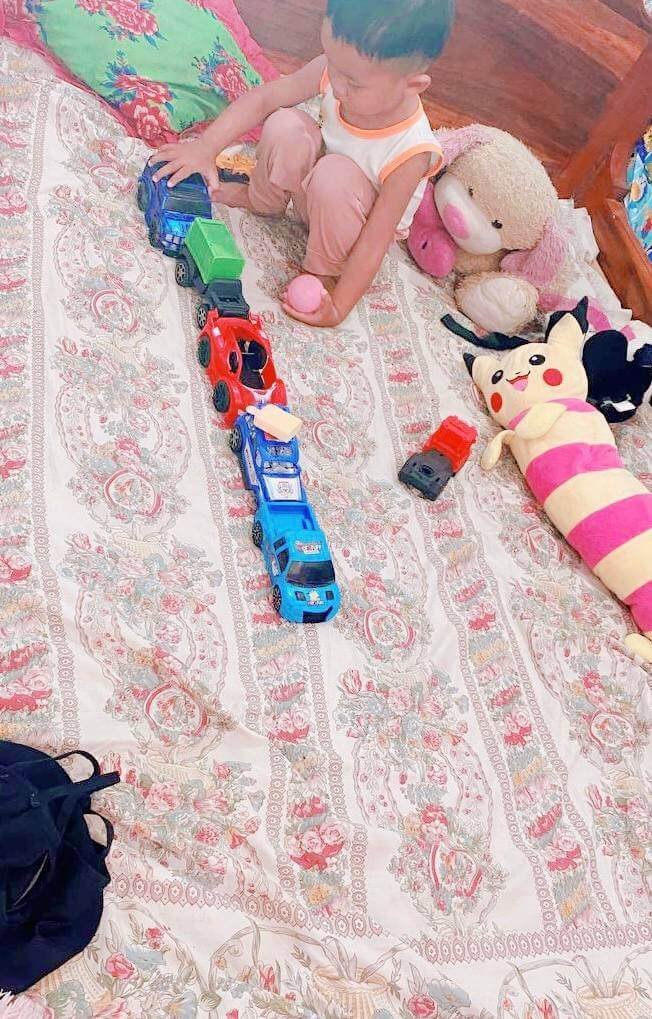
He wasn’t rushing.
He was adjusting each one, making sure they were perfectly straight.
At two years old.
My first thought was, “He’s actually working right now.”
That moment changed how I looked at those little cars.
They stopped being plastic things I was stepping on at midnight and started being something I actually paid attention to.
Because whatever he was getting from them, no screen or battery-powered toy had ever given him that kind of focus.
If you’ve got a toddler and you’re wondering whether the cars scattered across your floor are doing anything useful, they really are.
Are Toy Cars Good for Toddlers?
Most pediatricians and early childhood experts would say yes, and it makes sense when you understand why.
Toy cars fall into a category called open-ended toys, which just means there’s no single right way to use them.
Your toddler decides what happens.
They make the sounds, build the story, and set the rules.
That’s what makes open-ended toys so valuable for toddler development.
Electronic toys that light up and beep do most of the work for your kid.
Toy cars don’t. Your child must show up, use their imagination, make small decisions, and figure things out as they go.
My son is now two and a half years old.
His collection has grown to include garbage trucks, police cars, race cars, and a few mystery vehicles I still can’t identify.
He plays with them differently every day.
Some days they’re parked in neat rows.
Some days there’s a massive pile-up.
Some days, they appear to be heading to the kitchen for something very important.
How Do Toy Cars Help with Fine Motor Skills?
This is probably the most underrated benefit of toy cars for toddlers.
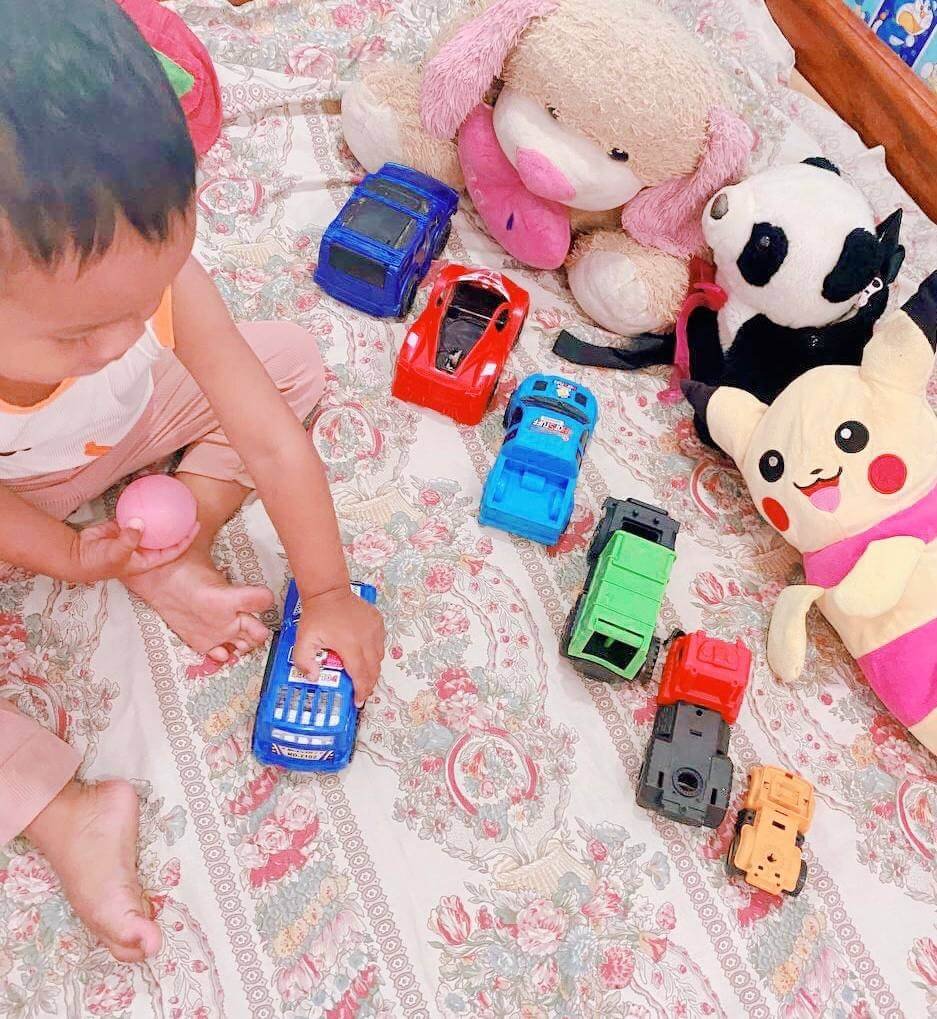
We talk a lot about walking and running, but small hand movements matter just as much.
They’re what kids need later for holding a pencil, feeding themselves, and eventually tying their shoes.
The pincer grasp is a good example.
Every time your toddler picks up a small car using their thumb and index finger, they’re practicing the exact grip they’ll use to hold a crayon.
I noticed my son’s grip getting noticeably stronger just from picking up and repositioning his cars every day.
Hand-eye coordination comes in too.
Pushing a car along a path, steering it through a tunnel, or sending it down a ramp requires the hands and eyes to work together in real time.
It looks simple, but their brains are doing a lot.
This is exactly why toy cars are so great for hand-eye coordination.
And then there’s wrist strength and flexibility, which builds through all that turning, steering, and backing up.
Six months ago, my son’s hand movements were shaky and uncertain.
Now they’re quicker and more controlled.
A lot of that has come from daily car play.
Are Toy Cars Good for Brain Development?
Once I started actually watching how my son played, I was surprised by how much was happening under the surface.
He was running little physics experiments without knowing it.
Push a car hard, and it goes far.
Drop it from a ramp, and it rolls.
Put it on the carpet, and it stops short.
Toddlers figure out cause and effect through this kind of trial and error long before they can explain what they’re doing.
This type of cause-and-effect play is a foundational part of their cognitive development.
Spatial reasoning builds the same way.
Driving a car under the coffee table, over a pillow, or through a cardboard tunnel is how kids start to understand how objects relate to each other in space.
Words like under, over, through, and around become real concepts when your toddler is actively navigating them.
That kind of spatial reasoning is actually a foundation for math later on.
Their vocabulary develops naturally, too. Fast, slow, stop, go, heavy, light, loud, quiet.
These words come up constantly during car play.
When you sit on the floor and narrate what’s happening alongside your toddler, the vocabulary sticks because it’s tied to something they’re doing.
It doesn’t feel like a lesson because it isn’t one.
Social and Emotional Benefits
Around age two, kids start getting into pretend play, and toy cars fit that perfectly.
The benefits of pretend play at this age are real and well-documented.
A truck stuck in traffic, a race car stopping for gas, a car going to the store.
Your toddler is using these little scenarios to process the adult world they watch every day.
That kind of toddler imaginative play is hard to replicate with a toy that has a fixed script.
When siblings or friends join in, playing with cars becomes a natural way to practice sharing, taking turns, and cooperating.
Those are hard skills for a toddler, and low-pressure, unstructured play gives them room to work on them without things feeling forced.
There’s also something genuinely calming about repetitive play.
Lining cars up, sorting them by color, pushing them back and forth.
For a toddler who’s overstimulated or just needs a minute, that kind of play can be really settling.
What Are Some Fun Toy Car Activities for Toddlers at Home?
You don’t need expensive tracks or big sets.
Here are a few things we do at home with stuff we already have.
These activities are simple, low-cost, and actually hold their attention.
The Parking Lot
Use a patterned bedspread and pretend the designs are parking spaces, or just draw lanes on a flattened cardboard box with a marker.
Add numbers or colors to sneak in a little extra learning while it still feels like play.
Toy Car Wash
A plastic bowl, a little water, a tiny drop of dish soap, and an old toothbrush.
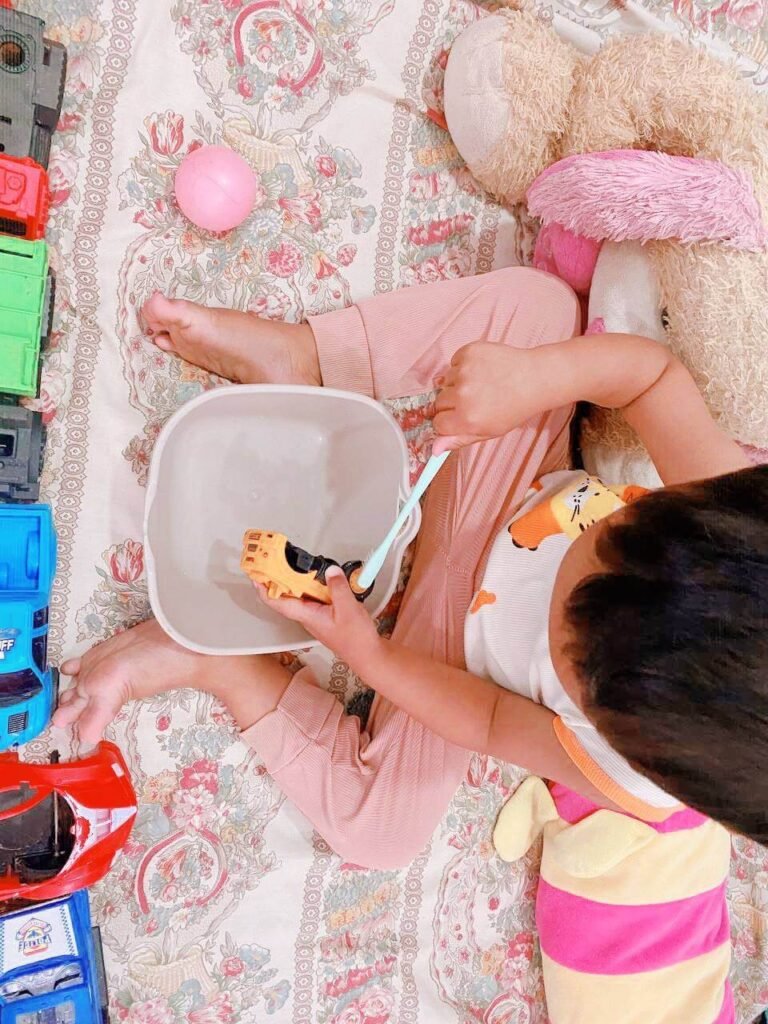
Let your toddler scrub the cars clean.
Kids love water play, and this will keep them busy for a good stretch.
Just sanitize the toothbrush in hot water first.
Color Sorting
Lay out sheets of construction paper in different colors and ask your toddler to park each car on the matching color.
Simple structure, still fun.
DIY Ramp Racing
Building a homemade ramp is one of our favorites.
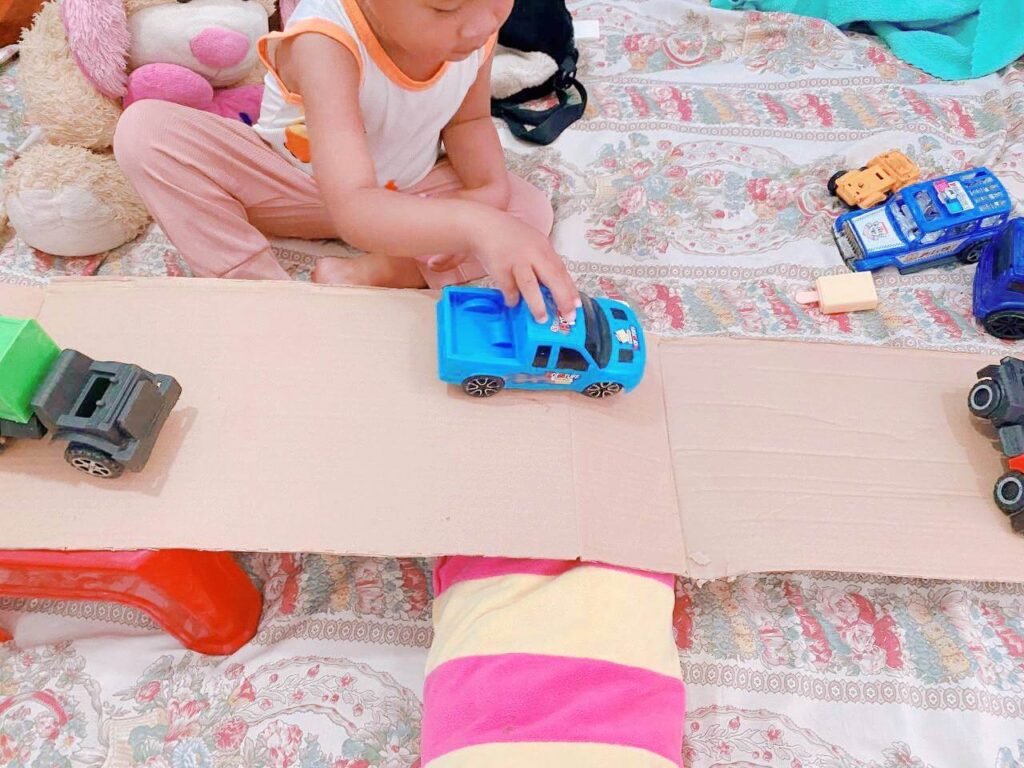
Fold a piece of cardboard and prop it on a stool or the edge of the bed.
Race cars down it and see which one goes farthest.
You can adjust the height and talk about why it goes faster or slower.
My son can do this for twenty solid minutes.
Sensory Road
Lay out different textures along a path: a folded towel, some bubble wrap, a smooth baking sheet, a rough doormat.
Drive the cars across each one and talk about how it feels and sounds.
This sensory play activity is really simple, but kids find it genuinely interesting.
Are Toy Cars Actually Educational for Toddlers?
Yes. Educational toys don’t need flashing buttons or the alphabet printed on the side.
What makes something educational is what it asks your child to do.
Toy cars cover fine motor skills, spatial reasoning, vocabulary development, creativity, and social skills all at once.
They’re open-ended, which means your kid’s imagination does the heavy lifting.
The benefits of toy cars for toddlers stack up quietly over time, across multiple areas of development.
The best ones are just the right size for little hands, tough enough to survive being dropped a hundred times, and simple enough that they don’t do anything on their own.
Final Thoughts
The next time you step on a toy car at six in the morning, it might help a little to know what it’s actually doing.
All that pushing, lining up, crashing, and imaginary road trip planning is real developmental work.
So, are toy cars good for toddlers?
Based on what I’ve watched firsthand and what the research supports, yes, genuinely.
They’ve stayed around this long for good reason.
They’re simple, durable, open-ended, and useful across a lot of areas of toddler development. You don’t need a huge collection, and you don’t need the expensive sets.
A handful of cars and a bit of floor space is honestly enough.
Your toddler will figure out the rest.
Frequently Asked Questions About Toy Cars for Toddlers
Are toy cars good for toddlers?
Yes. They are genuinely beneficial because they support development across multiple areas at once. They build fine motor skills, hand-eye coordination, spatial reasoning, and language — all through natural, open-ended play.
Unlike battery-powered toys that do the work for your child, toy cars require your toddler to imagine, decide, and explore on their own terms.
What do toy cars teach toddlers?
These toys teach a surprising range of skills. Children practice the pincer grasp every time they pick one up, develop spatial awareness by navigating cars around objects, and build vocabulary through play.
They also learn cause and effect (push hard, it goes far), practice pretend play scenarios, and when playing with others, work on sharing and taking turns.
At what age should toddlers play with toy cars?
Most kids can start playing with them from around 12 to 18 months, though the type of play changes with age. Young toddlers enjoy pushing and carrying cars, while children aged 2 to 3 begin pretend play and sorting.
Always check for small parts that could be a choking hazard and choose cars sized appropriately for your child’s age.
How do toy cars help with fine motor skills?
Every time a toddler picks up, pushes, or steers a toy car, they are strengthening the small muscles in their hands and fingers. The pincer grasp used to hold a car is the same grip needed to hold a pencil later.
Steering and turning also build wrist flexibility, while guiding a car along a path improves hand-eye coordination in real time.
Are toy cars considered open-ended toys?
Yes. Toy cars are a classic example of open-ended toys because there is no single correct way to use them. Your toddler sets the rules, makes the sounds, and creates the story.
This type of play is especially valuable for brain development because it requires imagination and decision-making rather than simply responding to buttons, lights, or sounds.
Do I need expensive toy car sets for my toddler?
No. A few simple vehicles and some floor space are genuinely enough. Toddlers benefit most from the act of play itself, not from elaborate tracks or large sets.
DIY activities like cardboard ramps, color-sorting with construction paper, or a simple toy car wash with a bowl of soapy water can keep a toddler engaged just as effectively as any premium set.
Disclaimer: I am a parent and an HR/education professional, not a licensed child psychologist or occupational therapist. This guide is based on my personal parenting experience. Always consult your child’s pediatrician for professional advice regarding your child’s behavioral development or potential sensory processing issues.
