


My toy box is stuffed with “proper” toys.
A colorful doctor kit, a plastic zoo, and expensive trucks that flash and beep.
But my 2-year-old son ignores all of them.
His favorite things to play with?
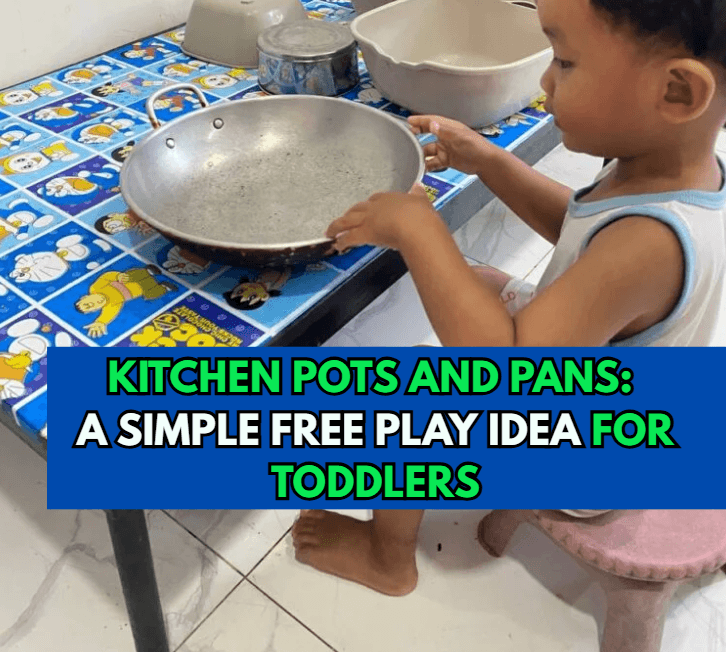
My battered metal frying pan and a set of beige plastic washing baskets.
For months, I kept saying no. “These are for cooking, not playing.”
Every time he reached for them, I would steer him back to his “real” toys.
Then one morning, I let him have them.
And watching what happened next changed how I think about home activities for 2-year-olds entirely.
Quick Takeaway
A toddler ignoring expensive toys in favor of kitchen bowls and pans is not being difficult. He is solving real problems.
Household items like metal pans and plastic baskets naturally support stacking, nesting, size sorting, and fine motor development because they have no “right” answer built in.
Unlike electronic toys that buzz when you press the wrong button, everyday objects let toddlers figure things out on their own.
This is the foundation of open-ended play, and it happens right in your kitchen at zero cost.
The Morning That Changed Everything
It was 8:00 AM.
I was wiping down the counters when I noticed something unusual: silence.
Any parent knows that silence from a toddler is suspicious.
When kids play with metal pots and pans, it usually sounds like a drum concert.
So the quiet caught my attention.
I peeked around the corner, expecting to find him napping or scribbling on the wall.
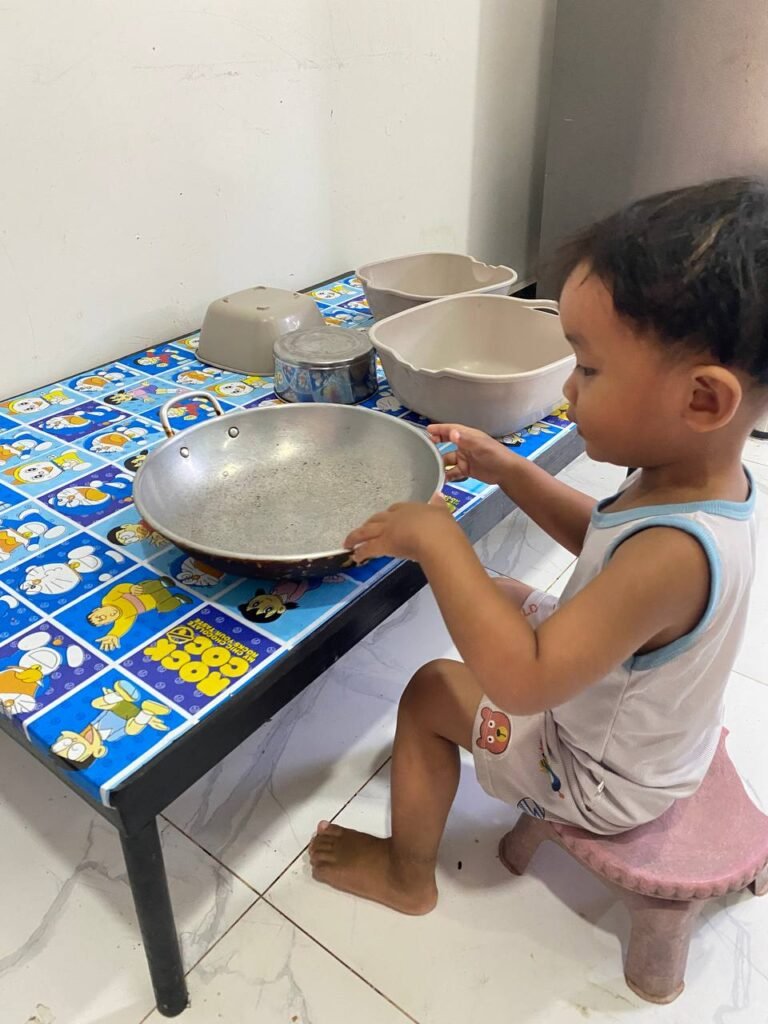
Instead, he was sitting at his little Doraemon table, completely focused on the frying pan and a stack of plastic basins.
He knew I usually said no to those items.
He did not want me to catch him.
So instead of banging them together like cymbals, he handled them carefully, staying quiet so I would not hear from the next room.
It was the sneakiest, most adorable thing I had ever seen.
And it gave me something parents rarely get: 15 full minutes of uninterrupted peace.
I did not say a word. I just watched.
The Physics Lesson Hiding Inside a Frying Pan
For those 15 minutes, he was completely locked in.
He picked up each bowl, studied it, and tried to stack them on the table.

This was not random banging.
He was solving a puzzle.
The moment that really got me was when he tried to fit the square beige washing basket into the round metal frying pan.
He pushed it, wiggled it, and frowned when it would not go in.
If this were a flashing electronic toy, it would have just buzzed to tell him he was wrong.
But with the pan, he had to figure it out himself.
He paused, pulled the basket out, flipped it over, and tried a different angle.
That is toddler problem-solving in action.
He was learning that “square” does not fit into “round” without me saying a single word.
This is exactly what child development experts describe when they talk about open-ended play for toddlers: a child-led experience with no predetermined outcome, where the process of figuring something out IS the learning.
A Math Class on the Kitchen Floor
I used to think he needed flashcards to learn math.
Watching him proved me wrong.
He started arranging the bowls from biggest to smallest.
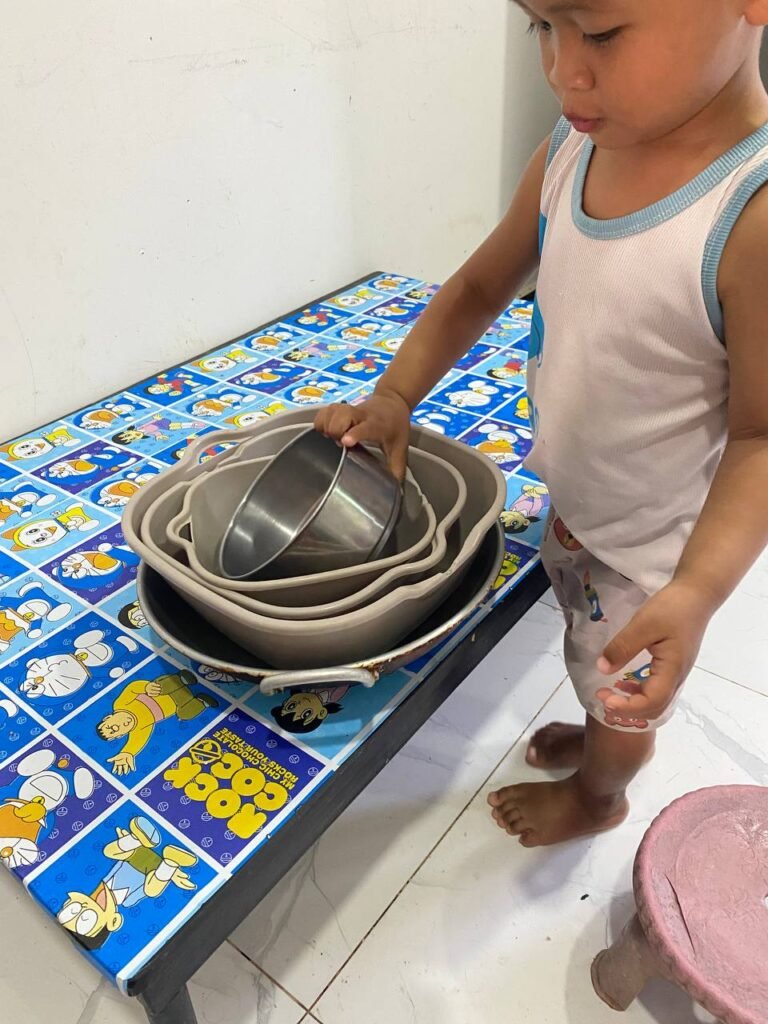
When a large bowl would not fit inside a smaller one, he switched them around without any help.
That is early math in real life: understanding size, order, and how objects relate to each other in space.
Stacking those awkward shapes also demanded real concentration and fine motor skill development.
He had to grip the rim of the basin, balance it carefully, and set it down gently so the tower would not fall.
Those are the same hand muscles he will use to hold a pencil or button a shirt in a few years, and he was building them right there at the kitchen table.
This kind of hands-on learning at home is what Montessori educators have championed for decades: give children real objects, real consequences, and real problems to solve.
How to Safely Set Up Kitchen Play for Toddlers
After seeing how much he loved this, I realized not all kitchen items work the same way.
Here is what worked for us and what to avoid.
Mix Your Materials
The magic happened because I gave him both metal and plastic.
The contrast between the heavy, cold pan and the lightweight plastic baskets kept him engaged.
Different textures make stacking feel more interesting than a set of matching plastic blocks.
This kind of sensory play at home, where children explore weight, temperature, and texture together, supports focus and emotional regulation in ways that single-material toy sets often do not.
Look for Nesting Ability
The washing baskets were perfect because they fit inside each other.
If all three items are the same size, there is nothing to figure out, and toddlers lose interest fast.
You need a clear small, medium, and large set for the activity to stay challenging.
The Base Matters
My old frying pan worked perfectly because it is wide and heavy.
It anchored the whole tower so he could build upward without everything tipping.
A lightweight plastic bowl at the bottom would have collapsed on the first attempt.
Do a Safety Sweep First
Before letting your toddler explore the kitchen cupboards, check everything carefully.
I thought my Tupperware drawer was completely safe until I found a sharp vegetable peeler that had slid to the back.
Not toddler-friendly at all.
Run through this checklist before you start:
- Weight: Skip heavy cast-iron skillets. If one drops on the small toes, it is a trip to the ER. Stick to aluminum or stainless steel.
- Pinch points: Check tongs or any gadget with a spring mechanism that could catch small fingers.
- No glass: Even Pyrex can shatter. Keep it to metal, wood, and plastic only.
- No sharp edges: Run your finger around the rim of any item before handing it over.
The Victory Moment
After 15 minutes of focused work, he finished.
He had built a perfect tower: the big metal pan at the bottom, the beige baskets nested in the middle, and the smallest silver bowl balanced on top.
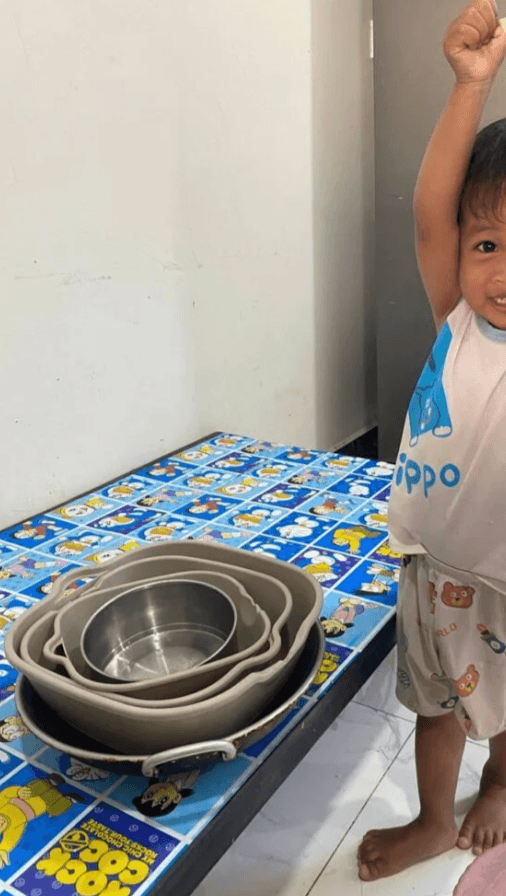
When he placed that last piece, he did not just smile.
He threw both hands straight up in the air.
A pure “I did it” moment.
Looking at his face, you would have thought he just won a race.
That is the kind of confidence that only comes from figuring something out completely on your own, with no help and no instructions.
Why Everyday Objects Often Teach More Than Expensive Toys
One of the biggest questions parents ask is: Why do toddlers ignore expensive toys?
The honest answer is that many modern toys do the thinking for the child.
They light up, play a song, or buzz when the wrong piece is pressed.
They remove uncertainty, which also removes the learning.
Household items like frying pans and plastic baskets have no built-in answers.
A toddler has to observe, test, fail, adjust, and try again.
That cycle of trial and error is the exact process that builds problem-solving skills, patience, and confidence.
The best kitchen toys for toddlers are often not toys at all.
They are objects with different sizes, weights, textures, and shapes that fit together in ways children have to discover for themselves.
In 2026, more parents are intentionally choosing these kinds of screen-free toddler activities at home, stepping back from stimulation-heavy toys in favor of simple, open-ended materials that let children lead their own learning.
I could have walked in at 8:00 AM and said, “No, put those back.”
I could have handed him a truck and stuck to my rule about keeping the kitchen off-limits for play.
But if I had, I would have broken his focus, cut short a real learning moment, and missed that proud smile.
The next time your toddler reaches for the pots and pans, maybe say yes.
You might be surprised by what happens.
And you might just get 15 minutes of blessed silence, too.
Frequently Asked Questions
Is it safe for toddlers to play with pots and pans?
Yes, with the right precautions. Choose lightweight aluminum or stainless steel items and avoid heavy cast iron that could injure small feet if dropped. Remove any utensils with sharp edges, springs, or pinch points.
Never allow glass items, including Pyrex, as these can shatter. Do a safety check of any drawer or cupboard before giving your toddler access to it.
What do toddlers learn from stacking and nesting toys?
Stacking and nesting activities teach early math concepts, including size comparison, sequencing, and spatial reasoning. They also build fine motor skills as children grip, balance, and place objects carefully.
When a toddler figures out that a large bowl fits inside a smaller one, they are independently solving a size and shape problem without any adult instruction.
Why does my toddler prefer everyday objects over expensive toys?
Everyday household objects are open-ended, meaning there is no predetermined “right” way to use them. This makes them more mentally engaging than many commercial toys, which often have limited functions or built-in feedback.
A frying pan and a few bowls can become a stacking tower, a drum, a pretend meal, or a puzzle, depending on what the child imagines. That creative freedom holds attention far longer than a single-function toy.
What are the best household items for toddler play?
Good options include lightweight metal or plastic bowls, stacking cups, measuring cups and spoons, plastic containers with lids, wooden spoons, and silicone baking molds. Look for items that vary in size, weight, and texture.
Avoid anything with sharp edges, glass, heavy cast iron, or small parts that could be swallowed.
How is this different from Montessori activities for toddlers?
The core idea is the same. Montessori activities for toddlers at home are built around giving children real objects with real properties, letting them explore independently, and resisting the urge to jump in and correct.
Using a real frying pan and real plastic baskets rather than toy versions follows this philosophy closely. The child gets genuine sensory feedback, genuine problem-solving opportunities, and genuine satisfaction when they succeed.
At what age can toddlers start playing with kitchen items?
Most toddlers around 18 months and up can safely explore supervised play with lightweight kitchen items.
By age 2, most children have enough grip strength and coordination to stack, nest, and sort objects meaningfully. Always supervise closely and remove anything sharp, heavy, or breakable before play begins.
Disclaimer: I am a parent and a university educator, not a licensed child psychologist or pediatrician. This guide is based on my personal parenting experience and educational background. Always consult your child’s teacher or pediatrician for professional advice regarding your child’s educational development.
