



Every evening at 7:00 PM, my family sits down for dinner.
After a quick break, my daughter and I start what we jokingly call “Home Academy” at 7:45 PM. It’s our learning time, and I take it seriously.
But last week, something unexpected happened. My 2-year-old son wasn’t having it. He didn’t want to be left out.
He marched in wearing his favorite orange shark shirt, grabbed his sister’s old notebook, and plopped down next to us. He was ready to learn.
What Is Pretend Reading in Early Literacy?
That’s when things got interesting. My daughter started reading out loud, and my son joined in. Sort of.
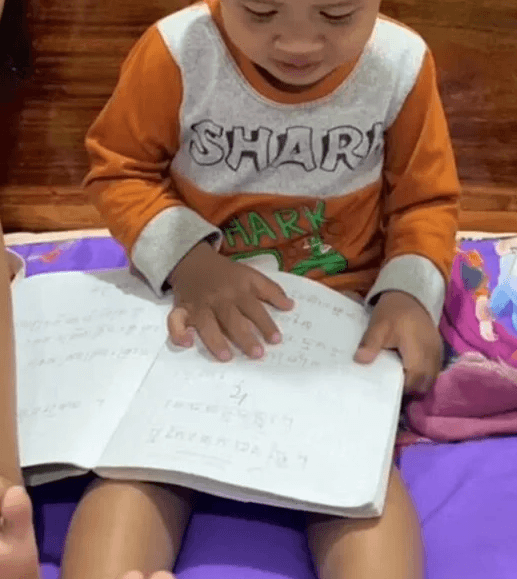
“Ahh… Ahh… EE… Ou…”
Not real words. But he copied everything else, her volume, her pauses, even the rhythm of how she spoke.
And he looked completely serious about it.
This is called pretend reading. It happens when toddlers mimic the act of reading before they actually can.
They hold books, turn pages, point at pictures, and make sounds like they’re telling a story.
It looks like playing. But it’s one of the most important early literacy activities a toddler can do.
Is Pretend Reading a Sign of Intelligence?
Watching my son “read” made me wonder if he was ahead of the curve.
But after looking into it, I realized pretend reading isn’t really about being gifted or advanced.
It’s about something better: interest.
When toddlers pretend to read, they’re showing that they want to be part of the reading world.
They already see books as important, fun, or worth paying attention to.
That attitude matters way more than whether they can recognize letters yet.
So, is pretend reading a sign of intelligence?
Maybe. But it’s definitely a sign that your child is watching, absorbing, and quietly building early literacy skills without even realizing it.
The “Point and Name” Game (And Why It Matters)
My son interacts differently depending on what kind of book is in front of him.
With his sister’s notebook, he scribbles. But with his colorful alphabet books, he plays what I call the “Point and Name” game.
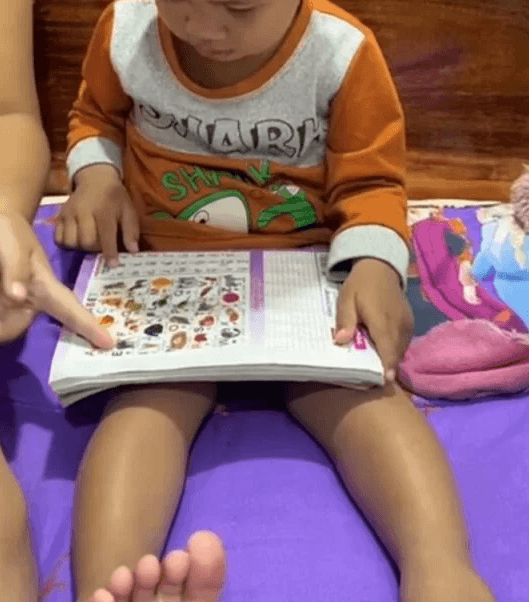
Watch a toddler with a picture book, and you’ll notice they use their index finger like a tool. My son does this constantly.
He stops mid-“sentence, jabs his finger at a picture of a lion or a piece of fruit, and looks at me.
That moment is actually a big deal. He’s isolating a concept. He understands that this specific drawing connects to a real thing in the world.
For parents trying to encourage this, I’ve found that busy books work best.
Books with grids of pictures, things like animals, foods, or household items, give his little finger a target to land on.
When he points, I give him the word right away.
He points to the cat. I say, “Cat.” He tries, “Ca.”
It feels like a game to him. But he’s building vocabulary. He’s not just looking at the page. He’s starting to decode it.
How My Son Showed Print Awareness Without Knowing It
At one point during his performance, my son stopped and pointed at something in the notebook.
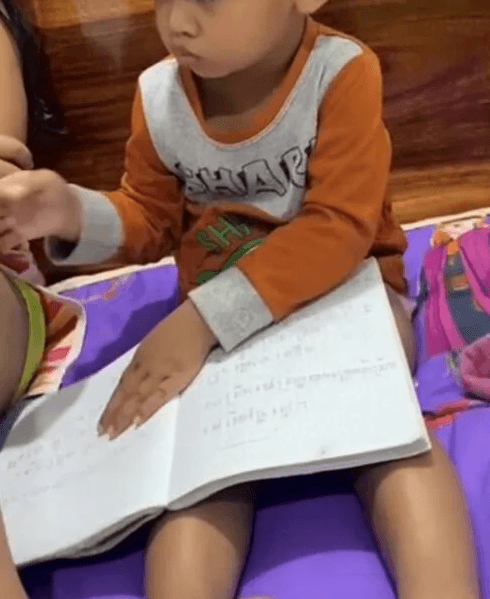
He made a sound, then looked up at me like he was asking, “Is this right?”
That tiny moment is called print awareness.
What Is Print Awareness for Toddlers?
Print awareness is when a child starts to understand that marks on a page have meaning, that books are read in a certain direction, and that pictures and words are connected.
My son can’t read yet. But he already knows the squiggles and images on the page mean something.
He’s figuring out the rules just by watching us. And the best part? I didn’t have to teach him. He learned it by crashing our study session.
How to Develop Print Awareness Without Flashcards
You don’t need special programs or apps.
Here’s what actually works, based on what I’ve seen at home.
- Let them join in. When older siblings are reading or doing homework, let the little one sit nearby. They absorb more than you’d think.
- Point while you read. Run your finger under the words during bedtime stories. It shows them that reading moves from left to right.
- Let them turn the pages. It teaches them that books have a flow and an order.
- Don’t correct their pretend reading. If they’re holding the book upside down and babbling, that’s fine. They’re practicing.
- Ask questions about pictures. “What do you see here?” helps them connect images to meaning.
- None of this feels like work. It feels like family time. And that’s exactly the point.
Designing a “Home Academy” Where Toddlers Are Welcome
A lot of parents ask how I get a 2-year-old to sit still for more than thirty seconds.
The honest answer? I don’t force it. But I do set up the environment so it’s easy for him to join.
Our Home Academy isn’t a rigid desk setup. We usually sit on the bed or a soft rug, and that’s intentional.
A tall dining table would physically exclude him. He’s too short to see the books, and being strapped into a high chair makes everything feel like a chore instead of a choice.
By bringing things down to his level, the barrier disappears.
A few things that help:
- Comfort first. We use soft bedding or a mat. If he wants to roll around, he can. If he wants to sit up and read, he can do that too.
- Let him wear what makes him feel ready. If the shark shirt gives him confidence, that’s his uniform.
- Give him his own prop. If his sister has a pencil, he gets a crayon. If she has a textbook, he gets a notebook.
If you want your toddler to care about reading, lower the barriers.
Books sitting on a shelf that they can’t reach? They won’t care. Books right there on the mat, waiting to be opened? They can’t resist.
Why I Didn’t Kick Him Out
Part of me wanted to say, “Buddy, go play. This is your sister’s time.”
But I didn’t. And I’m glad.
Right now, my son is building his identity.
He sees himself as a learner. He sees himself as someone who can do what his sister does. That confidence is fragile, and I’m not going to chip away at it.
In a few years, he’ll be reading for real. And I think he’ll remember these nights.
The nights he “read” next to his sister in his shark shirt, making sounds that didn’t quite mean anything but somehow meant everything.
The Real Lesson
Pretend reading isn’t just noise. It’s not just cute. It’s your toddler running a practice version of literacy inside their brain.
They’re trying on the identity of a reader, experimenting with sounds and symbols, and learning that books are worth their attention.
So if your 2-year-old grabs a book, babbles at the pages, and looks up at you like they just recited poetry?
Play along. Nod. Smile. Maybe even clap.
They’re not faking it. They’re practicing for the real thing.
And that’s worth celebrating.
Disclaimer: I am a parent and a university educator, not a licensed child psychologist or pediatrician. This guide is based on my personal parenting experience and educational background. Always consult your child’s teacher or pediatrician for professional advice regarding your child’s educational development.
