



My two-year-old son has an unofficial title at home: Chief Negotiator. And for a long time, something as basic as setting boundaries with a 2-year-old felt like declaring war every single time we left the house.
Parking lots were a wrestling match. Restaurants felt impossible. I was exhausted, he was furious, and I couldn’t figure out where I was going wrong.
Then it hit me. The problem wasn’t him. It was me.
I teach future managers at the university. Part of that is helping them understand how to bring new employees onto a team properly: orientation, shadowing, and hands-on practice.
You’d never hire someone, point them at a complicated machine, and yell at them for pressing the wrong button.
So why do we expect toddlers to follow brand-new rules perfectly the first time?
This four-step method, borrowed from Human Resource Development, changed everything for us. It works on safety rules, public behavior, and mealtime, all of it.
Why Public Tantrums Aren’t Really About Defiance
Toddlers don’t hate rules. What they hate is sudden transitions.
Child development experts call this a lack of “cognitive flexibility.” When you drop a new rule on a toddler mid-situation with zero warning, their brain simply can’t process the shift.
One second, they’re excited to get out of the car. The next, someone’s grabbing their hand and barking instructions they’ve never heard before.
Of course, they resist. Wouldn’t you?
Public tantrums almost always follow the same pattern: a new expectation, zero preparation, and a confused kid. Fix the preparation, and you fix most of the problem.
The 4-Step Method for Setting Boundaries with Toddlers
This process works for any new rule, whether it’s parking lot safety, sitting at the table during meals, or keeping their hands to themselves at the store.
Step 1: Have the Talk Before the Moment Hits
The worst time to introduce a rule is when you’re already in the middle of the situation.
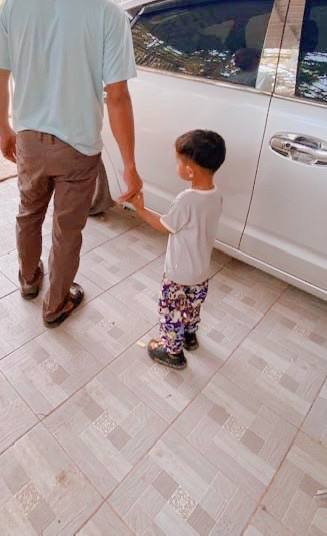
If you wait until cars are passing to tell your toddler they need to hold your hand, you’ve already lost.
Before you leave the house, get down to their eye level and have a calm, simple conversation.
Something like: “When we get out of the car, you need to hold Daddy’s hand. The cars are really big, and it’s my job to keep you safe.”
Keep it short. One or two sentences are enough. Toddlers don’t need a lecture; they just need to know what’s coming.
Step 2: Show Them What It Looks Like
New employees learn by watching someone else do the job first. Toddlers work exactly the same way.
My eight-year-old daughter has become what I call the “Assistant Manager.”

Before I expect my son to hold my hand in a parking lot, I make sure he sees his sister doing it first. “Look how your sister is holding my hand! She’s staying so safe!” That’s usually all it takes.
No older sibling? No problem. Model it yourself. Walk his favorite stuffed dinosaur on a pretend leash. Act it out together. Make it visual and keep it fun.
Step 3: Practice When the Stakes Are Low
You wouldn’t send a student pilot on a commercial flight on day one. You practice somewhere safe first.
We turn it into a game at home. “Let’s pretend we’re walking through the parking lot!” The “store” is just the couch.

We walk together, I cheer, he laughs. By the time we’re in a real parking lot, his body already knows what to do.
That repetition builds real muscle memory.
Step 4: Correct Gently, Praise Immediately
Your toddler will still mess up. At two years old, impulse control is basically nonexistent, and that’s completely normal.
When my son lets go of my hand, I don’t yell. I stop walking, wait a beat, and say calmly: “Oops! Our rule is to hold hands.
We can’t walk until you’re holding my hand.” The second he grabs back on, I praise him right away: “Thank you! You’re being so safe right now.”
Yelling spikes their stress, and a stressed toddler can’t learn a thing. Praise what you want to see more of. Correct the mistake. Move on.
The One Thing That Makes or Breaks All of This: Consistency
You can follow every step perfectly, but if you’re inconsistent, it won’t stick.
If holding hands in the parking lot is the rule on Monday, it has to be the rule on Saturday too, even when you’re tired, even when you’re running late, even when your arms are full of groceries.
The moment you let it slide, your child will test that boundary again. To them, it was never a real rule to begin with.
Consistency isn’t about being rigid. It’s about being trustworthy. When your child knows exactly what to expect, they feel safe.
Where This Approach Really Makes a Difference
Once you’ve run through this method a few times, it starts to feel automatic. Before any new situation, just ask yourself: Have I told them what to expect? Have I shown them what it looks like? Have we practiced somewhere safe?
A few places where this approach changes things fast:
- Walking through busy parking lots
- Getting through a restaurant meal without a meltdown
- Staying close in grocery stores or shopping malls
- Using an inside voice in quiet places
- Keeping their hands to themselves around other kids or pets
After a while, kids who are used to being “onboarded” into new expectations will actually start asking questions before new situations.
That’s when you know it’s working.
Making It Work When You’re Already in the Middle of a Meltdown
The four-step method is a prevention plan. If you’re already mid-meltdown, the goal is just to get through it calmly.
Get down to their eye level. Use a quiet voice. Name what’s happening: “I know you’re upset. We still need to hold hands.” Then wait it out.
Matching their energy won’t help. Threatening consequences they can’t understand won’t either. Just hold the boundary without turning it into a power struggle.
Toddlers aren’t trying to make your life hard. They’re just new here.
They learn best with patience, repetition, and a little bit of fun. Setting boundaries doesn’t have to feel like a daily war.
Try this with just one rule this week. Prepare, model, practice, praise. See what happens.
Disclaimer: I am a parent and a university educator, not a licensed pediatric psychologist. This article is based on my personal parenting experience and academic background in Human Resource Development. Always consult your pediatrician for professional advice regarding your child’s behavior and development.
