


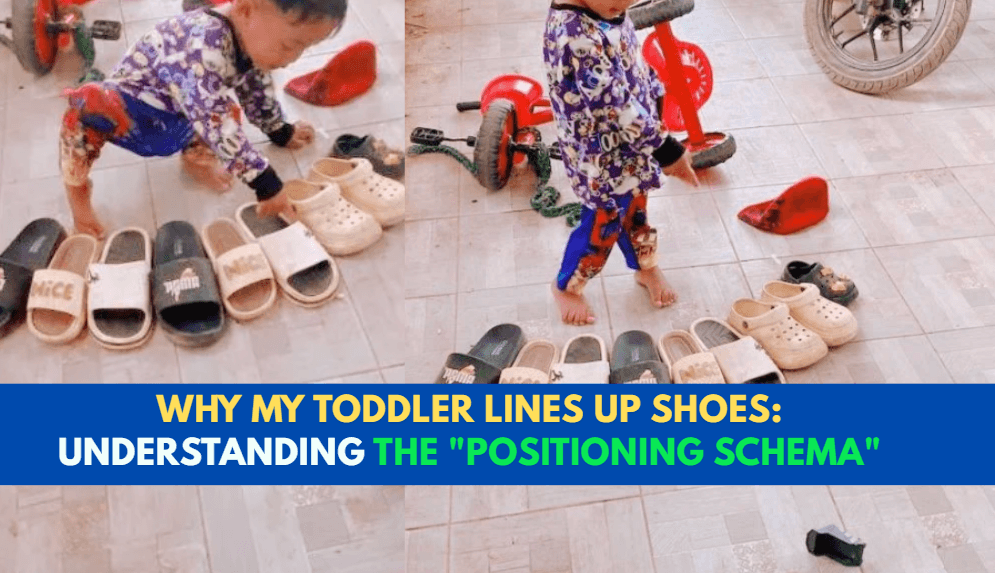
This morning, I walked onto my patio expecting the usual chaos.
Tricycle in the middle of the floor, bikes shoved in the corner.
But in the middle of that mess, I found something surprisingly orderly.
My two-year-old, wearing Spiderman pajamas and no shoes, stood there surveying his work.
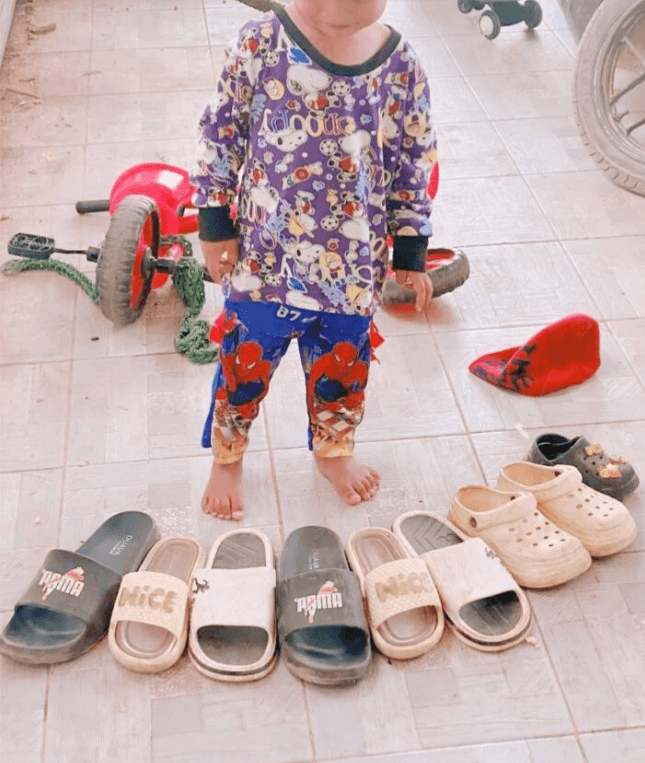
He had lined up every pair of sandals he could find — my slides, his mom’s sandals, his Crocs — all in a perfect row.
He didn’t just throw them down.
He placed each one carefully, stepped back to look, then adjusted again.
If you have ever watched your toddler do this and wondered what on earth is going on, you are not alone.
Parents wonder about this behavior every single day — and the psychological reason behind it is genuinely fascinating.
Quick Takeaway
- Toddlers lining up objects is completely normal developmental behavior.
- It is driven by what child development experts call a positioning schema — a pattern of repeated behavior children use to make sense of the world.
- This habit builds early math skills, fine motor control, and a healthy sense of agency.
- It is not automatically a sign of autism. Context matters (see the FAQ below).
- The best thing you can do as a parent: let them finish without interruption.
It Is Not Just Playing — It Is a Positioning Schema
When a toddler lines things up, they are not making a mess or wasting time.
They are exploring what child development experts call a positioning schema.
A schema, in early childhood terms, is simply a pattern of behavior that children repeat in order to understand the world around them.
The concept comes from Jean Piaget’s theory of cognitive development and is widely used in early years education today.
When my son lined up those shoes, his brain was quietly working through a series of quiet questions:
- Can I make these stay in a row?
- Do these shapes fit side by side?
- Does this small shoe belong next to that big one?
He spent 20 minutes on those sandals.
For a toddler, that is an eternity.
He was completely locked in — what psychologists call a flow state — and that is exactly where deep learning happens.
Schema play like this is one of the most important things a toddler can do.
It is not random. It is the brain doing its job.
The Hidden Math Lesson Hiding on My Patio
I did not catch it at first, but my son was doing math.
Lining up objects is one of the earliest mathematical skills children develop.
When he placed his tiny Croc next to my big slide, he was practicing one-to-one correspondence, building simple patterns, and sorting objects by category — all without a worksheet or a flashcard in sight.
Research in early childhood education consistently shows that this kind of schema play lays the groundwork for number sense, spatial reasoning, and logical thinking.
These are skills that show up again years later in reading, writing, and formal math instruction.
No tutoring required. Just shoes on a patio.
Why Do Toddlers Line Things Up? It Is About Control
Here is something that gets overlooked in most conversations about toddler behavior: the world is enormous and overwhelming when you are two years old.
Toddlers cannot control when they eat, when they sleep, or when they get buckled into a car seat.
But this line of shoes?
He controls this.
By arranging objects in a row, toddlers create order in their own small corner of the world.
They decide where each object goes.
They set the rules.
That sense of agency and independence gives toddlers a real boost in confidence — and developmental psychologists consider it genuinely important, not just cute.
This is also why you should resist the urge to “fix” the line or suggest a better arrangement.
The moment you reach in and adjust things, you are taking that control away.
A Workout for Tiny Hands
Toddler lining-up behavior looks simple.
It really is not.
Positioning a shoe exactly next to another without knocking the whole line over takes real fine motor skill development.
I watched my son squat there, balanced on his toes, reaching out to place each shoe gently, then pulling his hand back carefully to avoid bumping the wall.
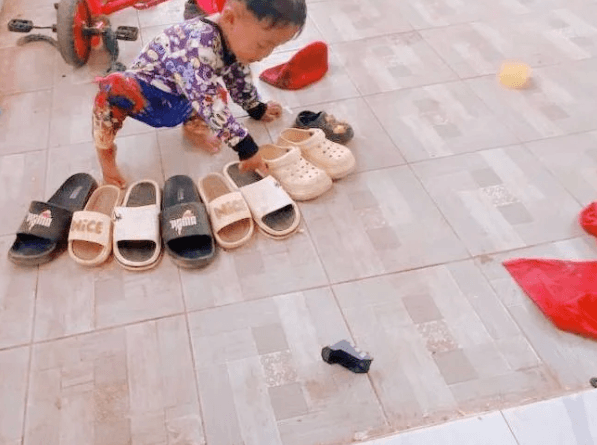
That takes hand-eye coordination, balance, and patience in a body that is still figuring out how all its parts work together.
These are the same muscles and neural pathways he will later use to hold a pencil, manage a spoon, and eventually tie his own laces.
Fine motor activities for toddlers do not need to be structured.
Often the best ones happen by accident, on a patio, with a pile of sandals.
How to Handle the Lining-Up Phase (What Actually Works)
My first instinct when I saw those shoes was to say, “Hey, put those back on the rack!” I am glad I stopped myself.
Here is what actually works:
1. Do not fix it
If the line is crooked, leave it crooked.
Let them figure out spacing and order on their own.
That problem-solving process is the whole point.
2. Watch and narrate
Stop for a moment, watch what they are doing, and then say something simple: “Wow, look at that long line you made!” You will see the pride on their face immediately.
Simple validation from a trusted adult goes a long way at this age.
3. Join the game on their terms
I tossed a few extra sandals into the pile to see what my son would do.
He was not annoyed.
He added them straight into his line, enjoyed the new challenge, and got to work adjusting.
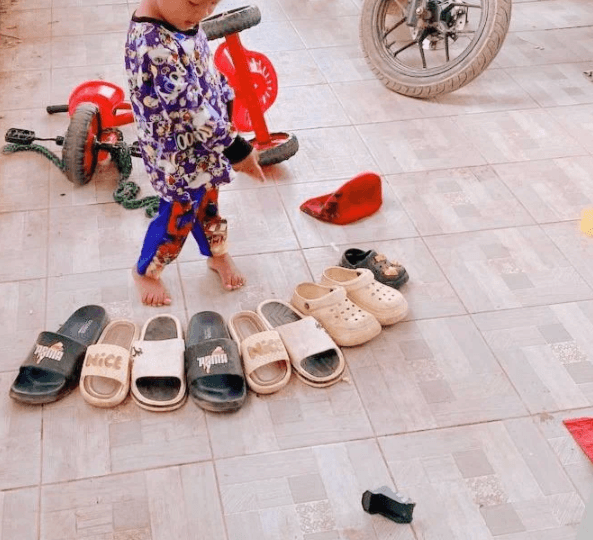
Following a toddler’s lead in play is one of the most powerful things a parent can do.
4. Give them time to finish
If you need to move them along, give a two-minute warning instead of interrupting mid-line.
The sense of completion matters to them more than it looks.
The Lesson from the “NICE” Sandals
There was something funny I only noticed when I looked at the photos later.
My sandals have the word “NICE” printed in big letters on them.
And honestly, it really was nice.
My house is usually a mess.
Laundry hanging up to dry, bikes tangled in the background.
But for this one moment, on this small patch of patio floor, everything was perfectly organized. My son had made an order out of chaos.
He looked down at his work, wiggled his bare toes, and walked away.
Completely satisfied.
Job done.
Me? I just had to figure out which pair was mine before I could leave the house.
The Bottom Line: Why Toddlers Line Things Up
The next time you find a careful row of toy cars stretching across your living room floor, or your toddler’s shoes arranged in order of size down the hallway, try to resist the urge to tidy it up.
That is not a mess.
That is your child’s brain doing exactly what it is supposed to do — building the early foundations of math, developing fine motor control, and practicing the deeply human need to create order in an unpredictable world.
Understanding why toddlers line things up changes how it feels to watch them do it.
It goes from a small frustration to something worth stopping for.
My son walked away from those sandals looking deeply satisfied.
I am starting to understand why.
Frequently Asked Questions
Is it normal for toddlers to line up toys and objects?
Yes, completely normal. Toddlers lining up toys, shoes, cars, blocks, or any other objects is a recognized, normal stage of child development.
Most children go through an intense lining-up phase sometime between ages 18 months and 4 years. It reflects schema-based learning, not a problem to be corrected.
Does lining up toys always mean autism?
Not at all. Lining up objects is a very common behavior in typically developing toddlers and is not, on its own, a sign of autism spectrum disorder.
That said, if lining up is the only type of play your child engages in, if they become intensely distressed when the line is disrupted, or if you are noticing other developmental delays, those are worth discussing with your pediatrician. A single behavior in isolation rarely means anything. Patterns and context matter.
What is a positioning schema?
A positioning schema is a repeated pattern of play behavior where a child explores putting objects in relation to each other — in lines, in groups, on top of each other, or in containers. It is one of several schemas identified in early childhood education research.
Children use schemas like this to build mental frameworks for understanding space, order, and how objects relate to one another.
What is one-to-one correspondence in toddlers?
One-to-one correspondence is the early math concept of matching one object to exactly one other object or position.
When a toddler places each shoe in its own spot in a line, they are practicing this foundational skill without any formal teaching. It is one of the building blocks of number sense and counting.
How long does the lining-up phase last?
There is no fixed timeline. Some toddlers go through an intense phase for a few months; others return to it on and off throughout the preschool years. As children develop more complex play skills and language, lining up often naturally gives way to more imaginative and social play.
If you are concerned that your child’s play is not developing and diversifying over time, a conversation with your pediatrician or a developmental specialist is always worthwhile.
Should I buy specific toys to encourage this kind of play?
You do not need to buy anything. Household objects — shoes, blocks, cups, crayons, toy cars — work perfectly.
If you want to gently extend this type of schema play, you can offer objects that sort naturally by size, color, or shape, and leave them accessible without directing how they should be used.
Disclaimer: I am a parent and a university educator, not a licensed child psychologist or pediatrician. This guide is based on my personal parenting experience and educational background. Always consult your child’s pediatrician or a qualified specialist for professional advice regarding your child’s behavioral or educational development.
