


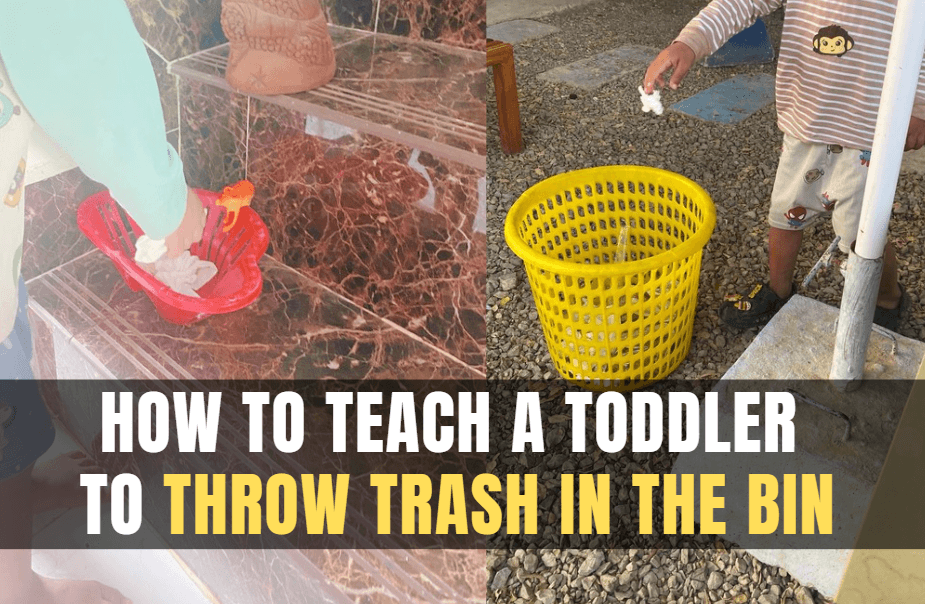
If you saw my 2-year-old walk across a gravel path, barefoot, to throw a used tissue into a bin, you might think I was simply lucky to have a well-behaved child.
I am not lucky.
I am a Professor of Human Resource Development who spent several months running a behavior change program on a toddler using a Pink Poodle as the primary training facilitator.
Allow me to explain.
The Problem With Telling Toddlers What To Do
Every parent has been there.
Your toddler is dropping trash on the floor, ignoring the bin entirely, and nothing you say seems to have any effect.
You are not alone — and the reason it is not working is not a discipline problem. It is an instruction problem.
In organizational training, we distinguish between two types of instruction: declarative and procedural.
Declarative instruction tells someone what to do. “Put the trash in the bin.”
Procedural instruction — the foundation of effectively teaching toddlers good habits — shows someone how to perform a task repeatedly, in context, until the behavior becomes automatic.
For adult learners, declarative instruction works reasonably well.
For a 2-year-old who is currently more interested in redistributing the contents of your living room than in waste management protocols, it does not work at all.
I tried telling him. Many times. In Khmer. With hand gestures. With pointing.
With the kind of patient, measured tone that I use when explaining complex organizational theory to university students.
He looked at me. He looked at the tissue in his hand. He put it on the floor.
I needed a different approach.
Phase 1: Simulated Training
In Human Resource Development, Simulated Training is a method where learners observe a model performing the target behavior in a realistic but controlled environment.
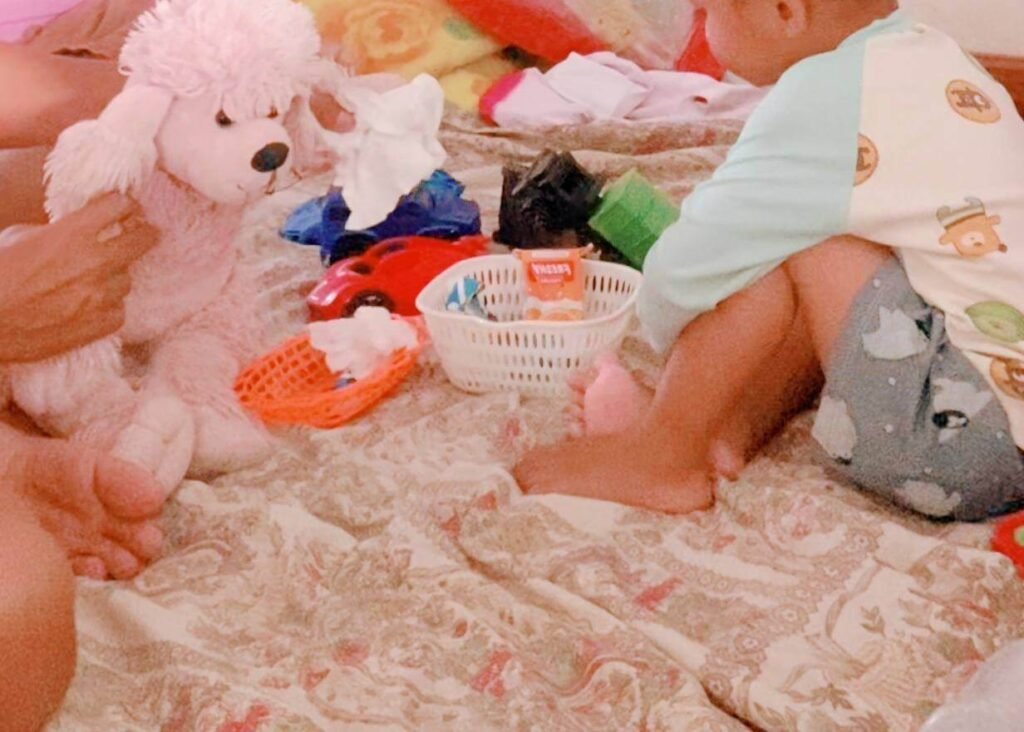
The learner watches, processes, and internalizes the behavior before being asked to perform it themselves.
For changing toddler behavior, this is one of the most underutilized techniques available to parents.
My simulation model was a pink stuffed poodle.
Almost every day, while the Head of Negotiations was playing, I would sit beside him and run the same scenario.
I would take a small piece of tissue or a wrapper.
I would hold up the Pink Poodle.
And I would make the Pink Poodle walk slowly and deliberately to the nearest small basket and drop the item inside.
This is modeling behavior for toddlers in its most practical form.
A toddler learns by imitation long before they learn by instruction — observational learning in young children is one of the most well-documented findings in developmental science.
The Pink Poodle was simply a more engaging model than I was.
I did this repeatedly. Day after day. Sometimes he watched with full attention. Sometimes he ignored me completely.
Sometimes he grabbed the Pink Poodle and used it for an entirely different purpose that was unrelated to waste management.
But I kept running the simulation.
I also redesigned the training environment.
I placed small trash baskets near the stairs, along the walls, and in his play areas — bringing the disposal points close to where the behavior needed to happen.
In behavioral science, this is called Environmental Design: reducing the distance between the impulse and the correct action until the correct action becomes the path of least resistance.
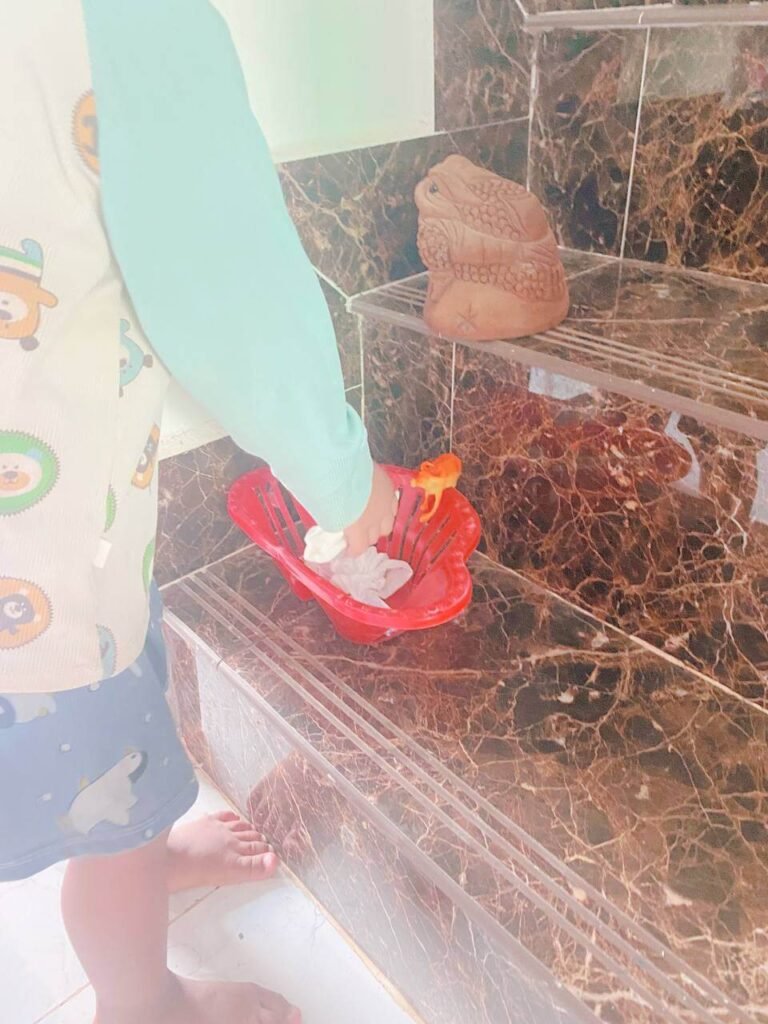
Where you place the trash bin for your toddler matters enormously.
A small basket in the toddler’s room, another near the play area, one at their eye level in the kitchen — these are not just convenient.
They are the infrastructure of the habit. The goal is to make good behavior easy for toddlers by engineering the environment before you ask anything of the child.
Gradually, something shifted.
He began to mimic what the Pink Poodle had been doing. Not perfectly. Not consistently. But the behavior was emerging.
It was time to move to Phase 2.
Phase 2: Field Testing
In any serious training program, classroom performance and field performance are two different things.
A trainee may perform perfectly in a controlled environment and fall apart the moment real-world conditions introduce friction, distraction, or discomfort.
This is why we test in the field.
Classroom training is only the beginning — what you really want to know is whether the behavior holds when conditions are imperfect.
I designed two field tests.
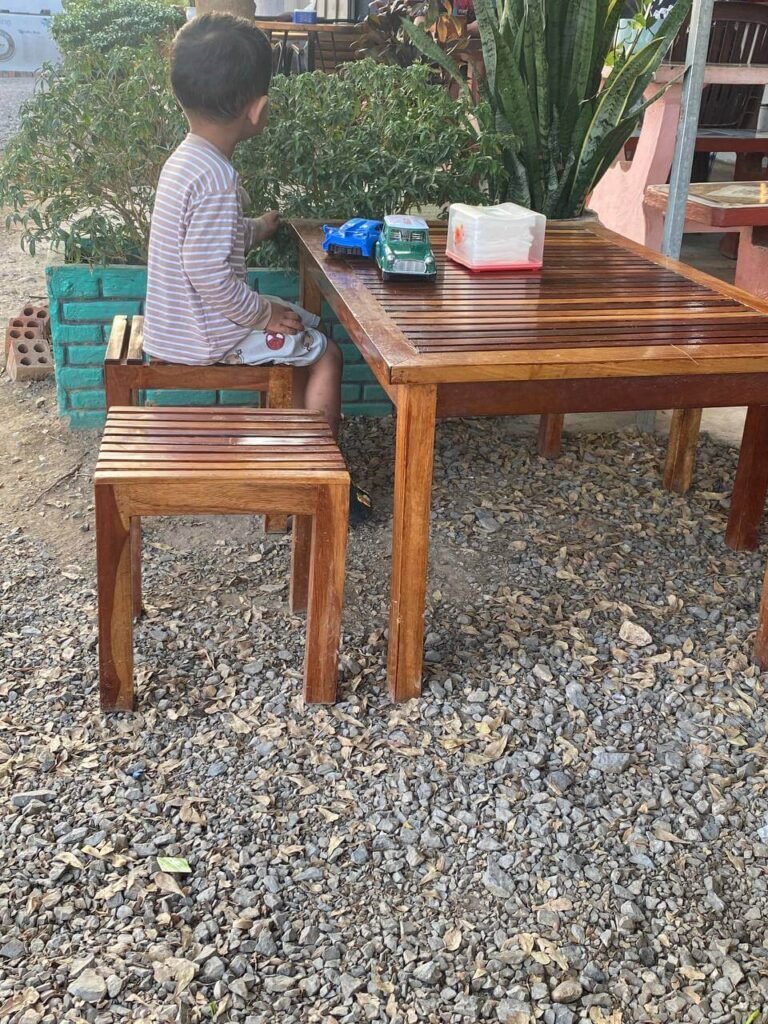
Both were conducted at a small café near our village in Battambang, a real environment with real variables that I could not fully control.
Field Test 1: The Chili Sauce Incident
Before we left for the café, I prepared a small amount of red chili sauce.
When the Head of Negotiations was distracted, examining the outdoor furniture with his usual professional thoroughness, I applied a small amount of chili sauce to the surface of his toy car.
I then presented the situation to him naturally.
“Look. What is that mess on your car?”
I handed him a tissue.
He examined the mess. He wiped the car.
And then, without any prompt from me, he walked to the nearest bin and deposited the tissue.
Test 1: Passed.
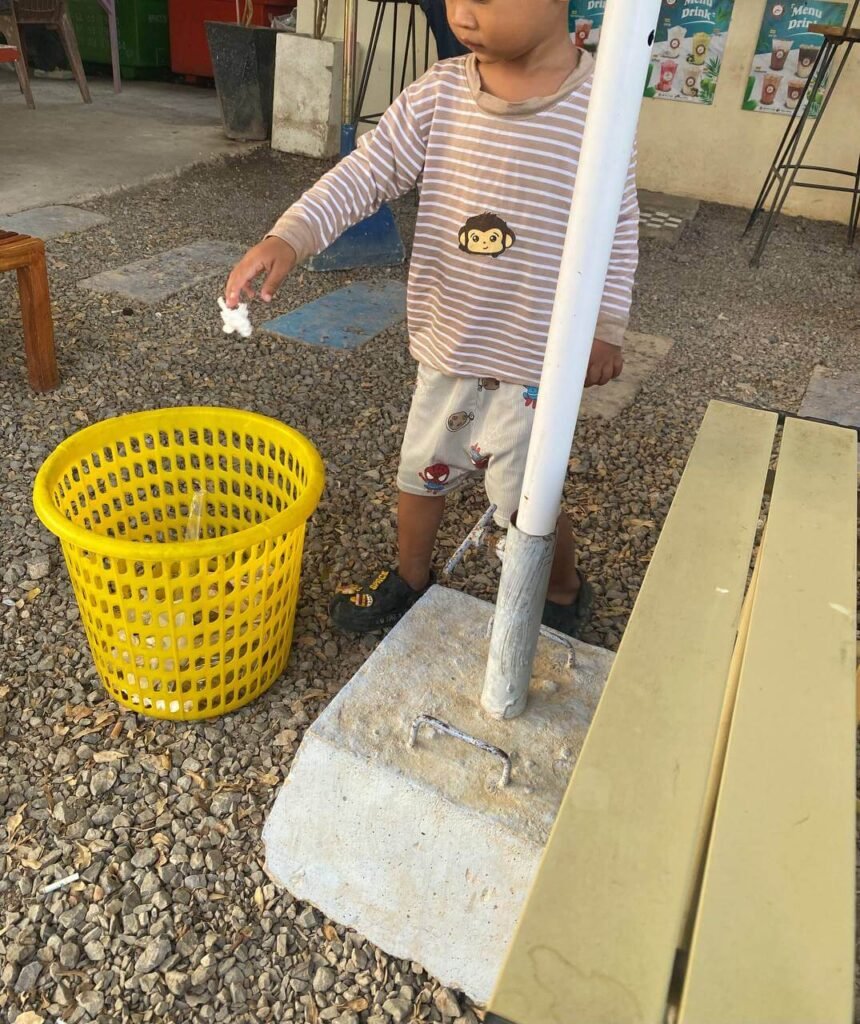
But I am a professor. One successful result does not constitute evidence.
I needed a second test under more challenging conditions.
Field Test 2: The Coffee Spill and The Pebble Obstacle
Two days later, we returned to the café.
This time, I introduced two variables simultaneously.
First, I pretended to accidentally spill a small amount of coffee on his hand.
I handed him a tissue. He wiped his hand: standard procedure, already established.
But then I introduced the obstacle.
Before he could walk to the bin, I quietly removed his shoes.
The café floor in that area was covered in small pebbles.
Not dangerous, but uncomfortable.
Unpleasant enough that a reasonable person, or a 2-year-old with other options, might simply drop the tissue where they were standing rather than walk across an uncomfortable surface to reach the bin.
I wanted to know if the habit was truly embedded, or only surface-level.
A behavior that disappears the moment conditions become slightly difficult is not a trained behavior. It is temporary compliance.
He looked down at the pebbles. He looked at the tissue in his hand. He looked at the bin.
He walked across the pebbles. Barefoot.
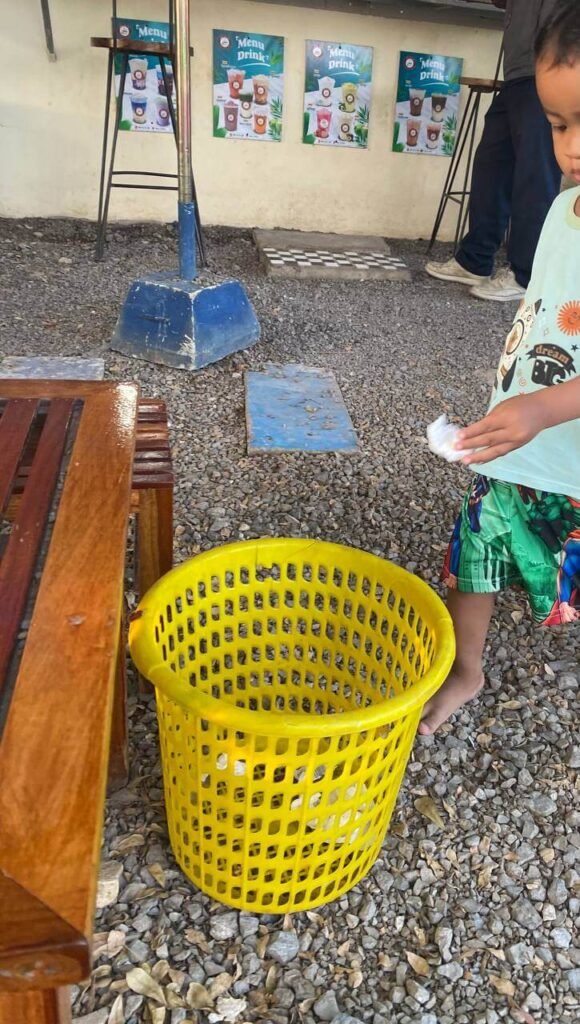
And deposited the tissue in the bin.
Test 2: Passed.
I put his shoes back on. He said nothing. He returned to his seat and resumed his work with the toy cars. He had absolutely no idea he had just passed a field competency assessment.
The Reality of Toddler Habit Training
I want to be completely honest with you, because this blog has always been about real results and not curated perfection.
He did not learn this in a day. He did not learn it in ten days. He did not learn it in a month.
How long does it take to teach a toddler a habit?
Longer than you think, and shorter than you fear — if you stay consistent.
The Pink Poodle ran that simulation for a long time.
The small baskets sat by the walls for weeks before he consistently used them.
There were days when he threw the tissue in the bin perfectly, and days when he looked directly at me and dropped it on the floor with the calm confidence of someone who has reviewed the policy and decided it does not apply to them today.
That is the nature of instilling habits in toddlers. That is, honestly, the nature of all training.
In HRD, we measure behavior change not by isolated performances but by trends over time.
Consistent parenting and consistent modeling are what produce consistent toddler behavior results.
The question is never “did they do it today?” The question is, “Are they doing it more consistently than they were three months ago?”
By that measure, the program is working.
What This Training Program Actually Requires
If you want to teach your toddler a habit — any habit — here is what I have learned from this process.
These principles apply whether you are teaching them to throw away trash, tidy up their toys, or build any other essential life skill.
1. Replace declarative with procedural
Stop telling them what to do. Show them what to do.
Repeatedly. With props if necessary. Using toys to model behavior is not a shortcut — it is developmentally appropriate.
A stuffed animal, a doll, a toy car — any model will do.
The Pink Poodle worked because she was consistent, available, and interesting to a 2-year-old.
2. Design the environment before you train the behavior.
Put the bin where the mess happens.
Put the basket where the toys are. Reduce the distance between the impulse and the correct action.
Make the right behavior the easy behavior.
Environmental design is not about decorating — it is about removing friction from the path of the habit you want to build.
3. Use simulation before live deployment.
Let them observe the behavior performed correctly — by you, by a toy, by an older sibling — many times before you ask them to do it themselves.
Observational learning is the foundation of imitation in young children.
Procedural learning for young children requires exposure before expectation.
4. Test in real conditions, not just at home.
A habit that only works in the living room is not yet a habit. Take it to the café. Introduce the pebbles.
Remove the shoes. See what actually happens when the conditions are imperfect.
Mastering the skill at home is the first step; the real world is the final exam.
5. Accept the irregular results.
Some days he does it. Some days he does not. This is not failure.
This is the normal distribution curve of early childhood behavior development.
Stay consistent. Stay patient. Keep running the simulation.
It is also important to note that while procedural training works wonders for physical tasks like throwing away trash, emotional regulation requires a different approach.
If you are struggling with meltdowns and want to teach your toddler how to manage big feelings, I use a completely different system involving visual cues and familiar characters.
6. Measure trends, not moments.
Do not evaluate your child’s progress on any single day. Look at the pattern across weeks and months. That is where the real data lives.
Success is less about any single technique and more about the discipline to keep showing up — to keep modeling, designing, and measuring — long after it stops feeling productive.
A Note on the Pink Poodle
She has been an excellent training facilitator.
Patient, consistent, never complains about working conditions, always available for another simulation.
In thirty years of education and professional development, she is one of the most effective training tools I have ever used.
She is also, I should note, currently missing one ear, an administrative matter that is still under internal review.
A Final Note
The Head of Negotiations does not know that he has been enrolled in a behavior change program since before he could walk steadily.
He does not know about the simulations.
He does not know about environmental design. He does not know about the chili sauce, the coffee, or the pebble obstacle course.
He just knows that trash goes in the bin.
Which is, ultimately, the only outcome that matters.
That is what good training looks like: not the process, not the methodology, not the Pink Poodle — but the moment when the behavior becomes so natural that the person no longer needs to think about it.
We are not there yet. But we are closer than we were.
And tomorrow, the Pink Poodle will run the simulation again.
FAQ: Questions Parents Ask About Teaching Toddlers to Use the Bin
How do I get my 2-year-old to put trash in the bin if they keep ignoring me?
Stop repeating the verbal instruction — it is not registering. Instead, demonstrate the behavior daily using a toy or stuffed animal as the model.
Place small bins within arm’s reach of where your toddler plays and eats. Make the correct action require less effort than dropping it on the floor.
The behavior follows the environment.
My toddler drops trash on the floor even after being told repeatedly. What am I doing wrong?
Nothing is wrong — you are using the wrong type of instruction. Telling a toddler what to do (declarative instruction) rarely produces lasting behavior change.
Showing them repeatedly, in context, with a tangible model (procedural instruction) is what builds the habit.
Shift from words to demonstration and give it several weeks of consistent practice.
When can toddlers start learning to throw trash in the bin?
Most children between 18 and 24 months have sufficient motor skills and observational ability to begin learning this habit.
The key is not to wait until they “understand” — start modeling the behavior with toys as early as 15–18 months. Understanding follows the habit, not the other way around.
How long does it take to teach a toddler to throw trash consistently?
Expect one to three months of consistent daily modeling before the habit becomes reliable.
Progress will be uneven — good days followed by days where they look directly at you and drop it on the floor anyway. Measure improvement across weeks, not individual days.
Can I use toys to teach toddler habits like bin use?
Yes — and this is one of the most effective methods available. Young children learn primarily through observational imitation.
A stuffed animal, doll, or toy character performing the target behavior repeatedly gives your toddler a concrete, engaging model to copy.
It works better than adult instruction for children under three because it operates at their level of attention and imagination.
Disclaimer: I am a parent and a university educator, not a licensed child psychologist or pediatrician. This guide is based on my personal parenting experience and educational background. Always consult your child’s teacher or pediatrician for professional advice regarding your child’s educational development.
