


If you have ever stepped in to fix your child’s mistakes before they even realized they made one, this article is for you.
In my years teaching Human Resource Development, I have relied on a concept called “the map is not the territory.”
The idea is straightforward: any plan you draw up on paper will never perfectly match the messy, unpredictable reality of the real world.
I usually illustrate this with corporate case studies and leadership frameworks.
But the clearest version of this lesson I have ever witnessed came from my eight-year-old daughter on a warm Sunday afternoon in the Cambodian countryside.
Stepping back and letting them navigate might be the most powerful investment you make in their future.
What Does Micromanaging Your Kids Actually Look Like?
Most parents who micromanage their children do not think of themselves that way.
They think of themselves as helpful. Involved. Caring.
And honestly, that instinct comes from a genuinely good place.
You love your child.
You can see the shortcut. You know the answer.
Why would you watch them struggle when you could just step in?
Here is the problem.
When you always step in, they never get the chance to figure things out on their own.
And figuring things out is exactly how children build confidence, develop problem-solving skills, and grow into capable, independent people.
The effects of overprotective parenting tend to show up later, and they are not easy to undo.
So how do you start breaking the habit?
Sometimes the best lessons arrive from the most unexpected places.
The Day My Daughter Drew a Map Like a Crab
We were visiting my grandmother’s house on the outskirts of the city.
After a long afternoon of catching up, my daughter announced she wanted to walk out to the rice fields.
We had visited those same fields a month earlier to watch the harvest, and she had been talking about going back ever since.
My grandmother looked at her with a little smirk and asked, “Do you remember the way?”
My daughter said yes. Immediately. No hesitation.
My grandmother was not convinced.
She slid a piece of grid paper across the table and said, “I don’t believe you.
Draw me the route.”
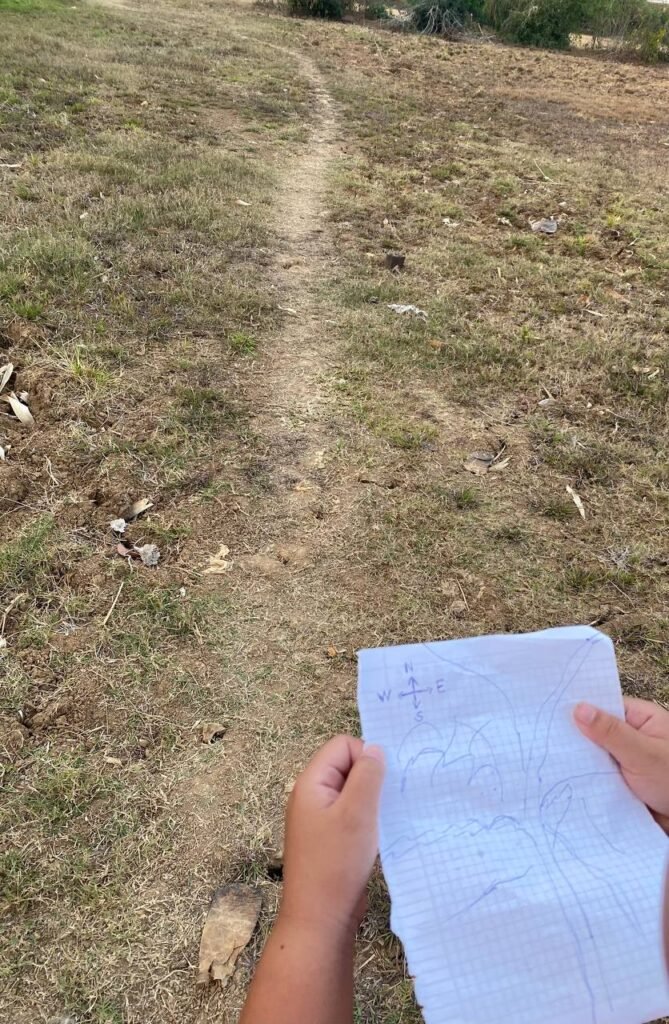
My daughter grabbed a blue pen and got to work.
What she produced was, in the most loving possible way, a total mess.
The lines zigzagged. The turns were more suggestions than directions.
My grandmother and I looked at each other and laughed.
We told her she had drawn a map “like a crab.”
But here is what I did not do. I did not redraw it for her.
I did not critique it.
I simply added the compass points (N, E, S, W) to give us a reference, handed her the paper, and said, “Lead the way.”
What Happens When the Territory Does Not Match the Map
This is where the real lesson about child independence began.
Rural dirt roads in Cambodia are constantly changing from month to month.
Tall grass and wild brush grow fast in the heat.
In just four weeks, the landscape had shifted enough to make familiar paths look completely different.
Her crab map was actually accurate, and her memory was solid.
The problem was that the territory had changed around her.
We hit three decision points on that walk, and each one turned into a quiet lesson in raising independent problem solvers.
Attempt 1: The Overgrown Path
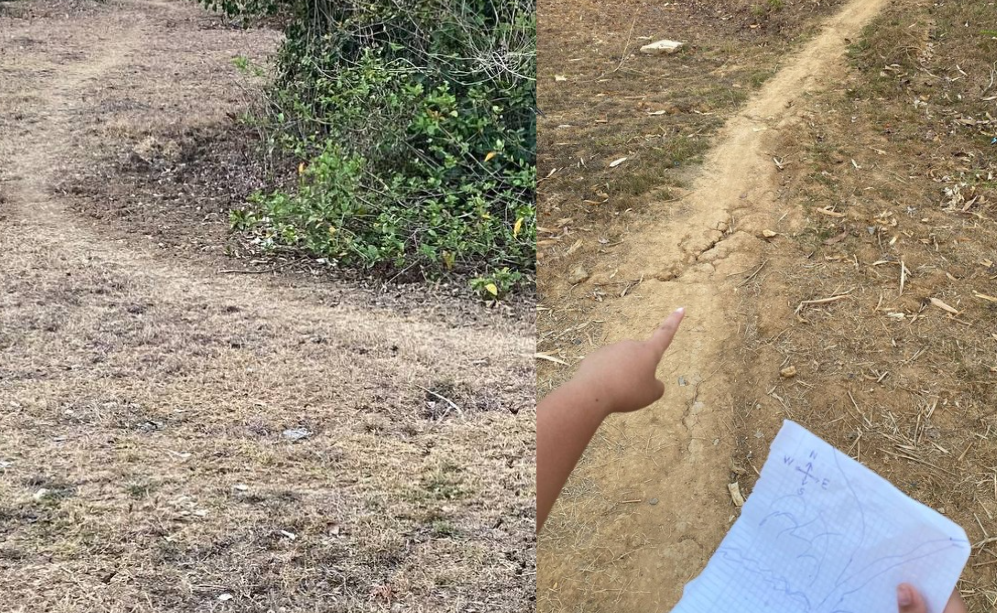
We came to a fork in the road.
This was, in fact, the exact path she had walked a month before.

But a thick wall of dry grass had grown over the trail.
The footprints were gone. It looked nothing like what she remembered.
She checked her map.
She shook her head. “I think we’re lost,” she said.
Every part of me wanted to say, “No, it’s right here, the grass just grew over it!” but I kept my mouth shut.
Attempt 2: The Brushy Forest Route
We tried a different direction.
This was also a valid path to the fields, but a cluster of young trees and brush had grown up along the sightlines, blocking the view she would have recognized.
She hesitated again. The changing environment was making her doubt her own memory.
She rejected this route, too.
Attempt 3: The Clear Road
Finally, we reached a third dirt path.
Local farmers had been using it regularly, so it was worn clear of overgrowth.
She could see down the dry, cracked dirt road.
She looked at the path. She looked at her crab map.
She pointed forward and said, “This is it.”
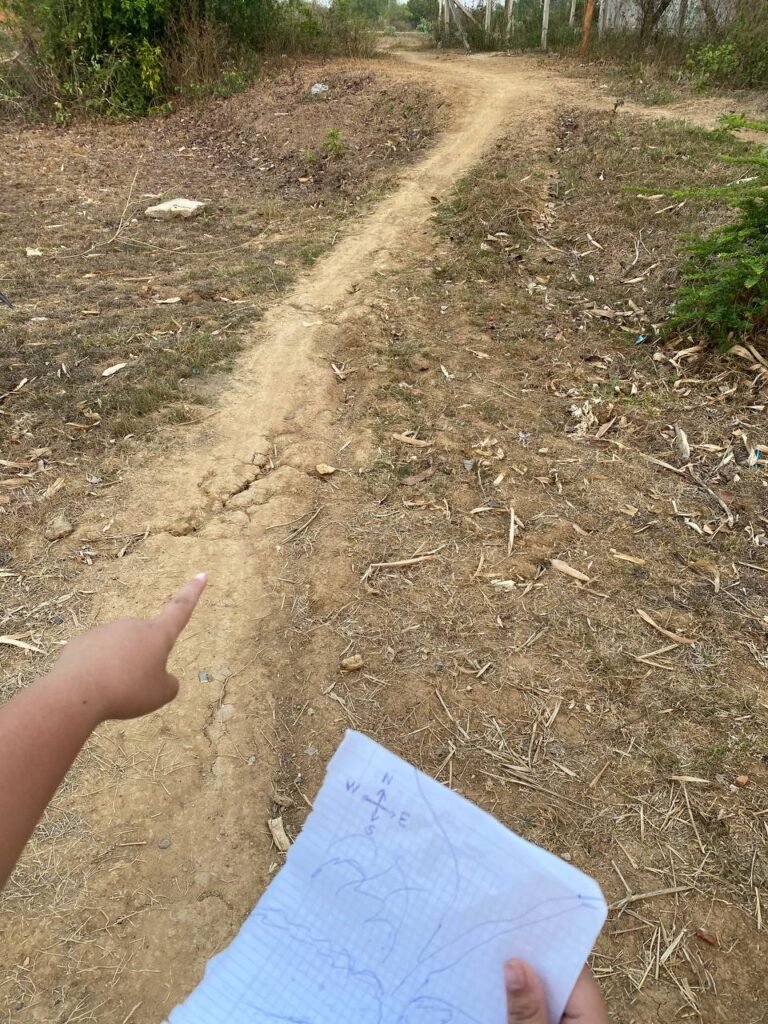
She was right. We walked straight to the rice fields.
What Happens to Kids Who Are Micromanaged?
The hardest part of that entire walk was the silence I had to hold at those first two attempts.
This is what micromanaging looks like in everyday parenting.
It is rarely dramatic.
It is just that small moment when your child is confused, you have the answer, and you open your mouth before they ever get the chance to look for it themselves.
When parents consistently step in too early, children miss the chance to develop the genuine problem-solving skills that only come through real experience.
Research consistently shows that kids raised under overprotective parenting tend to struggle with confidence, decision-making, and resilience as they grow older.
They begin to rely on adults to solve problems they are fully capable of working through themselves.
I teach this same principle to managers in leadership training: if you solve every problem for your team, your team never learns to solve problems.
The same is true for kids. When you let them feel stuck, even briefly, you give them the space to practice something that cannot be taught any other way.
She had to observe her surroundings.
She had to consult her resources.
She had to make a call and live with it.
She had to try again when the first answer was wrong.
That sequence is exactly how problem-solving skills develop and how you build a resilience that lasts well into adulthood.
HR Leadership and Parenting: More Connected Than You Think
For those who work in leadership or management, the overlap here is hard to miss.
The “map is not the territory” mental model is a cornerstone of adaptive leadership.
It teaches managers to hold their plans loosely, stay curious about how the environment is shifting, and trust their teams to navigate uncertainty without constant supervision.
Great managers do not hover.
They set a direction, hand over the tools, and trust the process.
Parenting and leadership share a lot of DNA.
In both cases, your job is not to guarantee the outcome.
Your job is to create the conditions where the person in front of you gets to grow.
When you pull back from micromanaging, both your team and your children develop something no shortcut can give them: the confidence that comes from solving real problems on their own.
How Do You Know When to Step Back and When to Step In?
If you are trying to break the micromanagement habit, you are probably asking: ” How do I know when to give space and when to help?
Here is a simple framework that works for me.
Step back when:
- The stakes are low. If your child gets it wrong, no one is in danger, and the consequence is manageable.
- The struggle looks productive. They are thinking, trying, and adjusting. They are not completely frozen.
- They have not asked for your help. This one matters a lot. If they did not ask, wait.
Step in when:
- There is a genuine safety concern.
- They are completely stuck and starting to shut down emotionally.
- They ask you directly.
Even then, try asking a question before giving an answer.
“What do you think we should try next?” goes a long way toward fostering autonomy in children without leaving them to struggle alone.
How Do You Raise an Independent Child? Start by Getting Out of the Way
By the time we reached the rice fields that afternoon, my daughter was beaming.
She did not just arrive at the destination.
She navigated there.
She made mistakes, reconsidered, and found the path herself.
That confidence she carried home was not something I could have handed her.
The moment I pointed to the right path, it would have become my victory, not hers.
Raising independent kids does not mean stepping away entirely.
It means knowing which moments are yours to fill and which ones belong to them.
It means trusting that the confusion is part of the process, not a problem to solve on their behalf.
It means letting kids figure things out on their own, even when every instinct you have wants to make it easier.
Child independence is not built through lectures or praise.
It is built through small, real, repeated experiences of working through something hard and coming out the other side.
The next time your child is standing at a fork in the road, literally or otherwise, try staying quiet for just a little longer than feels comfortable.
Let them look at their map. Let them get a little turned around.
The moment they find the way themselves is worth every second of silence.
Frequently Asked Questions
What is the difference between being involved and micromanaging your kids?
Being involved means staying present, offering guidance when your child asks for it, and creating a safe environment for them to grow.
Micromanaging your kids means stepping in before they have had the chance to try, correcting mistakes they have not made yet, or solving problems they are fully capable of working through on their own.
The key difference is ownership. An involved parent supports the child’s process. A micromanaging parent takes over that process, often without realizing it.
What are the signs that I am micromanaging my child?
The most common signs of micromanaging your kids usually involve stepping in before it is necessary. Look out for these behaviors:
- Finishing their sentences or tasks before they can complete them
- Feeling anxious when they struggle even briefly
- Correcting their work before they ask for feedback
- Making decisions for them that they could reasonably make themselves
- Feeling responsible for their emotional reaction to every outcome.
If you find it genuinely difficult to watch your child work through confusion without stepping in, that discomfort is worth paying attention to.
What happens to kids who are micromanaged long term?
Children who grow up in an overprotective parenting environment often struggle to develop confidence in their own judgment.
Over time, they can become overly dependent on adults for direction, avoid taking risks because failure feels catastrophic, and find it difficult to build the problem-solving skills they need in school, friendships, and eventually the workplace.
Research on helicopter parenting consistently links excessive parental control to higher rates of anxiety and lower self-efficacy in children as they grow older.
At what age should I start letting my child be more independent?
Child independence should grow gradually from a very young age, not begin at a specific age. Toddlers can choose between two outfit options.
Primary school children can pack their own bags and manage small responsibilities at home. By the time children reach the upper primary years, they should regularly be solving low-stakes problems on their own, navigating social situations, and experiencing natural consequences for their choices.
The goal is to slowly expand the circle of autonomy as your child demonstrates readiness, rather than waiting for a single milestone age to let go.
How do I stop the urge to step in when my child is struggling?
The most practical way to stop micromanaging in the moment is to pause and ask yourself two questions before you intervene:
- Is my child in genuine danger?
- And have they asked for my help?
If the answer to both is no, stay quiet and wait. What feels like harmful struggle to a parent is often productive failure for a child, the exact kind of experience that builds resilience, problem-solving skills, and real confidence.
It also helps to remind yourself that your child’s success only belongs to them when they are the ones who earned it.
Can micromanaging affect my relationship with my child?
Yes, and this is one of the most overlooked effects of overprotective parenting. When children feel constantly monitored, corrected, or controlled, they begin to associate the parent with pressure rather than safety.
Older children and teenagers especially tend to pull away from parents who micromanage, not because they do not want a relationship, but because they need space to develop their own identity. Stepping back, even in small ways, often brings children closer rather than pushing them away.
What is the right balance between guiding my child and letting them figure things out on their own?
The right balance shifts depending on your child’s age, temperament, and the situation. A useful framework is to match your level of involvement to the stakes involved.
For low-stakes situations where your child is safe and capable, let them figure things out on their own. For higher-stakes situations or moments where they are genuinely stuck and have asked for support, step in with a question rather than an answer.
Asking “What do you think you should try next?” keeps the problem-solving in their hands while letting them know you are there. Raising independent kids is not about doing less. It is about doing differently.
Disclaimer: I am a parent and a university educator, not a licensed child psychologist or pediatrician. This guide is based on my personal parenting experience and educational background. Always consult your child’s teacher or pediatrician for professional advice regarding your child’s educational development.
