


If you have ever wondered why toddlers resist change so dramatically, you are not alone.
Child development experts tell us that toddlers between 18 and 36 months rely heavily on predictable environments for emotional security.
When their known system disappears without warning, even something as simple as new furniture can feel like a full crisis.
I learned this the hard way.
There is a principle in Change Management that every HR professional knows, and most parents learn through experience.
It goes like this: it does not matter how good your new idea is.
If you do not communicate it to your team first, someone is going to riot.
I have taught this principle to university students for years and thought I had a complete understanding of it.
Then my two-year-old dismantled an entire wardrobe reorganization in four minutes, reminding me that I am not actually as good at this as I thought.
Three Years of Training in One Afternoon
I want to start with the part that actually went well because it deserves to be documented.

My daughter, the Assistant Manager, has been learning to fold and organize laundry since she was five.
Today, you could see the results of that investment.
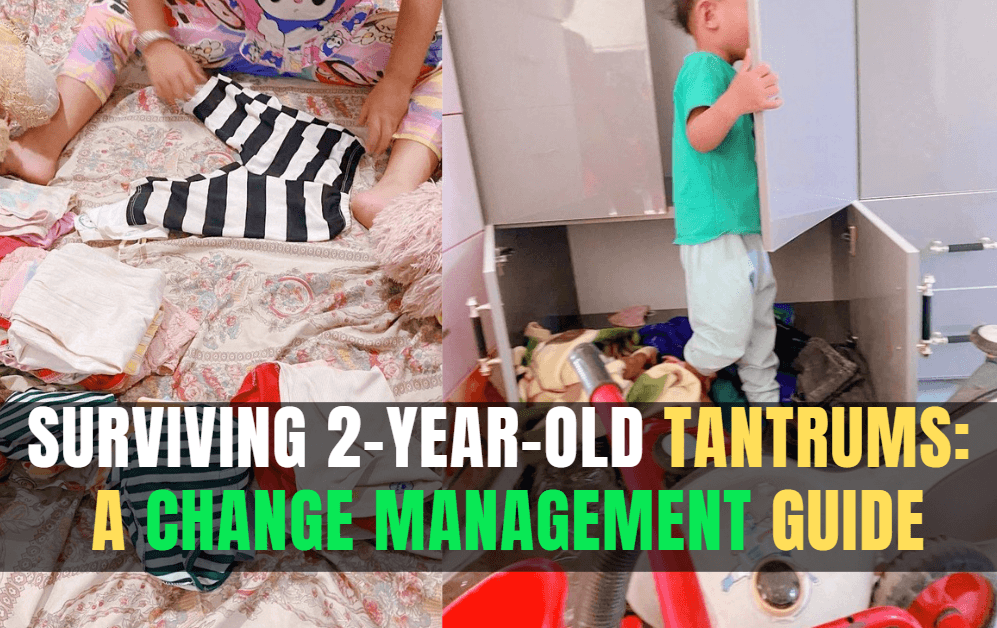
I gave her the laundry pile, and she sat right down on the floral bedsheets in her Kuromi shirt and got to work. No complaining, no negotiating.
She just started matching up the striped pants and stacking them perfectly.
In HR, we refer to this as the Unconscious Competence stage, where a skill becomes completely automatic.
But let us be honest as parents.
Watching a kid sit there for thirty minutes and actually fold clothes without whining feels like a literal miracle.
You might wonder where the Head of Negotiations was during all of this productivity.
His mother had taken him upstairs to play.
This was a strategic management decision.
If he had been in the room, my daughter would have spent two hours refolding those neat stacks of shirts.
Some team members just require physical separation from the workflow to maintain productivity.
The Critical Management Error
Here is where I made my mistake.
Last week, I replaced their old wardrobes with shiny new grey ones.
The Assistant Manager knew all about this.
She was consulted and prepared for the transition.
But the Head of Negotiations had not been briefed.
In the corporate world, this is a Stakeholder Communication Gap.
When you change things without telling someone, they experience it as a massive disruption instead of an upgrade.
After my daughter finished loading her neat stacks into the new wardrobe, she left for her English class.
The door was unlocked, and the Head of Negotiations came downstairs.
The Audit Begins
I watched him walk in.
He immediately sensed something was wrong.
His face shifted into a look of deep, professional suspicion.
He looked around and said one word.
“NaNa…?”
In toddler-Khmer, this translates roughly to, “Where are my things, and who authorized this?”
He went straight to the spot where his old wardrobe used to be.
That was his known system.
When he realized the familiar setup was gone, he was completely disoriented.
This reaction has a name in child psychology.
Researchers call it System Disruption Anxiety, and it is completely normal in two-to-three-year-olds.
Children at this developmental stage use familiar objects and routines as anchors for emotional security.
When those anchors disappear without warning, a toddler’s adjustment to a new environment does not happen smoothly.
It happens loudly.
He then spotted the new grey wardrobe.
He opened it, saw his sister’s careful work, and made his position on this unauthorized change absolutely clear.
The Emergency Review
He did not just pull the clothes out.
He conducted a formal protest.
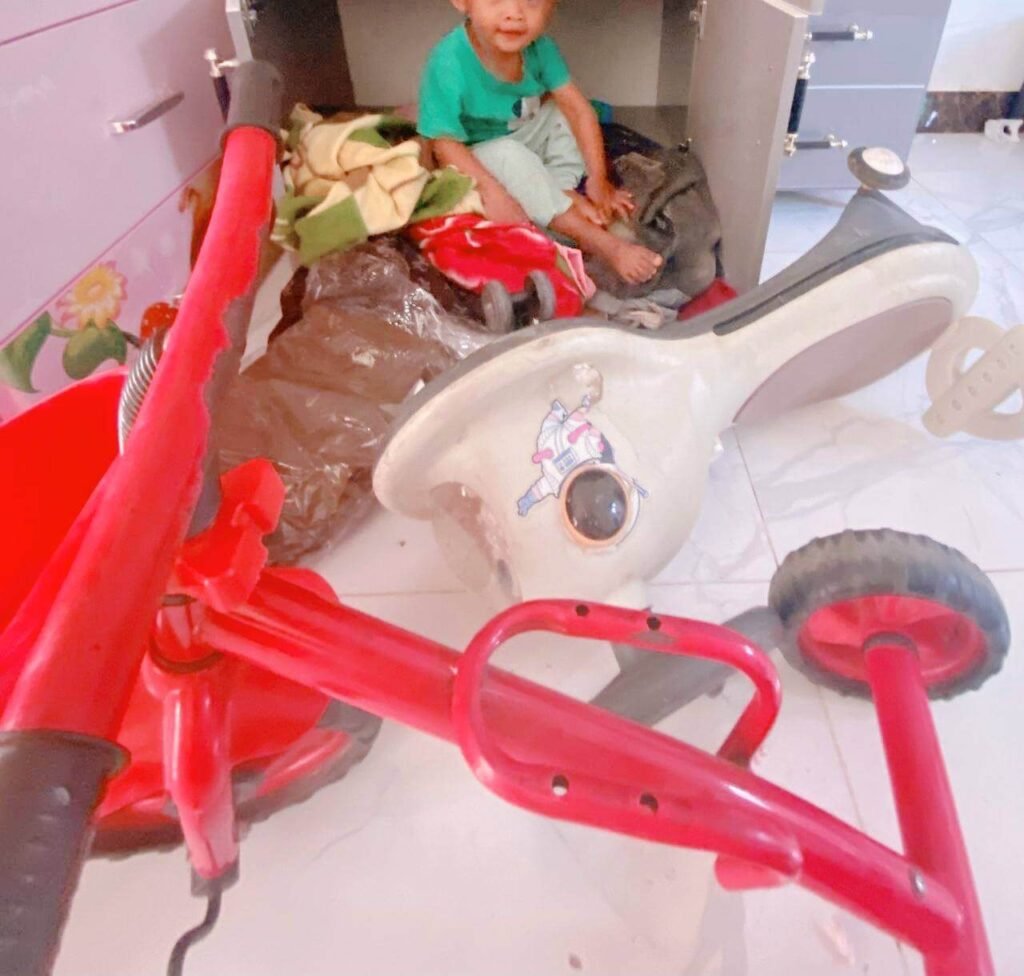
He literally climbed inside the empty bottom section of the wardrobe, stepping on blankets right behind his tipped-over red tricycle.
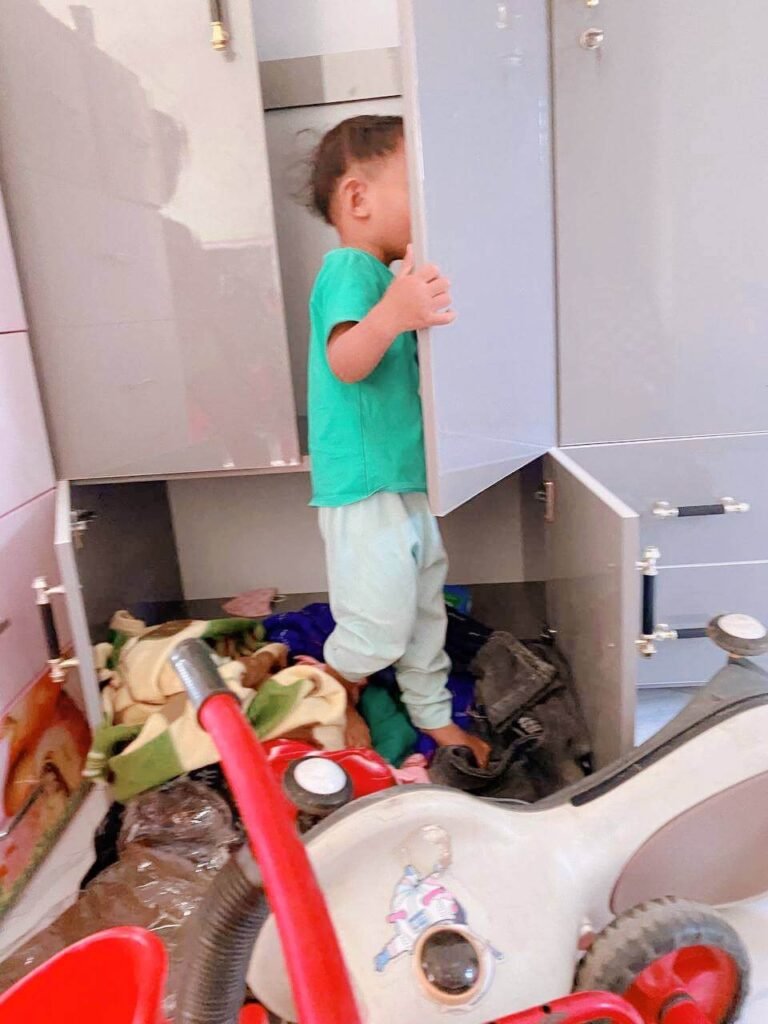
From that command post, he started dismantling the system.
He threw shirts on the floor. He tossed perfectly folded pants out into the room.
It was not random misbehavior.
It was a very clear message.
He was asking me how I could make a major restructuring decision without his input.
His resistance was actually just communication.
Understanding toddler behavior through this lens completely changes how a parent responds to it.
Accountability and Recovery
When my daughter came home from English class, she walked into the bedroom and just stared at the chaos on the floor.
She asked who made such a mess of her hard work.
I had to practice some leadership accountability right then and there.
I told her not to be angry with her brother because this was entirely Daddy’s fault for not telling him about the new furniture in advance.
She sighed, sat back down on the bed, and spent another thirty minutes reorganizing everything.
That kind of quiet resilience is exactly why she is the most reliable employee in the house.
That evening, I had to formally close the audit.
I sat with my son and properly introduced the new wardrobe. I showed him where his clothes lived now.
I let him touch the drawers and put a few items back himself.
Once he felt included, he was satisfied, and the new system was finally accepted.
When I teach Change Management, I tell my students that the quality of a change is only half the battle.
The other half is communicating it to absolutely everyone affected before it happens.
Size does not matter. If a stakeholder is left in the dark, they will resist.
The Parents’ Guide to Toddler Change Management
Before any future household restructuring initiatives, the Head of Negotiations will be formally consulted.
I might even bring visual aids. I just needed a two-year-old to remind me of my own lesson.
Here is the full framework for any parent navigating similar disruptions.
Tip 1: Communicate Early
Brief your stakeholders, meaning your toddlers, before making structural changes.
A simple conversation the day before is enough to prevent a full audit.
Toddlers process change much better with advance notice, even if that notice is brief.
Try: “We are getting a new wardrobe tomorrow, and your clothes will live here.”
Tip 2: Expect the Audit
Tantrums after a change are often just System Disruption Anxiety, not misbehavior.
Your toddler is not being difficult.
They are communicating that their emotional anchor has disappeared.
Reframe the reaction as information, and you will respond with patience instead of frustration.
Tip 3: Use Visual Aids
Show pictures of the new item before it arrives.
If you are replacing furniture, find an image online and show it to your child.
Let them see it, touch it in the store if possible, or help choose it.
Child psychology research consistently shows that children who preview a change accept it more easily.
Tip 4: Involve the Team
Let them touch and explore the new system so they feel a sense of ownership.
In my son’s case, letting him place a few items in the new drawers himself was the turning point.
Involving toddlers in household decisions does not need to be complicated.
It just needs to be intentional.
Tip 5: Give Formal Introductions
When a big change has already happened without warning, sit down and formally introduce the new system.
Show your child exactly where things live now. Walk through it together.
This mirrors how good managers handle post-change communication in organizations, and it works just as well at home.
Tip 6: Repair Quietly
Hold your older children accountable with grace, not frustration.
When my daughter came home to chaos, she had every right to be annoyed.
Modeling calm accountability and telling her the fault was mine taught her something more valuable than folding.
It showed her what leadership looks like after a mistake.
Frequently Asked Questions
Why do toddlers resist change so strongly?
Toddlers between 18 and 36 months rely on predictable environments for emotional security. Familiar objects and routines act as anchors that help them feel safe.
When those anchors are removed without warning, the disruption registers as a threat, which is why the reaction can feel completely out of proportion to the change.
Is a toddler’s tantrum about change considered normal behavior?
Yes, it is completely normal. It signals that your child is processing their environment and forming healthy attachments to their routine.
The behavior typically decreases as children develop stronger language skills and can better express their feelings.
How do you prepare a 2-year-old for changes at home?
Give advance notice, even just a day ahead. Use simple language and, where possible, show them a picture of what is changing.
Let them participate in small ways, such as placing items in a new space themselves. Children who feel included in a change are far more likely to accept it without resistance.
How long does a toddler’s resistance to a new routine last?
It depends on how the change is managed, but most toddlers adapt within a few days to a couple of weeks. Re-establishing their “emotional anchors” by giving them a sense of control—like letting them organize a drawer—can speed up this recovery.
Disclaimer: I am a parent and a university educator, not a licensed child psychologist or pediatrician. This guide is based on my personal parenting experience and educational background. Always consult your child’s teacher or pediatrician for professional advice regarding your child’s educational development.
