


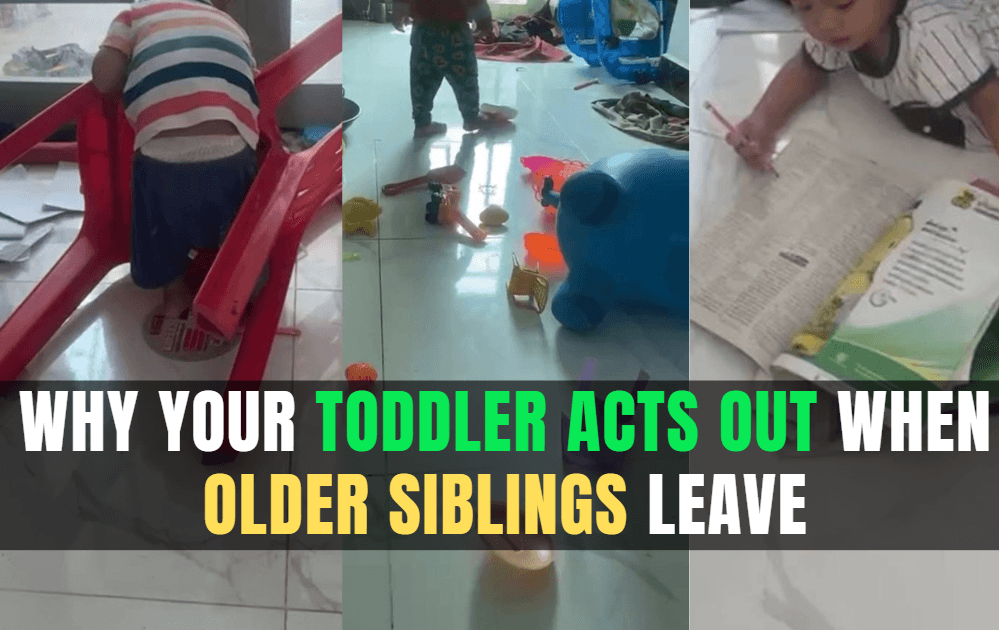
Ever wonder why your toddler acts out when their older sibling leaves the house?
In our home, it is not a tantrum. It is a hostile takeover.
Here is what happened when my daughter left for the day, and what it taught me about toddler sibling dynamics and the psychology behind why toddlers copy and imitate the older children in their lives.
There is a well-documented phenomenon in organizational behavior that occurs whenever a key team member takes an unplanned leave of absence.
Within hours of their departure, a junior colleague will begin a systematic review of their workspace, equipment, and personal belongings.
Management theory refers to this as Substitute Resource Acquisition.
I called it last Saturday.
The Departure
My daughter, the Assistant Manager, finished her school exams last week.
At 6:30 AM on Saturday morning, she left for the day to visit her grandmother.
For exactly one hour and fifteen minutes, our house was quiet, organized, and completely peaceful.
Everything was in its proper place.
Then, at 7:45 AM, the Head of Negotiations woke up.
He surveyed the room, processing the sudden vacancy, and immediately demanded to know the whereabouts of his mother and sister.
After I explained that they were out for the day, he did not cry or throw a fit.
He is, after all, a professional.
He simply looked at me, scanned the room, and began his inspection.
What followed was the most comprehensive operational audit I have ever witnessed.
OFFICIAL AUDIT REPORT
- Subject: Full Household Asset Review
- Inspector: The Head of Negotiations
- Date: Saturday
- Status of Inspector’s Headache Tolerance: Not my problem
Audit Item 1: Chair Ergonomics Review
The Head of Negotiations has his own perfectly good, toddler-sized blue stool.
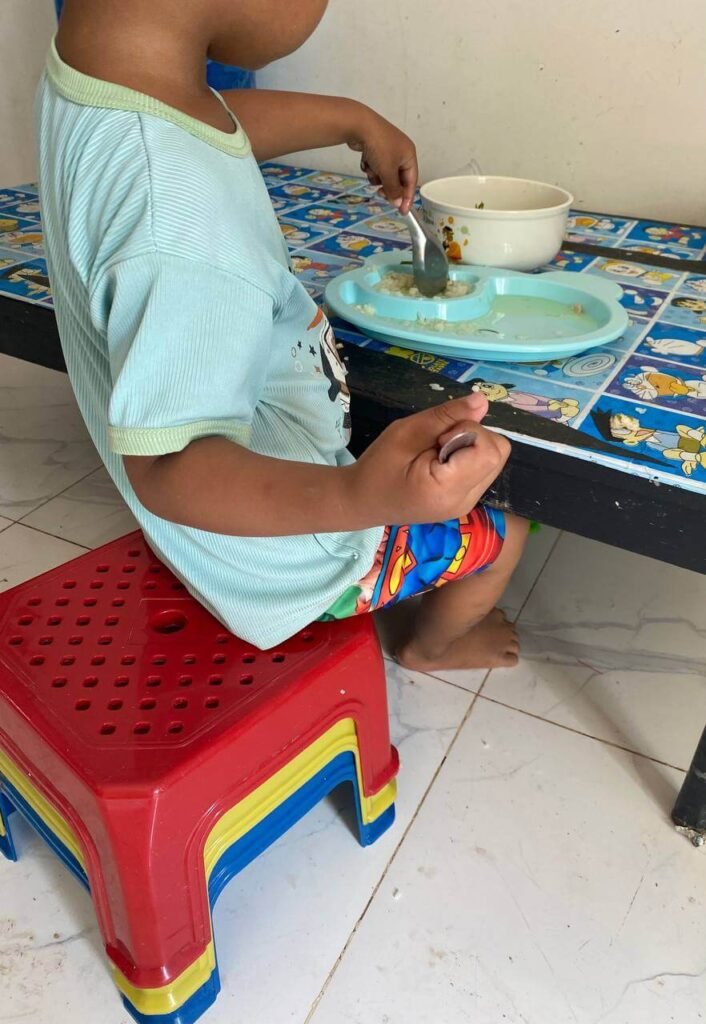
He did not want it.
Instead, he stacked three plastic stools (blue, yellow, and red), climbed to the very top, and claimed the red one as his operational headquarters for his morning meal.
In facilities management, this is called Unauthorized Workspace Reconfiguration.
In our house, it is called breakfast.
Audit Item 2: School Supplies Quality Control
With his meal finished, he moved on to his sister’s school bag.
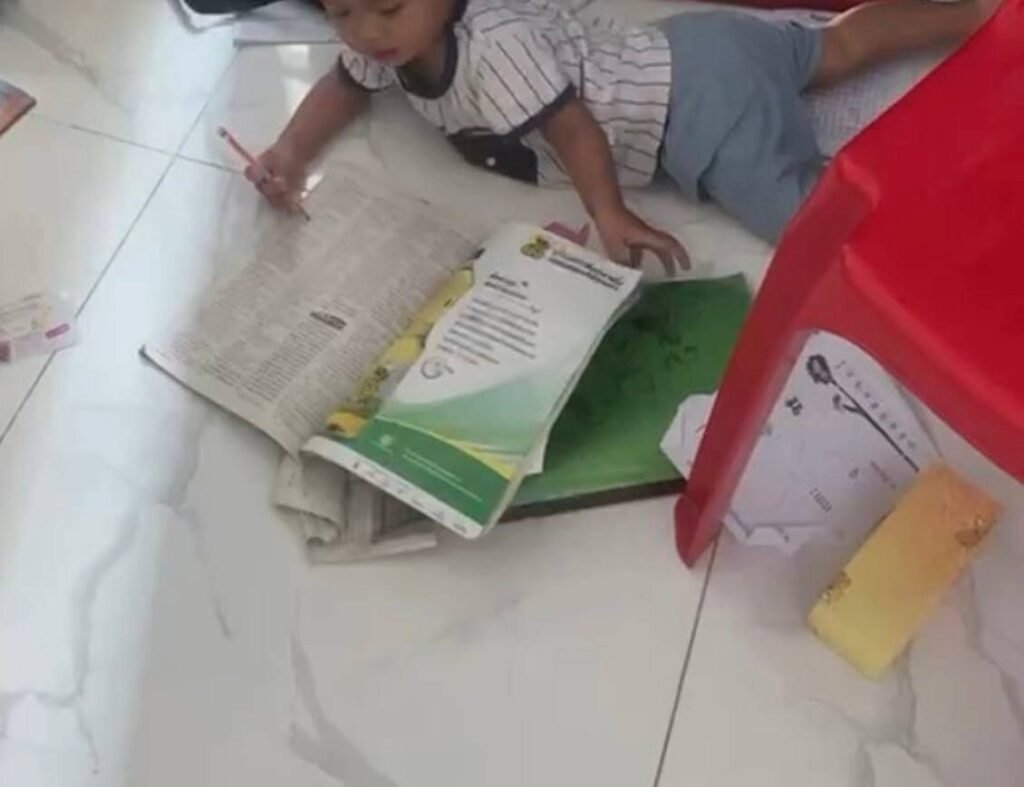
He emptied the contents across the floor, examining each item with the intense scrutiny of a quality assurance inspector.
I quickly intervened, swapping her good textbooks for old workbooks before he could begin his paper review.
He accepted the substitution without complaint, proceeding to file his scribbled findings across four pages of an old workbook.
Audit Item 3: Structural Integrity Inspection
Next was his sister’s red plastic chair. He did not just knock it over.
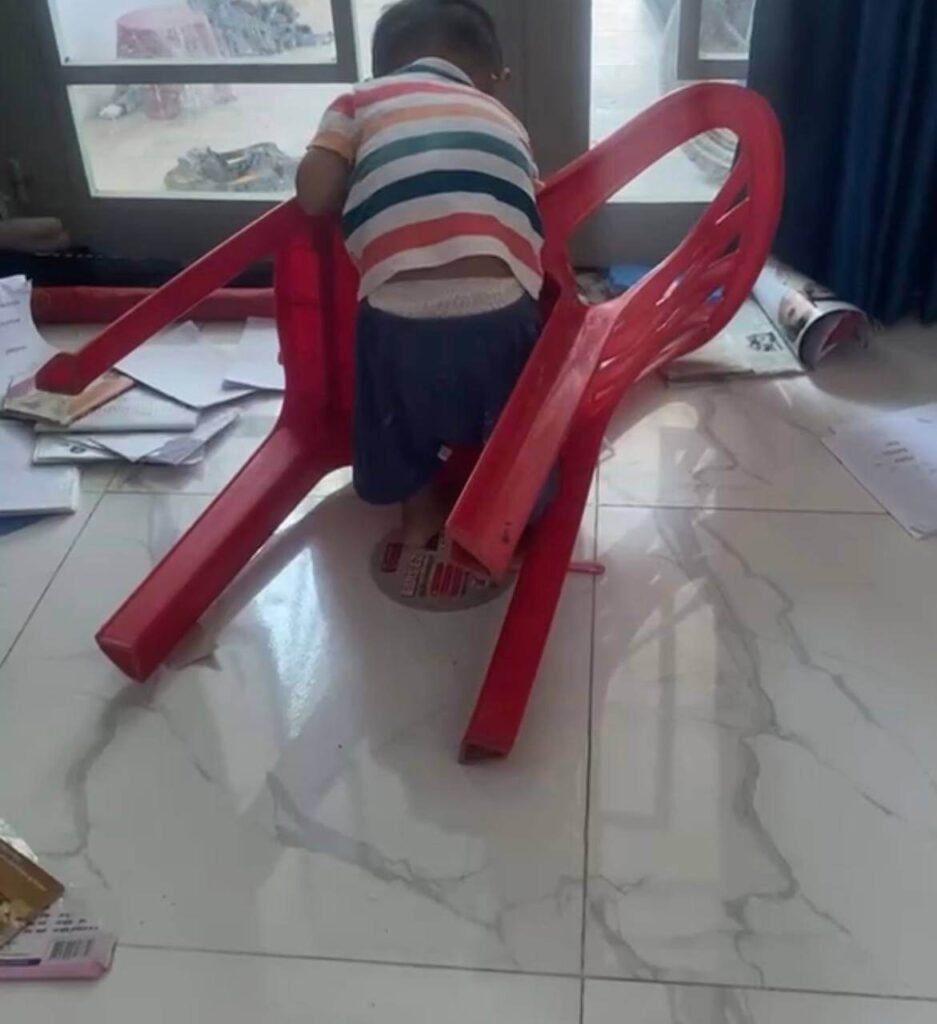
He approached it deliberately, tipped it onto its side, and climbed right into the plastic frame to examine it from every conceivable angle.
He was checking for defects.
Finding none, he left it upended on the tiles and moved on.
Audit Item 4: Fleet Maintenance Assessment
His sister owns a pink bicycle that we keep indoors.
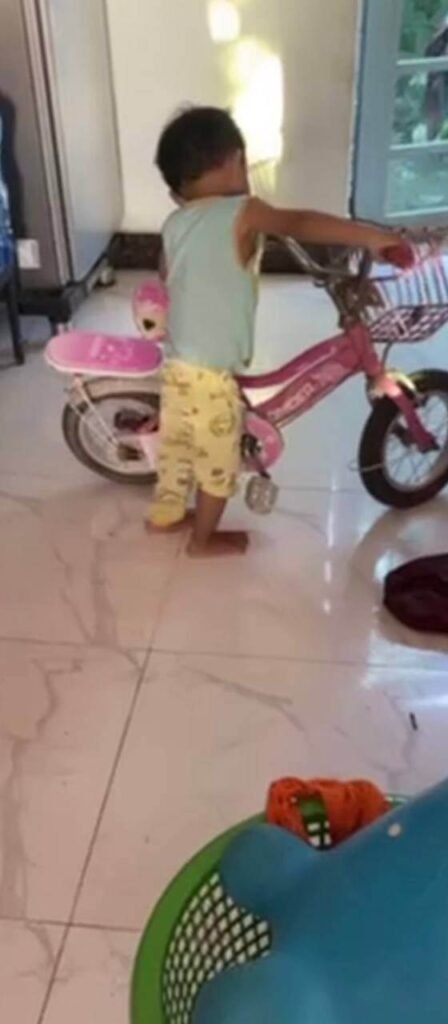
Rather than trying to ride a bike that is objectively too large for him, he dragged it across the living room to conduct a thorough evaluation of its mobility and handling.
Once the vehicle passed inspection, he parked it a few meters away.
Audit Item 5: Inventory Redistribution
In parenting, a sudden period of unexpected silence usually means your toddler has found something interesting to dismantle.
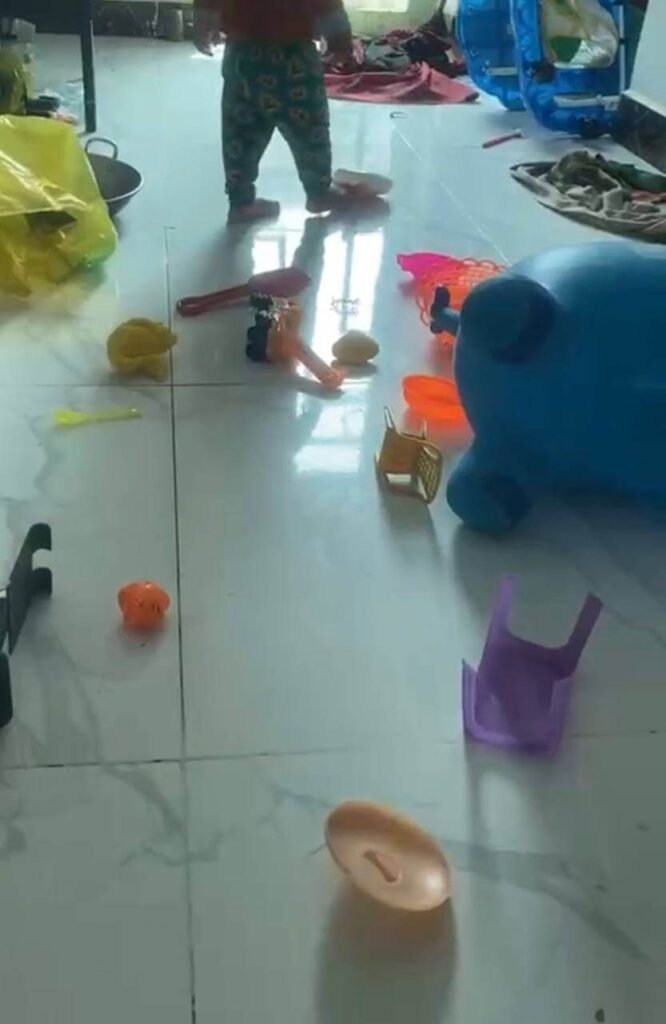
I walked in to find her entire play inventory (tiny pots, pans, and plastic baskets) redistributed across the floor.
He stood in the middle of the chaos, surveying his warehouse reorganization with deep satisfaction.
My Head, at This Point
I want to be transparent with you: by 11:00 AM, I had a headache that I can only describe as a full organizational crisis occurring inside my skull.
(And if you are looking at the pictures, wondering why his outfit is always different, this is a huge part of that headache. I have to change him nearly 10 times a day!)
I made a management decision. We were going outside.
The exit process, however, introduced two final audit items.
Audit Item 6: Uniform Compliance Review (Footwear Division)
I presented his perfectly sized outdoor shoes.
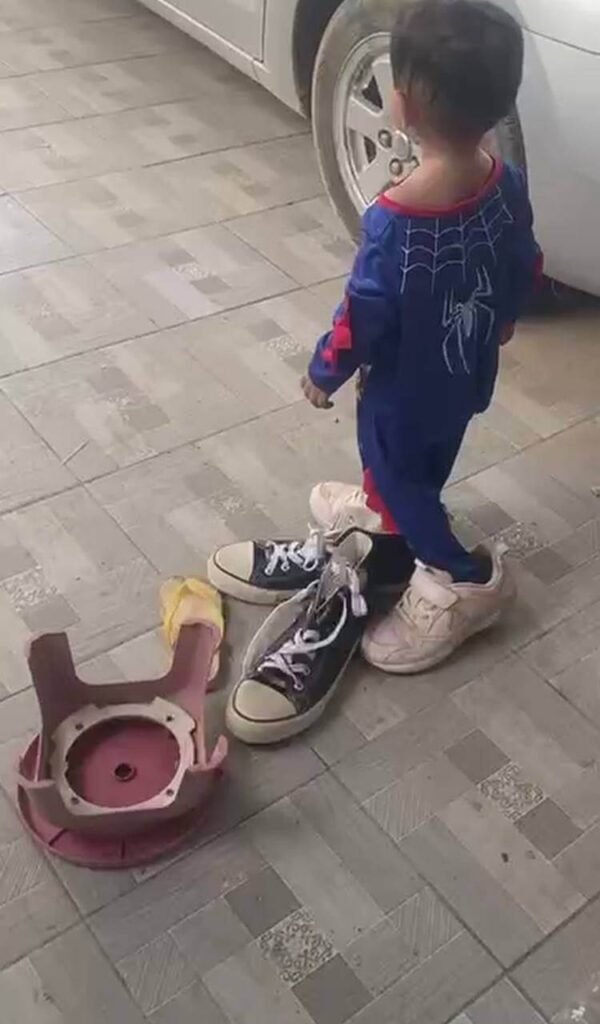
He ignored them completely.
Instead, he opted for a pair of giant, adult-sized black sneakers lying by the door, slipping his tiny feet inside.
He walked with the deliberate, shuffling gait of someone fully aware their footwear choice is ridiculous but utterly committed to the bit.
In HR, we call this creative uniform compliance. I just call it exhausting.
Audit Item 7: Safety Equipment Assessment (Helmet Division)
Helmets are non-negotiable before going outside.
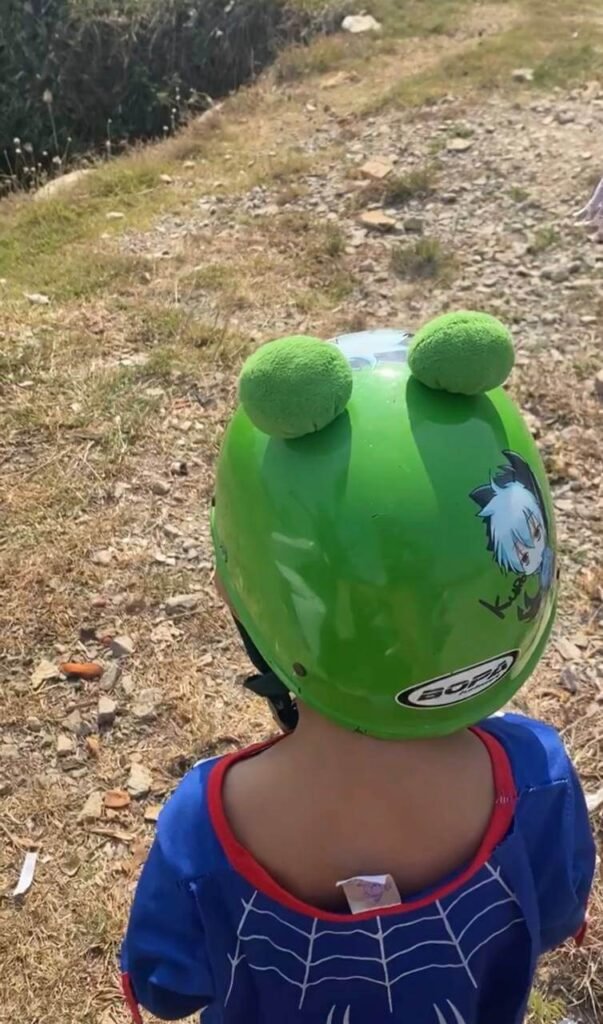
I held out his usual helmet, but he reached right past it for his sister’s. It is bright green, features two plush pompom ears on top, and, objectively, is an excellent piece of safety gear.
He strapped it on and looked at me, declaring the matter settled.
The pompom ears were, frankly, an improvement.
Why Toddlers Imitate Older Siblings: The Psychology Behind It
If you have ever watched your toddler go straight for their older sibling’s belongings the moment that sibling walks out the door, you are not imagining it.
This is one of the most consistent and well-observed patterns in toddler sibling behavior.
Young children between the ages of one and three are in what developmental researchers call the imitative learning stage.
They absorb everything they see, and the person they watch most closely is not always a parent.
It is often the older child living right beside them.
The older sibling walks, talks, reads, and moves through the world with a confidence that the toddler is actively studying.
When the sibling leaves, the toddler does not sit quietly and misses them.
They begin practicing.
They test every object, every chair, every bag, every piece of equipment that belongs to the person they most want to become.
This is not misbehavior.
It is one of the clearest signs of sibling attachment you will ever see in a toddler, and it is happening right in front of you.
How to Handle a Toddler When Their Older Sibling Is Away
If you are dealing with similar toddler sibling dynamics at home, here is what actually works during those long, chaotic, audit-filled days.
1. Recognize the respect behind the behavior
When your toddler wants to use everything their older sibling owns, they are not just being difficult.
Imitation is the highest form of toddler respect. They are saying: I want to be like you.
2. Establish a safe zone for older siblings
Let the audit happen, but within boundaries.
Designate one high shelf or a specific room for the older sibling’s most prized or breakable possessions, and let the rest of the shared space be fair game for toddler exploration.
3. Swap the assets
Just like I traded the good textbooks for old workbooks, keep substitute items on hand.
Offer an unplugged old keyboard if they want the laptop, or an old notebook if they want to do homework.
Toddlers care about the ritual, not the object.
4. Manage the aftermath together
When the older sibling comes home to find their things reorganized, validate their frustration first.
Then have the toddler help them put things back so the older child feels their space is respected, and the toddler learns accountability.
5. Go outside
When the indoor inspection reaches full operational chaos, fresh air is a legitimate crisis management strategy.
Use it without guilt.
6. Pick your battles
The helmet is on the head. The giant shoes are on the feet.
We are going outside safely. Everything else is negotiable.
A Final Note
When my daughter came home that evening, she walked in, looked around the house, and paused.
“Daddy. What happened?”
I told her the truth: “Your brother missed you. He conducted a full review of your operations in your absence.”
She looked around the room one more time, smiled just slightly, and went upstairs.
She never asked him about it.
She just put her things back, quietly, the way she always does.
The Head of Negotiations watched her from across the room. He had absolutely no notes.
Frequently Asked Questions
Is it normal for toddlers to act out when their older sibling leaves?
Yes, completely. When a toddler’s older sibling is away, the toddler loses their primary role model for the day.
What looks like acting out is usually a mix of restlessness, imitation, and a way of staying connected to the sibling who is missing.
It tends to peak between ages 18 months and 3 years, when imitative behavior is at its highest.
Why does my toddler go through their older sibling’s belongings?
Toddlers imitate the people they admire most, and older siblings are often at the top of that list.
Touching and exploring a sibling’s things is how a toddler practices being them.
It is a sign of attachment and admiration, even if it does not feel that way when you are pulling your child out of a school bag at 8 AM.
How do I stop my toddler from destroying their sibling’s stuff?
You likely cannot stop it entirely, and that is okay. The most effective approach is to create a safe zone for the older sibling’s important items (a high shelf, a closed room, a locked drawer) and allow supervised exploration of everything else.
Providing substitute items that mirror what the toddler wants, like an old notebook instead of a school planner, also helps redirect without a battle.
Will this behavior get better on its own?
Yes. As toddlers develop more language and independence, the intensity of imitative behavior naturally decreases.
By age four or five, most children have enough of their own identity that they are less fixated on their siblings’ possessions.
The sibling bond, however, built partly through all of this chaotic early observation, tends to stay strong.
What should I tell the older sibling when their things get touched or moved?
Validate their frustration honestly. Then explain, in simple terms, that their younger sibling looks up to them so much that they want to touch everything they own.
Most older siblings, once they understand it as admiration rather than aggression, find it a little easier to tolerate. A little.
Disclaimer: I am a parent and a university educator, not a licensed child psychologist or pediatrician. This guide is based on my personal parenting experience and educational background. Always consult your child’s teacher or pediatrician for professional advice regarding your child’s educational development.
