


It happens fast.
One day, your sweet, cooperative two-year-old lets you buckle their car seat without a fight.
The next?
They’re face down on the sidewalk, crying because you had the nerve to open the car door first.
Welcome to the toddler “I do it myself” phase.
It is easily one of the most exhausting and, honestly, most important stages of early childhood.
If you’re a parent deep in it right now, you’re not alone.
If you feel like you’re constantly walking a tightrope between honoring your child’s independence and actually getting out of the house before noon, keep reading.
I got a front-row seat to this phase last weekend at the park.
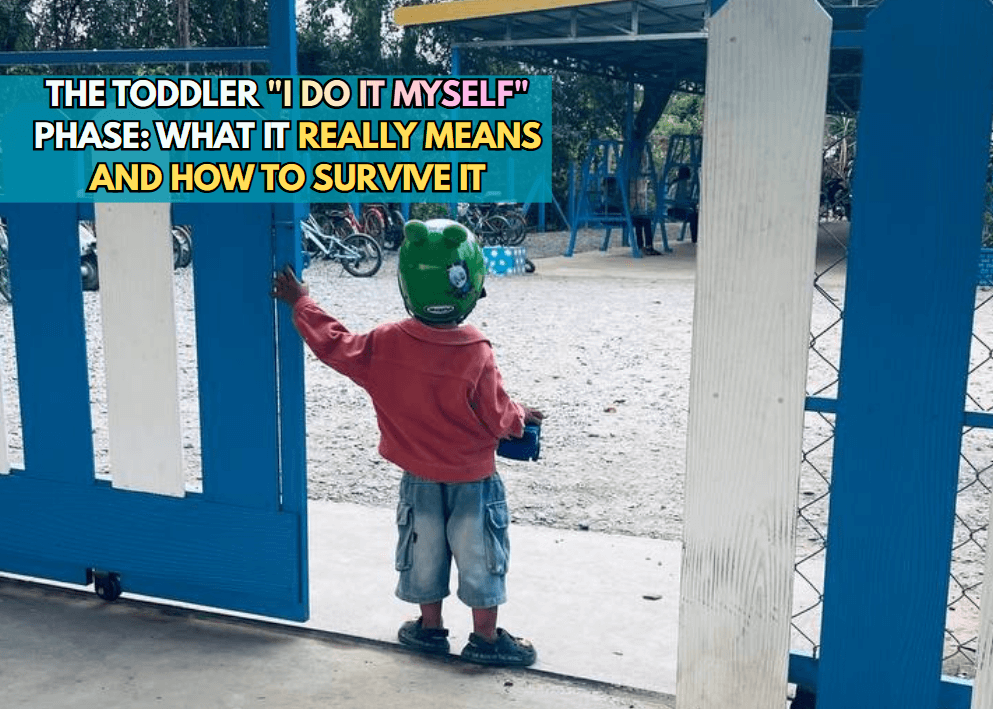
My two-year-old decided his true calling wasn’t the slide or the swings.
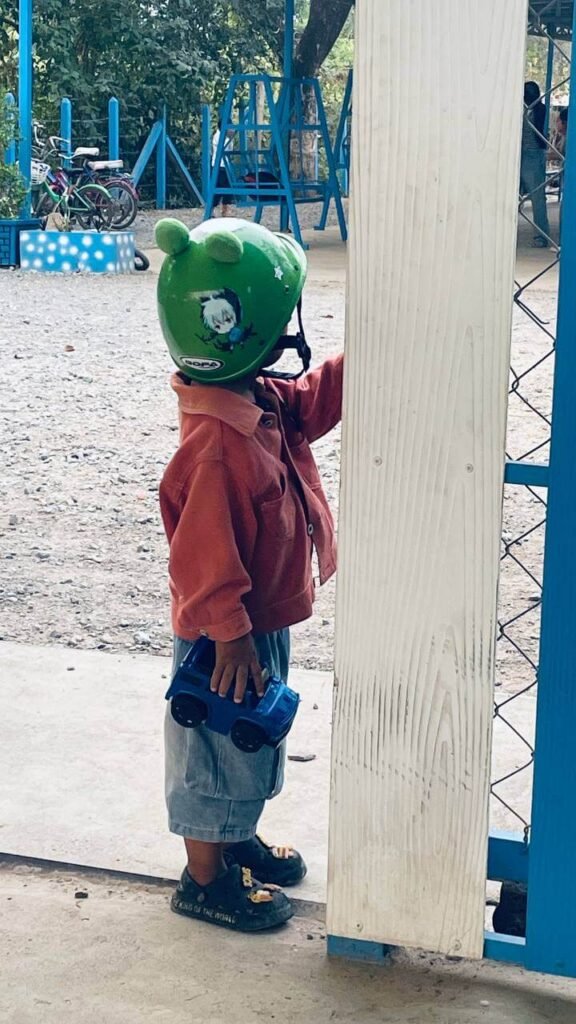
It was the heavy blue park gate.
He put on his little green frog helmet, grabbed his blue toy truck, and planted himself at the entrance.
He had to open it.
He had to close it.
If anyone else even touched it, full meltdown.
We stood there 45 minutes longer than I planned.
My coffee was completely ice-cold by the time we left.
Is It Normal for a 2-Year-Old to Want to Do Everything Himself?
Yes, completely.
Toddler independence isn’t a behavior problem.
It’s a developmental milestone.
Between ages one and three, kids are actively building their sense of self.
They’re figuring out they’re separate people with their own abilities, and they want to test that constantly.
This is one of the most significant milestones children go through, and the drive to do things independently sits right at the center of it.
Here’s what hit me when I was living through it: toddlers have almost zero control over their lives.
We decide when they sleep, what they eat, where they go, and what they wear.
So when they stumble onto something they can actually control, like a gate, a zipper, or a light switch, they hold on tight.

That small moment of independence is their way of saying: I exist. I matter. I can do this.
It’s not defiance. It’s development.
This phase typically peaks around 18 to 36 months, when toddler autonomy is at its most intense.
Most children move through it gradually as their language and emotional regulation skills improve.
Why Does My Toddler Have a Meltdown When I Try to Help?
Toddler power struggles tend to follow the same pattern every single time.
Your child wants to do something.
You step in to help because you’re in a hurry.
They lose it completely.
You get frustrated.
Everyone ends up miserable.
The escalation happens because we treat their need for control like an obstacle.
When a toddler melts down because you helped them, they aren’t manipulating you.
Their nervous system is genuinely overwhelmed.
The task mattered to them, and in their mind, you just pulled the rug out from under them.
This is a key thing to understand about how their brains process emotion: at this age, their brains simply don’t have the tools to manage that kind of frustration calmly.
The meltdown isn’t a choice. It’s a flood.
Understanding that doesn’t make tantrums disappear.
But it does make it easier to respond with patience instead of frustration.
How to Handle the Toddler “I Do It Myself” Phase Without Losing Your Mind
Here are three approaches that genuinely work when you’re stuck in these daily standoffs.
1. Give Them the Official Job
Instead of fighting your toddler for control over a task, hand them the job outright.
At the park, I stopped trying to drag my son away from the gate and told him he was the official Security Officer in charge of opening it for the family.
His whole demeanor changed.
Toddlers respond to ownership.
When something is their job, they feel proud instead of defensive.

Try it at home with small tasks: “Can you be in charge of turning off the bathroom light?” or “I need my helper to push the elevator button.”
A standoff can turn into a moment of pride surprisingly quickly.
This approach works because it honors your child’s need for toddler autonomy without creating a power struggle.
You’re not giving up control. You’re redirecting it.
2. Build a Toddler Buffer Into Your Schedule
This is the hardest one to accept, but it is probably the most practical tip you’ll find: your toddler is slow.
Everything takes longer when they do it themselves.
My son takes a while to slide that heavy gate.
When I rushed him, we both ended up frustrated.
When I started adding a mental ten-minute buffer to our schedule, the whole dynamic shifted.
Give your child a heads-up before transitions. “We’re leaving in five minutes, and you get to close the gate when it’s time.”
This simple change does two things: it prepares their brain for the switch, and it gives them a role instead of a verdict.
Managing your schedule with these small buffers reduces the meltdowns that come from being rushed or caught off guard.
3. Use Guided Autonomy
When your toddler is struggling but still refusing help, don’t jump in and take over.
That’s a guaranteed meltdown trigger.
Instead, use what I call guided autonomy for toddlers: offer a choice that keeps them feeling in control while you gently step in.
“Do you want to push with your left hand or your right hand?” or “Should I hold the bottom while you push the top?”
You’re stepping in, but they still feel like they’re leading.
That distinction means a lot to a two-year-old.
It’s the difference between being rescued and being supported, and toddlers feel that difference deeply.
How to Leave the Park Without a Toddler Meltdown
Transitions are one of the hardest parts of parenting a toddler through this phase.
Here’s what consistently helps:
- Give warnings early. Tell them five minutes before, then two minutes before. It genuinely helps their brains shift gears and reduces the shock of being told it’s time to go.
- Give them a role in leaving. “When it’s time to go, you get to wave goodbye to the slide.” Making them part of the exit reduces the feeling of being dragged away. It turns a loss into a ritual.
- Stay calm. The more regulated you are, the easier it is for their nervous system to follow. Toddler emotional regulation is deeply connected to yours in these moments.
- Acknowledge the feelings. “I know you want to stay. It makes sense that you’re sad. We’re still going home now.” Validation isn’t the same as giving in. You can honor the feeling and still hold the boundary.
These strategies work not because they trick your child, but because they respect the way a two-year-old’s brain actually works.
Why This Toddler Developmental Milestone Actually Matters
Every time I’m standing at that blue gate waiting for my son to slide it open himself, I remind myself: this moment matters.
Every time I resist stepping in to do it faster, I’m sending him a message.
I believe you can figure this out. Your effort counts. You are capable.
The defiance that feels so exhausting right now is practicing something real.
The kid who insists on buckling his own car seat at two is developing the persistence that will serve him at twelve and twenty-two.
Does that mean every moment feels like a beautiful growth opportunity?
No. Some days it just feels like you will never leave the park.
That’s okay too.
When Does the Toddler “I Do It Myself” Phase End?
For most children, this phase of intense toddler independence peaks somewhere between 18 and 30 months and gradually softens as language develops.
When toddlers can express their needs and frustrations in words, they rely less on controlling their environment to feel safe.
By age three or four, many children move into a more cooperative stage, though the underlying need for autonomy never fully disappears.
It just becomes easier to navigate.
If you’re in the thick of it right now, know that it does ease.
Not all at once, but steadily.
When to Talk to Your Pediatrician
For most kids, the “I do it myself” phase is a healthy part of toddler development, and it eases up on its own.
However, if your child’s need for control is seriously disrupting daily life, causing distress well beyond typical toddler tantrums, or if you’re completely burnt out, it is worth a conversation with your pediatrician.
There’s no shame in asking for support.
One Last Thing
The toddler “I do it myself” phase is loud, slow, and occasionally infuriating.
It is also completely normal.
Let them wear the frog helmet. Let them slide the heavy gate.
Build in the extra five minutes.
And on the days when you’re standing outside longer than planned because your two-year-old has appointed himself gatekeeper, take a breath.
He isn’t trying to make your life hard. He’s just trying to figure out his.
Frequently Asked Questions
What do I do if my toddler insists on doing something dangerous?
When safety is on the line, you have to hold the boundary while still offering a micro-choice to maintain their sense of autonomy.
For example, if they refuse to hold your hand in a parking lot, you can say, “It is my job to keep you safe in the parking lot. Do you want to hold my left hand or my right hand, or do you want me to carry you?”
How do I handle the ‘I do it myself’ phase when we are running extremely late?
When the “toddler buffer” fails and you are out of time, validate their frustration before stepping in. Say, “I know you want to zip your coat yourself, and you are getting so good at it! Right now, we are out of time, so I am going to help you. You can try again when we get home.” Expect a meltdown, stay calm, and move forward.
Is it okay to let my toddler struggle with a task?
Yes! Productive struggle is how children learn persistence. If they are trying to put on a shoe and getting frustrated, pause before rescuing them. Offer verbal encouragement (“You are working so hard on that!”) and only offer physical help if the frustration escalates toward a full meltdown.
Does the ‘I do it myself’ phase cause sleep regressions?
It can. Major developmental leaps—like realizing they have autonomy—often cause temporary sleep disruptions. Your toddler’s brain is working in overdrive, processing these new skills and concepts, which can lead to bedtime resistance or night wakings. Stick to your firm, calming routines to help them through it.
Disclaimer: I am a parent and an HR/education professional, not a licensed child psychologist or occupational therapist. This guide is based on my personal parenting experience. Always consult your child’s pediatrician for professional advice regarding your child’s behavioral development or potential sensory processing issues.
