


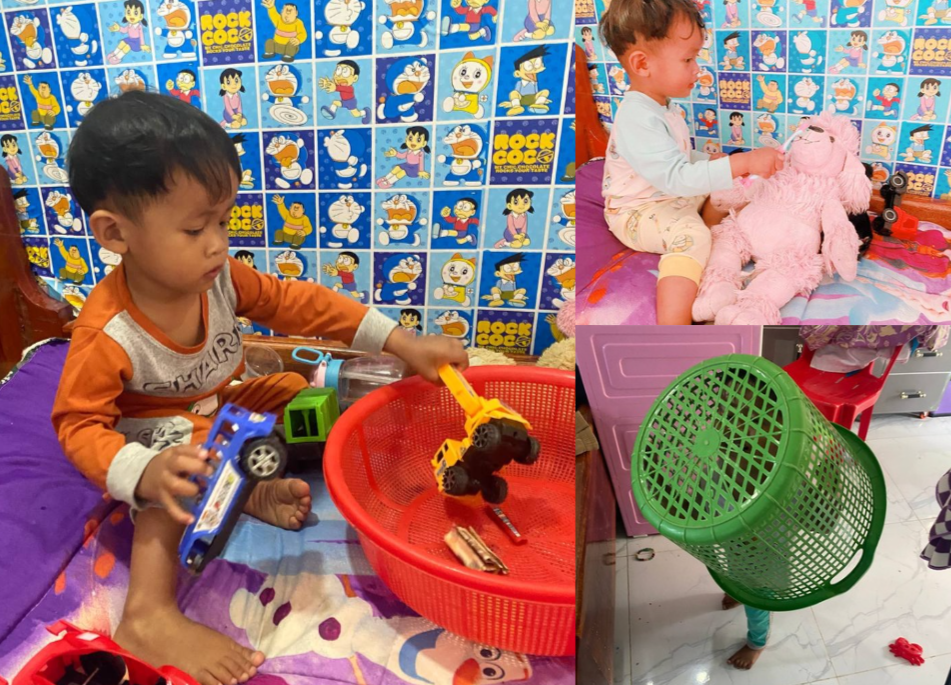
Working from home with a 2-year-old is pure chaos.
One minute, they are quietly stacking blocks, and the next, they are convinced the cat needs a diaper change.
I have been there.
My home office has basically become a toddler theme park.
I have had conference calls interrupted by someone demanding cheese sticks, and urgent deadlines competing with potty training emergencies.
But after way too many trial-and-error days, I have come to know for sure: you do not need Pinterest-perfect setups to survive the week.
Most effective indoor activities are surprisingly simple and utilize items you already have at home.
No subscriptions, no craft supplies, no glue gun required.
Quick Takeaway:
To keep a 2-year-old busy while working from home, skip the elaborate crafts and give them “real” jobs.
Repurpose household items for heavy work (pushing a laundry basket), sensory play (sorting toy cars by color), and imitation tasks (using a real broom) to buy yourself 15-30 minute blocks of focused work time.
The Simple Supply List for Surviving Your Work Week
You do not need to spend a fortune on fancy toys or Montessori kits to get an hour of focused work time.
Most of our essential equipment at home is just regular household stuff repurposed for toddler entertainment.
Here is what we actually use:
A Sturdy Stuffed Animal
Pick one that can handle rough medical procedures and a lot of love.
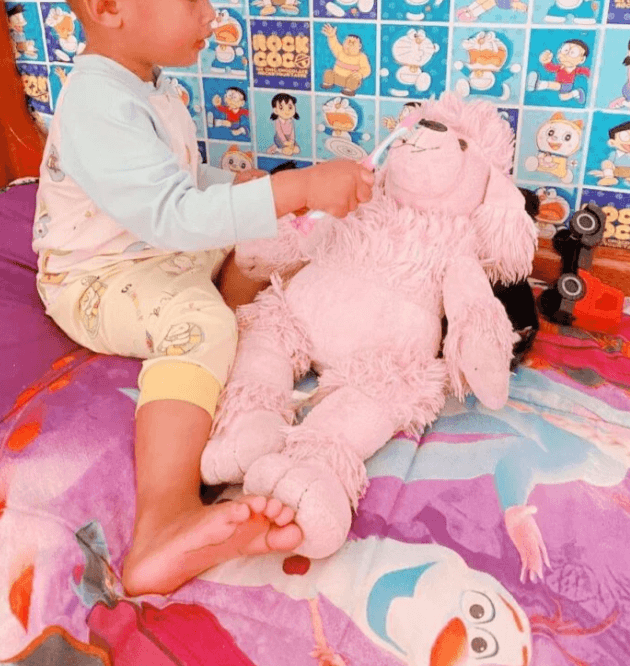
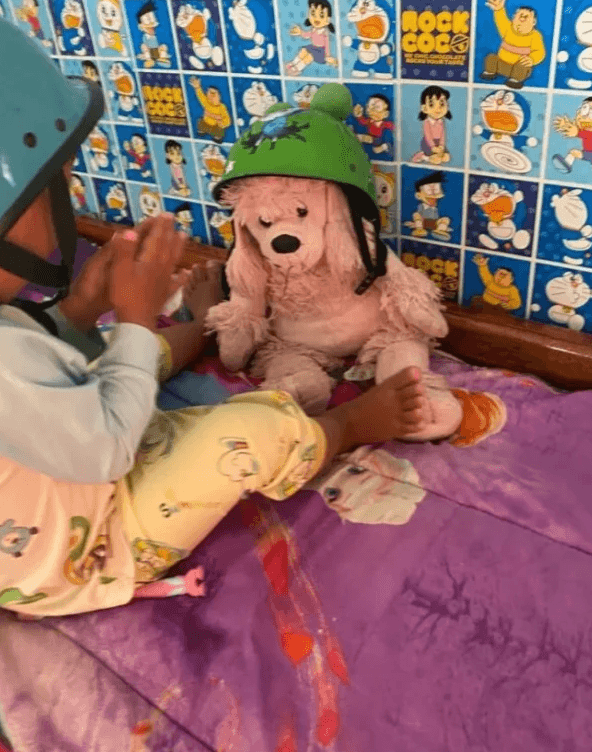
Ours is a pink poodle.
She has been a dental patient, a student, and a crash-test dummy.
Pro tip: Grab a plushie with a distinct mouth area if you want to play the dentist game.
A Simple Plastic Stool
I cannot overstate how useful this is.
In our house, the red stool is a podium for speeches, a patient chair, and a parking garage for toy cars.
It is sturdy, easy to clean, and the perfect height for a 2-year-old to feel like they are in charge of something.
A Heavy Work Basket
We use a plain plastic laundry basket.
Pediatric occupational therapists often recommend heavy work activities, which are tasks that push or pull against the body, to help toddlers burn energy and self-regulate.
Carrying toys from room to room does exactly that.
It also inevitably becomes a hat.
A Mixed Fleet of Toy Vehicles
You do not need a matching set.
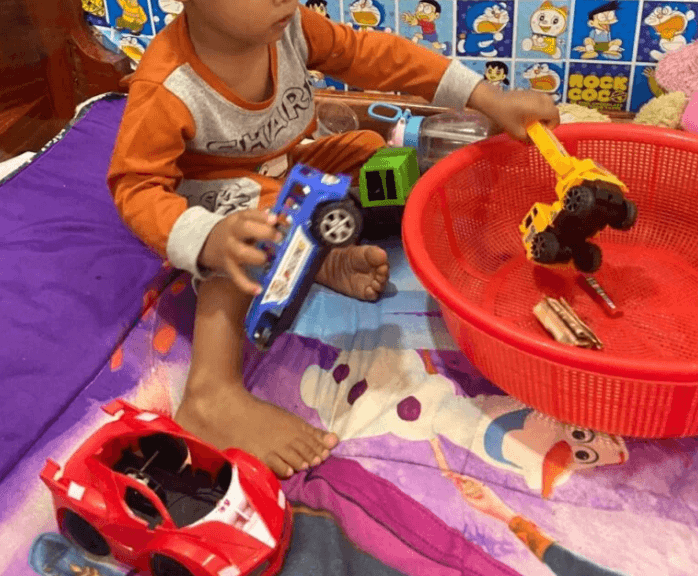
Our collection is all over the place: yellow excavators, blue police jeeps, red race cars.
The variety actually helps.
You can ask your toddler to line the trucks up by size or park all the yellow ones in the basket.
A Kitchen Drum Set
Skip the toy instruments.
A shallow metal pan and a few plastic bowls make the best sounds, and your toddler will bang on them far longer than you would expect.
A Real Broom
Toy brooms are cute, but toddlers want to use what you use.
There is something about the resistance of a real broom that keeps them focused way longer than a flimsy plastic version.
Why Do Traditional Toddler Activities Stop Working After Five Minutes?
Two-year-olds have the attention span of a goldfish on espresso.
They want to be independent, but they also want you watching them.
The activities that actually buy you focused working time tend to fall into three categories:
- Things that mimic real adult work, so they feel important
- Sensory activities that are genuinely engaging
- Low-prep setups that do not require a craft blog and a glue gun
If an activity takes more than three minutes to set up, I am out.
The sweet spot is novelty plus simplicity.
How Do I Keep My Toddler Busy So I Can Work?
The fastest way to keep them occupied while you work is to give them real jobs.
Toddlers have a deep desire to do exactly what you are doing, and channeling that instinct is your biggest productivity hack.
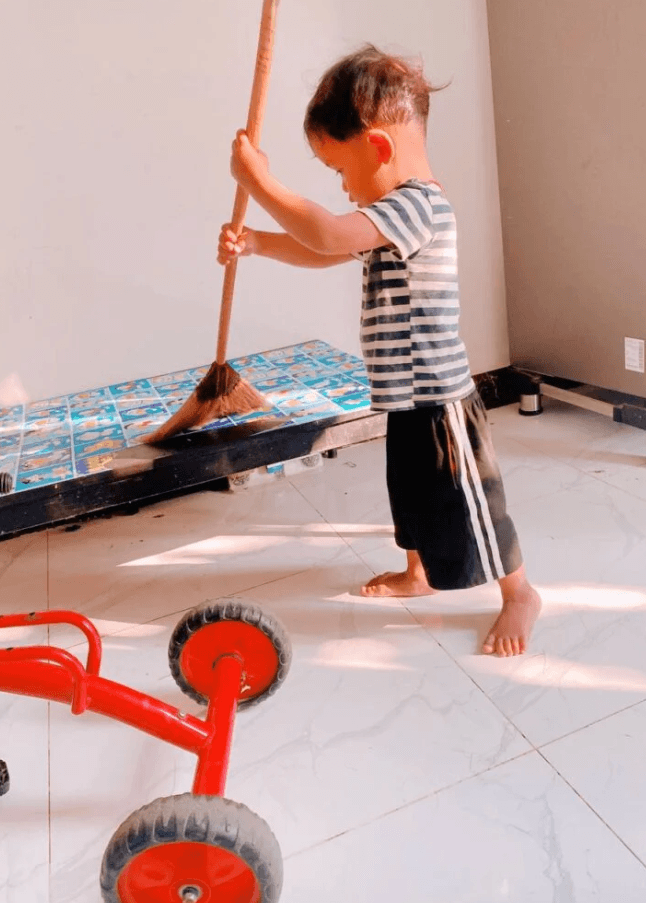
One of the best tricks is handing your toddler a full-sized broom.
Does he actually clean the floor?
Rarely.
He currently believes the play table needs more sweeping than the tiles, but it buys enough peace to send an email.
Other jobs that actually work:
- Sorting laundry by color on the bed
- Wiping baseboards with a damp sock
- Moving laundry from the washer to the dryer
- Stacking canned goods in the pantry
Each of these keeps little hands busy, makes them feel capable, and gives you a window of uninterrupted time.
The Kitchen Is Your Secret Weapon for Entertaining a 2-Year-Old at Home
The Pot-and-Spoon Recording Studio
Hand your toddler a real metal pan and a few plastic bowls.
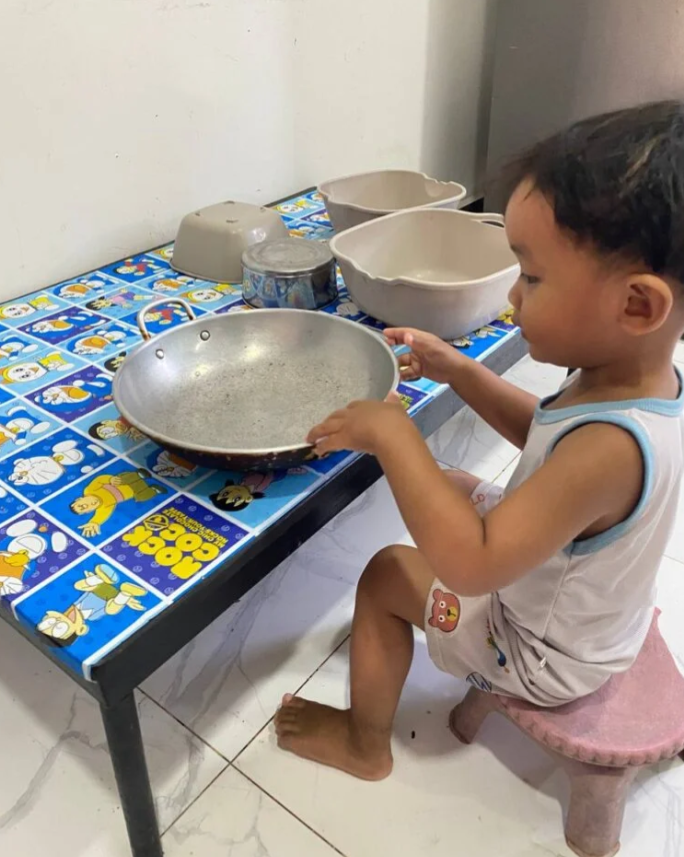
If you have a small table, set it up right in the kitchen so they are at your level.
A 2-year-old will spend ages cooking alongside you, rearranging a collection of bowls while you handle the actual stove.
The Sorting Basket
Grab a colander or a basket and a handful of toy trucks.
Ask them to rescue the trucks by sorting them by size into the basket.
It is a simple sensory task, keeps their hands moving, and buys you a solid chunk of time.
What Can a 2-Year-Old Do Independently? Quiet Activities for Video Calls
When you need actual quiet for a client call, you need high-engagement, low-noise activities.
These are the emergency stash for working from home with a toddler:
The Stuffed Animal Dentist
Hand your toddler a spare toothbrush and a stuffed animal.
The pink poodle has never had cleaner teeth, and this activity buys a surprisingly long stretch of quiet.
Safety School
If the dentist game runs out of steam, switch to this one.
Give the stuffed animal a small toy helmet for imaginary bike rides.
It is quiet, creative, and keeps them locked into a task without needing you to participate.
The Traffic Jam
Encourage them to line up all their trucks in a long, long train across the rug.
Seeing how many they can fit in a row is genuinely absorbing for a 2-year-old, and the activity self-extends as they keep trying to beat their own record.
The Reading Nook
Never underestimate this one.
Even if your toddler cannot read yet, flipping through pages and telling the story to themselves is a solid, quiet-time skill worth building early.
What Are Heavy Work Activities for Toddlers?
Heavy work is a term pediatric occupational therapists use for activities that engage the muscles and joints through pushing, pulling, or carrying.
These tasks help toddlers regulate their energy and calm their nervous systems, which means they are less likely to bounce off the walls while you are on a deadline.
Simple heavy work activities you can set up today:
- Pushing a laundry basket full of stuffed animals across the room
- Carrying a small backpack filled with books from one room to another
- Pulling a blanket loaded with toys like a sled across the floor
- Pressing playdough flat with their palms
Low-Prep Activities for 2-Year-Olds Using Household Items
Cardboard Box City
A big Amazon box becomes a house, a spaceship, or whatever your toddler decides it is that day.
Offer a few crayons and let them decorate it.
This one can last 30 to 45 minutes with minimal supervision.
The Stool Challenge
Sometimes, just giving a toddler a sturdy stool to balance toys on is enough.
We use ours for stacking plushies or as a pretend podium.
The act of arranging and rearranging keeps them focused without any input from you.
Color Sorting with Toy Cars
Line up three containers and ask your toddler to sort their toy vehicles by color.
This is a classic Montessori-style activity that also builds early learning skills, and it is completely free to set up.
Water Play in the Sink
Fill the sink with a small amount of water and add some plastic cups or containers.
Water pouring keeps a 2-year-old busy for a long time, and cleanup is as simple as a towel on the floor.
Expect the Unexpected
No matter how much you plan, toddlers are agents of chaos.
Some days, they will decide the best use of a laundry basket is wearing it as a giant helmet.
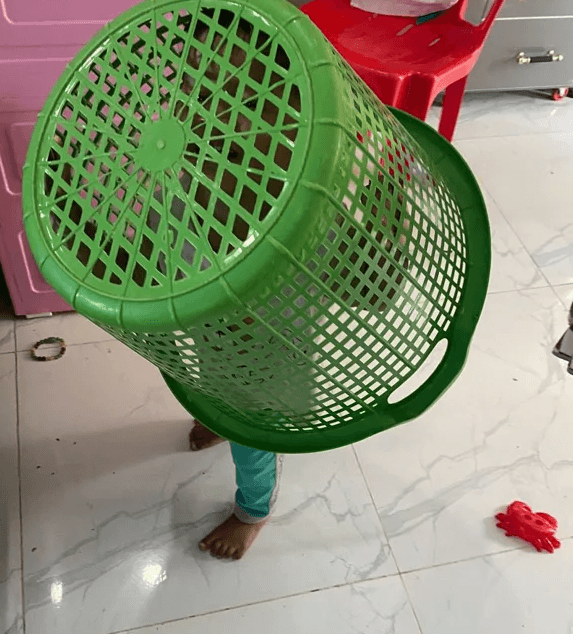
When that happens, just laugh, take a picture, and move on.
You are doing fine.
Is Screen Time Okay While Working from Home with a Toddler?
Honest answer: yes, when it is planned rather than reactive.
I am not going to pretend I never use screen time.
Some days, Bluey or Sesame Street is the only reason I hit my deadlines.
Screen time works best when it is scheduled.
If you wait until you are desperate, you feel guilty.
If you plan it, for example, one episode while you finish a report, everyone is happier, and there is no shame in that.
The key distinction is intentional versus reactive use.
Planned screen time is a tool.
Reactive screen time is a symptom of running out of other options, which is exactly what this list is designed to prevent.
The Real Secret: Rotate Everything
Novelty matters more than the activity itself.
I keep a few bins of toys hidden in the closet and swap them out every few days.
Suddenly, the trucks they ignored last week are the most exciting thing in the world.
This rotation method is one of the best working-from-home-with-a-toddler tips I can give you.
It costs nothing, takes two minutes, and consistently delivers a fresh burst of independent play without buying a single new toy.
You Are Going to Be Fine
Working from home with a 2-year-old is hard. Some days you will nail it.
Other days, you will find yourself hiding in the bathroom just to answer one text.
Both are completely normal.
These simple setups are not going to turn your toddler into a quiet angel.
But they will buy you pockets of time.
And honestly, that is all you need.
Start with one activity from each section this week.
See what sticks.
Build your own rotation from there. You have got this.
Frequently Asked Questions
How long can a 2-year-old play independently?
A 2-year-old can typically play independently for around 5 to 30 minutes, depending on the activity and how much practice they have had with solo play. Research published in the Infant and Child Development Journal puts the natural attention span at 5 to 8 minutes, but with the right setup and a consistent rotation of activities, many toddlers can stretch well beyond that. Starting small and building up gradually is the most reliable approach.
What are the best no-prep indoor activities for 2-year-olds?
The best options use items you already own. A laundry basket becomes a heavy work station, a metal pot becomes a drum kit, a real broom becomes a cleaning job, and a cardboard box becomes a city. These work better than elaborate setups because they feel real to a toddler and require zero preparation time from a busy parent.
How do I keep my toddler quiet during a video call?
The most reliable quiet activities for a 2-year-old during a video call are the stuffed animal dentist game, lining up toy trucks in a long train, and flipping through board books independently. Set the activity up two minutes before your call starts, position your toddler nearby but not directly beside you, and keep a backup snack ready for emergencies. These activities are low-noise and absorbing enough to last the length of most calls.
What are heavy work activities for toddlers, and why do they help?
Heavy work activities for toddlers are tasks that push or pull against the body, such as carrying a laundry basket, pushing a box of toys across the floor, or pressing playdough flat with their palms. Pediatric occupational therapists recommend them because they engage the muscles and joints in a way that helps toddlers regulate their energy and calm down. For working parents, heavy work activities are particularly useful because they naturally tire out an energetic 2-year-old without screen time.
Should I feel guilty about using screen time while working from home?
No, planned screen time is a legitimate parenting tool. The American Academy of Pediatrics distinguishes between passive and high-quality screen time, and programs like Bluey or Sesame Street are designed with developmental value in mind. The key is being intentional rather than reactive. Scheduling one episode as part of your child’s routine is very different from reaching for the remote out of desperation. Both happen to every parent, and neither makes you a bad one.
How do I get my 2-year-old to play alone so I can work?
Start by setting up the activity alongside your toddler for a few minutes, then gradually shift your attention to your work while staying in the same room. Toddlers play longer when a parent is nearby, even if you are not actively participating. Offer only one or two activity options rather than a full toy chest, since too many choices can cause them to switch rapidly rather than settle. Rotate the available activities every few days to keep novelty working in your favor.
Why does my toddler always want to do what I am doing?
Toddlers are wired to imitate adults as their primary way of learning about the world. Between ages 1 and 3, children are in what developmental researchers call a sensitive period for imitation, meaning they find copying adult behavior deeply satisfying and motivating. This is actually your biggest advantage as a work-from-home parent. Giving your toddler a real broom, a real basket, or real kitchen bowls taps directly into this drive and keeps them occupied far longer than any toy designed for children.
How many activities does a 2-year-old need in a day?
Most 2-year-olds do well with three to five activity rotations across the day, which works out to roughly one new setup every 30 to 60 minutes. Rather than planning a packed schedule, keep two or three activity bins hidden and rotate them as engagement drops. Pairing one higher-energy activity like heavy work with one quieter activity like the stuffed animal dentist game covers both the physical and focused play needs of a toddler without exhausting a working parent in the process.
Disclaimer: I am a parent and a university educator, not a licensed child psychologist or pediatrician. This guide is based on my personal parenting experience and educational background. Always consult your child’s teacher or pediatrician for professional advice regarding your child’s educational development.
