



Last Tuesday afternoon, I walked into my son’s room and found him on the floor, completely focused.
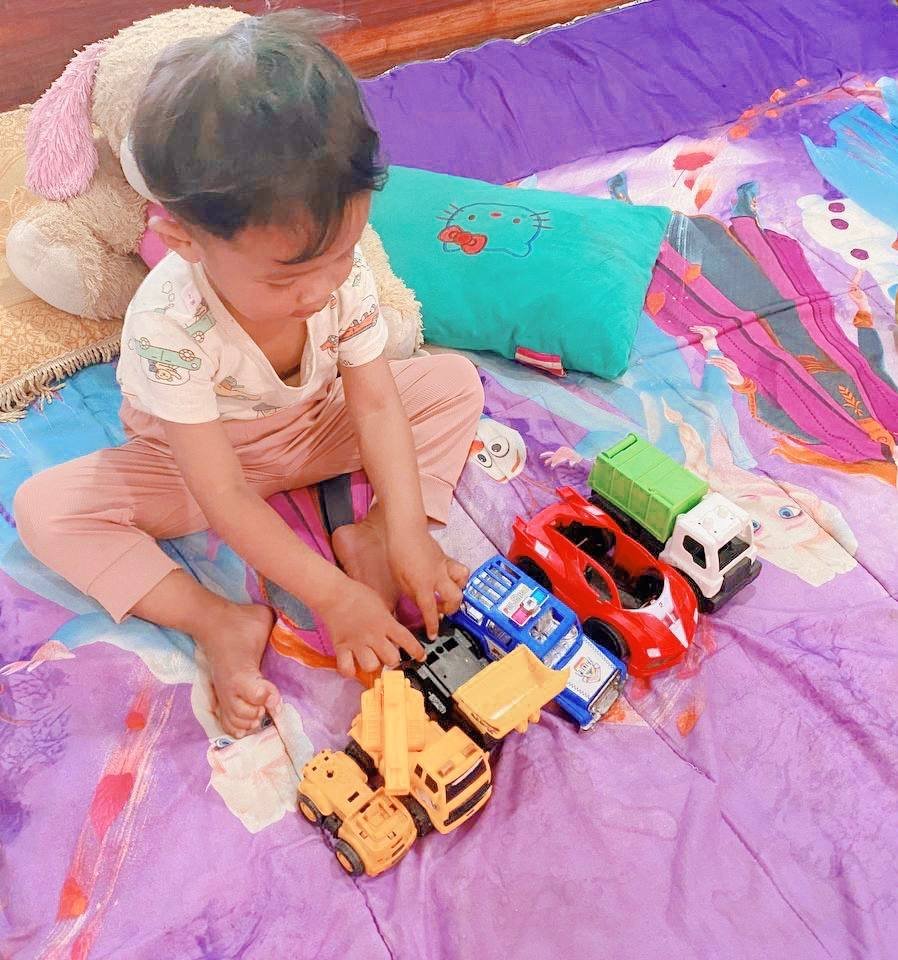
Toy cars were scattered all across his purple Frozen bedspread, lined up along the edge of the mattress, and parked under his pillow.

At first, I thought it was just another mess I would have to clean up later.
But then I stopped and watched him for a minute.
Sitting there in his peach pants and patterned pajama top, he was not just playing.
He was working.
Quick Takeaway
Toddlers playing with toy cars are not just making noise. They are building fine motor skills, practicing language, exploring how different jobs work, and learning to create order.
This kind of screen-free, child-led play is one of the most powerful learning tools available to young children, and it costs nothing extra to support.
When Toddler Play Looks Like Real Work
My three-year-old picked up a yellow construction truck. “Vroom… vroom…” He drove it slowly across the bed and parked it carefully at the edge.
Then he grabbed a blue police car and did the exact same thing.
One by one, he was building something.
Not crashing. Not throwing. Building.
I had read plenty about the benefits of pretend play for toddlers, but watching it happen in real life is completely different.
This was not chaos. It was planned.
He had a vision, and I was about to mess it up.
The Moment I Realized He Was Smarter Than I
As he lined up his little fleet, which included a green garbage truck, a red sports car, and a couple of yellow dump trucks, I decided to “help.”
I pointed at the blue police car.
“Hey buddy, the police car should go first, right? They lead the way.”
He stopped, looked at me, looked at the cars, and slowly shook his head. No.
He pushed the yellow construction truck to the front instead.
In his mind, the builders came first.
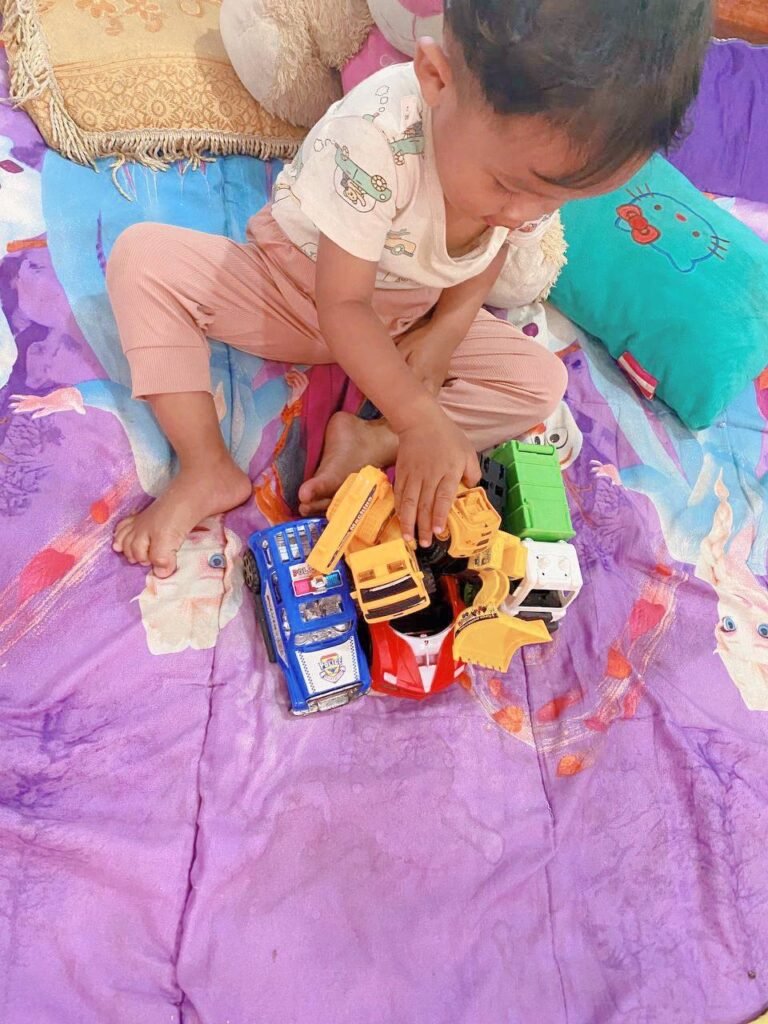
You cannot have police protecting a city that does not exist yet.
I sat back. He was absolutely right.
What Toddlers Learn from Playing with Toy Cars
That afternoon really shifted my perspective.
When toddlers play with toy cars, they are not just making noise and creating messes.
They are figuring out how the world operates, one small parking spot at a time.
Here is what I watched my son work on, all in a single play session.
Fine Motor Skills and Spatial Awareness
He was practicing his fine motor skills just by trying to park each car perfectly so it would not fall off the edge of the mattress.
Every small grip, turn, and placement was training the tiny muscles in his hands.
He was also working on spatial awareness without realizing it, judging how much room each car needed and whether the truck could fit beside the race car without bumping it off.
Early Language and Storytelling
He was working on his language too, whispering “vroom vroom” and holding quiet conversations between the police car and the dump truck.
This kind of role play builds vocabulary, narrative thinking, and the early foundations of storytelling, all without a single worksheet or screen.
Understanding Jobs, Community, and Teamwork
Most surprisingly, he was learning about different jobs and how they relate to each other.
He knew the construction truck built things, the garbage truck cleaned up, and the police car kept things safe.
The red sports car was just for fun.
And once they were all parked, he did not separate them by type.
The police car sat next to the garbage truck.
The construction vehicle was right beside the race car.
In his little world, everyone worked together.
That is a pretty advanced concept for a three-year-old.
Problem Solving and Early Math
There is also a strong connection between this type of open-ended play for toddlers nd early math skills.
Sorting, sequencing, and organizing objects into groups are the building blocks of number sense.
He was doing all three, entirely on his own terms.
Easy Ways to Encourage This Kind of Play at Home
You really do not need expensive setups or structured activities to get kids thinking like this.
A few simple ideas can extend the learning without interrupting the magic of child-led play.
Make a parking lot with tape.
A few strips of painter’s tape on the floor create parking spaces and teach spatial reasoning in a way that feels like a game.
Set up a car wash station.
A small tub of soapy water and a sponge turn into a sensory play activity that toddlers love. Yes, it is messy.
It is also completely worth it.
Try a sorting challenge.
Ask your child to line up all the red cars, or group the big trucks separately from the small ones.
This sneaks in some early math practice without it feeling like learning at all.
Follow their lead.
The most important thing you can do is resist the urge to take over.
Child-led play is more powerful when kids feel free to direct it.
Sit nearby, observe, and let them show you how their world works.
Let Them Play Their Way
Before that afternoon, I honestly just saw those toy cars as landmines waiting for me to step on in the dark.
Now, I try to sit back and watch my son build his little world right on top of Elsa and Anna.
When kids engage in pretend play, they are not escaping reality.
They are trying to make sense of it.
They are testing ideas, solving small problems, and creating order out of chaos, even if that chaos is a pile of toys on a bed.
The next time your child empties the entire toy bin onto the floor, give them a few minutes before asking them to clean it up.
You might be surprised by the little community they are carefully putting together, and what they are quietly learning along the way.
Frequently Asked Questions
What do toddlers learn from playing with toy cars?
Toddlers build a wide range of skills through toy car play, including fine motor development, spatial awareness, early language through narration and role play, problem-solving, and an understanding of community roles like construction workers, garbage collectors, and police officers. It is one of the richest forms of screen-free, open-ended play available to young children.
Why do toddlers line up toy cars instead of just playing with them?
Lining up toys is a completely normal and developmentally healthy behavior. It reflects a child’s natural drive to create order, sort by category, and make sense of their environment. It also exercises fine motor skills and early mathematical thinking, like sequencing and spatial reasoning. If your toddler lines up cars, trucks, or other objects, it is a sign of focused, purposeful thinking, not a cause for concern.
Is pretend play with toy cars good for toddler development?
Yes. Research consistently shows that pretend play supports cognitive, social, emotional, and physical development in early childhood. When toddlers assign roles to toy cars, create narratives, and organize their play environment, they are strengthening skills that form the foundation for reading, math, and social cooperation later in school.
At what age do toddlers start pretend play?
Most children begin simple pretend play between 12 and 18 months, often imitating actions they have seen adults do. By age two to three, pretend play becomes more complex and imaginative, with children assigning characters, roles, and storylines to their toys. By age three, like my son, many toddlers are managing surprisingly elaborate scenes on their own.
How can I encourage unstructured play without buying more toys?
You do not need new toys. Simple supports like painter’s tape on the floor for a parking lot, a bowl of soapy water for a car wash, or a sorting challenge based on color or size can extend the learning naturally. The most effective thing you can do is reduce interruptions and give your child uninterrupted time to direct their own play. Boredom, it turns out, is one of the best creativity tools available.
Is it okay if my toddler plays with toy cars for a long time without wanting to do other activities?
Extended, focused play is actually a positive sign. It indicates your child has found something meaningful enough to sustain their attention, which is an important skill in itself. As long as basic needs like food, movement, and rest are being met, deep play sessions are healthy and worth protecting. Research from SWPS University found that toddlers typically reach peak engagement in pretend play around 10 to 15 minutes in, so longer sessions mean your child is in a real creative flow.
Disclaimer: I am a parent and a university educator, not a licensed child psychologist or pediatrician. This guide is based on my personal parenting experience and educational background. Always consult your child’s teacher or pediatrician for professional advice regarding your child’s educational development.
